
Boot Chains for Snow: 4 Traction Cleats Compared

For boot chains for snow, the Sportneer 28-spike crampons suit most people who want extensive underfoot coverage for walking or shoveling on ice. Choose a 19-spike design for fewer contact points, and match the size to your footwear before heading out.
We earn a commission if you buy through links on this page. As an Amazon Associate I earn from qualifying purchases. Products are compared on manufacturer specifications, not hands-on testing.
- Best overall: Sportneer 28-Spike Crampons, Orange, Large – Its 28 stainless steel spikes and double-chain layout give broad traction coverage.
- Best for simple slip-on use: Pecube Traction Cleats, Silver, Large – The maker highlights strong stretch for putting the cleats on and carrying them.
- Best for adjustable fit: 19-Spike Stainless Steel Crampons, Large – An adjustable strap is specified alongside its 19 stainless steel spikes.
| Product | Best for | Spikes per foot | Stretch material | Shop |
|---|---|---|---|---|
| Sportneer 28-Spike Crampons, Orange, Large | Broad spike coverage | 28 | Reinforced TPE | Check Price on Amazon |
| Sportneer 28-Spike Crampons, Black, Large | Black color option | 28 | Reinforced TPE | Check Price on Amazon |
| 19-Spike Stainless Steel Crampons, Large | Adjustable attachment | 19 | TPE | Check Price on Amazon |
| Pecube Traction Cleats, Silver, Large | Everyday winter walking | — | Rubber with metal grommets | Check Price on Amazon |
Boot chains for snow compared
Compare spike layouts and attachment features, then choose a size that fits your boots or shoes.
Sportneer 28-Spike Crampons, Orange, Large

With 28 stainless steel spikes per foot and a double-chain design, this Sportneer pair has more spike points than the 19-spike options. The maker says its reinforced TPE remains flexible to -45°C, and the 5 mm-thicker material is intended to resist tearing. This design suits people walking, hiking or shoveling across icy ground who want traction across more of the sole.
Bottom line: Choose this pair if broad spike coverage matters more than selecting from multiple sizes.
Sportneer 28-Spike Crampons, Black, Large
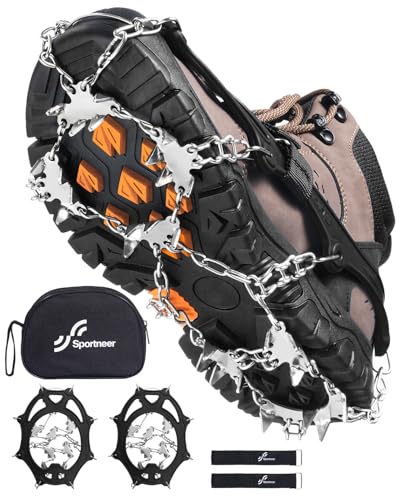
The black version keeps the same 28-spike, double-chain construction as the orange Sportneer pair, so color is the clear distinction between these two options. Its 5 mm-thicker reinforced TPE is designed to stay flexible in cold conditions, with the maker giving a -45°C figure. The cleats suit walkers who want a slip-on traction design for snow and ice, including shoveling. Since the size is Large, check that it stretches securely over the particular boots or shoes you plan to wear; a loose cleat can shift underfoot.
Bottom line: Pick this version if you want the 28-spike design in black.
19-Spike Stainless Steel Crampons, Large

An adjustable strap sets this 19-spike pair apart from the other cleats, which emphasize stretch-on construction. Each foot has 19 stainless steel spikes, and the TPE body is described by the maker as 5 mm thicker than ordinary rubber and flexible to -45°C. That combination suits hikers, walkers and ice fishers who value a strap they can adjust while securing the cleat. The lower spike count means fewer metal points than the 28-spike Sportneer designs, so consider those alternatives if your priority is more underfoot spike coverage.
Bottom line: Choose this pair if an adjustable strap is a priority.
Pecube Traction Cleats, Silver, Large

The Pecube cleats use metal chains connected to a stretch rubber body through metal grommets, rather than a spike count. The maker says the reinforced connections are intended to resist tearing, and highlights stretch for easier putting on and carrying. Silver Large cleats suit routine winter tasks such as clearing a driveway, walking a dog or moving along icy sidewalks.
Bottom line: Pick these for everyday snow and ice walking with chain-style traction.
How to choose boot chains for snow
Start with footwear fit, then decide how many metal contact points you want underfoot. These options range from 19 spikes per foot to 28, while the chain-style Pecube cleats do not give a spike count. A higher count spreads the contact points across more of the sole, but spike placement and a secure fit matter too. For icy sidewalks and shoveling, a slip-on design can be convenient; for trails or angled terrain, a secure strap or chain system helps keep the traction device in position. Choose Medium only when it matches your footwear; the remaining stated sizes are Large. If the cleat twists or shifts during a careful indoor fit check, do not use it outdoors until you find a secure fit.
| Need | Feature to compare | Options here |
|---|---|---|
| More spike points | Spikes per foot | 28-spike designs |
| Adjustable attachment | Strap | 19-spike adjustable pair |
| Chain-style traction | Metal chains and grommets | Silver Large cleats |
Spike count and placement on winter cleats
Spike count is useful for comparing designs, but placement changes how the sole meets the ground. One 19-spike model divides its points into 12 at the forefoot and 7 at the heel, while the 28-spike Sportneer designs specify a double-chain layout. Underfoot traction devices are not substitutes for boots with a stable sole, and metal points can be slippery on hard indoor floors, tile or polished stone. Put cleats on outdoors or remove them before entering smooth indoor spaces. Avoid using spiked traction on surfaces where metal points could scratch or snag, and take shorter steps on mixed pavement, where bare patches can interrupt the grip.
Cold-weather materials and secure fit
TPE stretch bodies are used on several of these cleats; the makers give temperature figures of -45°C or -31°F for particular models. Those figures describe their material claims, not a guarantee of traction on every icy surface. A cleat should sit evenly over the boot, with its traction elements centered beneath the sole rather than bunched at the toe or heel. Test the fit while standing on a dry, level surface and check that straps or elastic edges do not roll off. With footwear near the edge of a size range, choose according to the manufacturer’s size guidance rather than assuming a stretch body fits every boot. Do not walk on bare floors in metal-spiked cleats.
Frequently Asked Questions
How many spikes should snow cleats have?
These options use 19 or 28 spikes per foot, while one chain-style design gives no count. A 28-spike layout provides more metal points than a 19-spike layout, but fit and placement still affect how securely the cleat contacts the ground.
Can I wear ice cleats inside a building?
Remove metal-spiked cleats before walking on smooth indoor floors. Metal points can slip on tile or polished surfaces and may scratch floors; put them on again only when you return to snow or ice.
Do snow cleats fit over hiking boots?
Stretch-on cleats are made to fit over footwear, but the sizes here are Medium or Large. Compare the maker’s size guidance with your boot and check that the traction device stays centered without shifting.
What temperature can TPE snow cleats handle?
These material figures do not guarantee grip on every snow, ice or pavement condition.