
Ridge Power Bank: 5 Portable Chargers Compared

Ridge 20W Magnetic Power Bank, 10,000mAh suits phone owners who want a 10,000mAh power bank with magnetic attachment, built-in cables, and 20W charging. Choose another option if you need higher capacity or laptop-level output; the alternatives range up to 25,000mAh and 170W.
A power bank stores energy for charging devices away from an outlet, with capacity and output affecting how much and how quickly it can recharge.
We earn a commission if you buy through links on this page. As an Amazon Associate I earn from qualifying purchases. Products are compared on manufacturer specifications, not hands-on testing.
- Best overall: Ridge 20W Magnetic Power Bank, 10,000mAh – Combines 10,000mAh capacity, magnetic attachment, built-in cables, and 20W charging.
- Best for extended travel: Miady 20,000mAh Power Bank 2-Pack – Offers 20,000mAh capacity and 22.5W charging in a two-pack.
- Best for laptop charging: EF ECOFLOW Laptop Power Bank, 25,000mAh – Provides 25,000mAh capacity, 170W total output, and two 140W USB-C ports.
| Product | Best for | Capacity | Maximum output | Standout charging feature | Shop |
|---|---|---|---|---|---|
| Ridge 20W Magnetic Power Bank, 10,000mAh | Magnetic phone charging | 10,000mAh | 20W | Magnetic attachment, built-in cables | Check Price on Amazon |
| Miady 20,000mAh Power Bank 2-Pack | Two-bank travel kit | 20,000mAh | 22.5W | Three outputs, LED display | Check Price on Amazon |
| Anker Nano 45W Power Bank, 10,000mAh | Compact USB-C charging | 10,000mAh | 45W | Retractable USB-C cable | Check Price on Amazon |
| EF ECOFLOW Rapid 20,000mAh Power Bank | Aluminum USB-C charging | 20,000mAh | 45W | Built-in USB-C cable, USB-C and USB-A | Check Price on Amazon |
| EF ECOFLOW Laptop Power Bank, 25,000mAh | Laptop and tablet power | 25,000mAh | 170W total; 140W per USB-C port | Two 140W USB-C ports | Check Price on Amazon |
Ridge Power Bank and Portable Charger Alternatives
Compare capacity, charging output, and connection options to match a portable charger to your devices.
Ridge 20W Magnetic Power Bank, 10,000mAh

Magnetic attachment and built-in cables distinguish this 10,000mAh charger from the larger, port-focused alternatives. Ridge says it supports MagSafe-compatible phones, Lightning, USB-C, and wireless charging, and claims up to three full phone charges. The integrated kickstand adds hands-free viewing, and its 20W rating suits phone charging rather than high-power laptop use. Choose it if your priority is an all-in-one phone setup; choose a higher-output option if you need to power a laptop or charge several devices at once.
Bottom line: Pick this for magnetic phone charging and built-in connection options.
Miady 20,000mAh Power Bank 2-Pack

A two-pack and 20,000mAh capacity set this choice apart for travelers who want more than one battery pack. The product name gives a 22.5W rating, and the maker describes three outputs and an LED display. The maker claims the pack can charge an iPhone 17 to 50% in 30 minutes; actual charging depends on the phone, cable, and charging protocol. This option is less suited to someone seeking magnetic attachment or laptop-class output. Its two-pack format is the main reason to choose it over a single compact bank.
Bottom line: Choose this when a two-pack and larger phone-charging reserve matter most.
Anker Nano 45W Power Bank, 10,000mAh

A retractable USB-C cable and 45W maximum output make this a stronger fit for USB-C devices than the Ridge’s 20W phone-focused setup. The power bank also has a USB-C port, pass-through charging, and a smart display. Anker gives its dimensions as 3.21 × 1.99 × 1.42 inches and weight as 8.2 ounces. The maker says the included cable and port support fast charging for compatible phones. This is not the pick for magnetic wireless attachment or Lightning built into the bank; choose it for a compact, cable-based USB-C setup.
Bottom line: Pick this for a compact bank with a retractable USB-C cable and higher output.
EF ECOFLOW Rapid 20,000mAh Power Bank
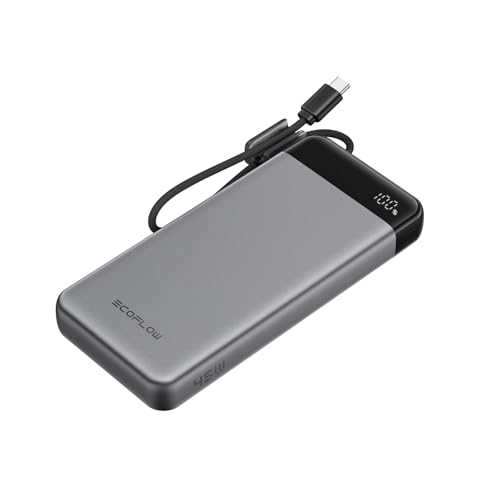
An aluminum body and built-in USB-C cable distinguish this 20,000mAh model from the other chargers here. The maker gives a maximum 45W output, USB-C and USB-A ports, a digital display, and PPS support. ECOFLOW says its built-in cable is designed to withstand more than 10,000 bends and repeated 90-degree folding. The larger capacity than the Ridge is useful for people prioritizing stored charge, but this model does not offer the Ridge’s magnetic phone attachment. Consider it for wired charging across compatible USB-C and USB-A devices.
Bottom line: Choose this for 20,000mAh capacity, a built-in cable, and an aluminum body.
EF ECOFLOW Laptop Power Bank, 25,000mAh

Two USB-C ports rated up to 140W each and 170W total output make this the laptop-focused alternative. Its 25,000mAh capacity is also the largest among these choices. The maker says it can power a laptop, phone, and tablet at once, and describes 1–2 days of remote-work support; actual runtime depends on device draw and charging conditions. At about 1.28 pounds, it is heavier than the compact phone-oriented options. Pick it for compatible high-power laptops and multiple-device charging, not for a lightweight magnetic phone setup.
Bottom line: Pick this when high-output laptop charging outweighs compact size.
How to Choose a Portable Power Bank
Match output and ports to the device you need to charge, then choose capacity for the number of top-ups you want. USB-C Power Delivery (USB-PD) is a common fast-charging standard; the device and charger must both support the relevant power level for faster charging. Samsung devices may use PPS, a USB-PD feature that adjusts voltage and current. A high wattage printed on a power bank does not guarantee that every connected phone or laptop will accept that rate. For phone-only carry, prioritize size and suitable ports; for laptops, check the computer’s required input wattage and USB-C charging support before choosing a bank. A 10,000mAh rating generally suits lighter phone use, while 20,000–25,000mAh offers more stored capacity but usually adds bulk.
Power Bank Capacity and Real-World Charging
Capacity ratings in milliamp-hours describe stored charge, not the exact charge delivered to a phone. Power banks convert internal battery voltage to USB output voltage, and conversion losses mean usable energy is lower than the headline rating. Watt-hours provide a better comparison across battery voltages: watt-hours equal amp-hours multiplied by volts. Phone battery size, screen use, and charging efficiency also change how many top-ups a bank provides, so advertised charge counts are estimates rather than guarantees. Use the table to match typical needs to capacity, then consider weight and output. For a laptop, wattage compatibility can matter more than adding capacity alone.
| Typical need | Capacity to consider | Key check |
|---|---|---|
| Occasional phone top-up | About 10,000mAh | Connector or wireless compatibility |
| Multiple phone charges or travel | About 20,000mAh | Airline watt-hour limit |
| Laptop and multiple devices | About 25,000mAh or more | USB-C PD output wattage |
Airline Rules for Carrying Power Banks
Power banks belong in carry-on baggage, not checked baggage, under common U.S. aviation rules. Batteries up to 100 watt-hours are generally allowed in carry-on bags; batteries from 101 to 160 watt-hours require airline approval, and more than two spare batteries in that range may be restricted. Watt-hour capacity is often printed on the battery; if it is missing, calculate it from voltage and amp-hours. A product marketed as flight-safe still needs to meet the airline’s current rules, so confirm the watt-hour rating before flying. Protect exposed terminals from short circuits, and do not pack a damaged or swollen battery.
Magnetic and Built-In Cable Charging
Magnetic wireless charging depends on a compatible phone or case and proper alignment; a magnetic attachment alone does not make every phone charge wirelessly. Wireless charging can also generate more heat and take longer than a suitable wired connection. Built-in cables reduce the need to carry a separate lead, but they cannot cover every connector type or charging standard. Before choosing a cable-equipped bank, match its connector to the device and verify the device’s maximum charging rate. A wired bank is often the practical choice for laptops, while magnetic attachment is most useful when the phone supports the required wireless charging system.
Frequently Asked Questions
How many times can a 10,000mAh power bank charge a phone?
A 10,000mAh power bank commonly provides roughly one to two full smartphone charges, depending on the phone battery and conversion losses. A larger phone battery or heavy use while charging reduces the number of top-ups.
Can I bring a power bank on a plane?
Yes, spare power banks generally must travel in carry-on baggage, and those up to 100Wh are typically permitted without airline approval. Check the watt-hour marking and your airline’s rules, especially for batteries over 100Wh.
Does a magnetic power bank work with every phone?
No; magnetic attachment and wireless charging require a compatible phone or case and correct alignment. A phone without compatible wireless charging may need a wired cable instead.
What power bank output do I need for a laptop?
Check the laptop’s USB-C charging requirement and choose a power bank whose supported output meets it; many phones can use much lower wattage than laptops. A 45W bank may suit some smaller computers, while larger models can require 65W or more.
Can I charge devices while recharging a power bank?
Only if the power bank supports pass-through charging, and the maker identifies that support for the Anker Nano. Simultaneous input and output can add heat, so use it only as intended and avoid charging a damaged or unusually hot battery.