
NU Aqua Systems: 4 Models Compared by Setup

NU Aqua 6-Stage Alkaline RO System suits most households seeking a tank-based NU Aqua reverse osmosis system, with six filtration stages and alkaline remineralization. Choose NU Aqua 7-Stage UV + Alkaline RO System for added UV treatment, NU Aqua 7-Stage Tankless RO System for a tankless design, or NU Aqua 7-Stage RO System with Ice Maker Kit if you need an ice maker connection kit.
Reverse osmosis systems use a semipermeable membrane to reduce dissolved substances in drinking water; tank style and available under-sink space are key selection points.
We earn a commission if you buy through links on this page. As an Amazon Associate I earn from qualifying purchases. Products are compared on manufacturer specifications, not hands-on testing.
- Best overall: NU Aqua 6-Stage Alkaline RO System – Six-stage filtration and alkaline remineralization in a tank-based under-sink system.
- Best for UV treatment: NU Aqua 7-Stage UV + Alkaline RO System – Adds UV treatment and a booster pump to its seven-stage alkaline setup.
- Best for tankless setup: NU Aqua 7-Stage Tankless RO System – Tankless design lists 600 GPD capacity and a 2:1 pure-to-drain ratio.
- Best for refrigerator connection: NU Aqua 7-Stage RO System with Ice Maker Kit – Includes a connection kit for an ice maker and refrigerator.
| Product | Best for | Stages | Rated capacity | Configuration | Shop |
|---|---|---|---|---|---|
| NU Aqua 6-Stage Alkaline RO System | Tank-based alkaline RO | 6 | 100 GPD | Tank; alkaline | Check Price on Amazon |
| NU Aqua 7-Stage UV + Alkaline RO System | UV and alkaline | 7 | 100 GPD | Tank; UV; alkaline | Check Price on Amazon |
| NU Aqua 7-Stage Tankless RO System | Tankless filtration | 7 | 600 GPD | Tankless; LED faucet | Check Price on Amazon |
| NU Aqua 7-Stage RO System with Ice Maker Kit | Refrigerator connection | 7 | 100 GPD | Tank; booster pump | Check Price on Amazon |
NU Aqua Reverse Osmosis Systems
Compare the tank-based, UV-equipped and tankless options by their setup and capacity.
NU Aqua 6-Stage Alkaline RO System

For a straightforward tank-based alkaline setup, this six-stage model includes a faucet, storage tank and PPM meter. The maker gives it a 100 GPD flow rate and includes alkaline remineralization, which distinguishes it from a basic RO setup. Its dimensions are 18 inches high, 15 inches long and 5.5 inches wide, useful when checking the cabinet footprint. Choose it if you want a conventional tank arrangement without the UV feature of NU Aqua 7-Stage UV + Alkaline RO System. Buyers who need UV treatment or an ice maker connection should compare those models instead.
Bottom line: Choose this system for a tank-based alkaline setup without UV treatment.
NU Aqua 7-Stage UV + Alkaline RO System

UV treatment is the distinguishing addition in this seven-stage system, which also includes alkaline remineralization, a booster pump, faucet, tank and PPM meter. The maker gives the system a 100 GPD flow rate. At 20 inches high, it needs more vertical cabinet clearance than NU Aqua 6-Stage Alkaline RO System, while its length and width are listed at 15 and 5.5 inches. It suits buyers prioritizing UV in a tank-based arrangement; choose NU Aqua 6-Stage Alkaline RO System for a simpler six-stage setup, or NU Aqua 7-Stage Tankless RO System if avoiding a storage tank matters more.
Bottom line: Choose this model when UV treatment and alkaline remineralization are priorities.
NU Aqua 7-Stage Tankless RO System
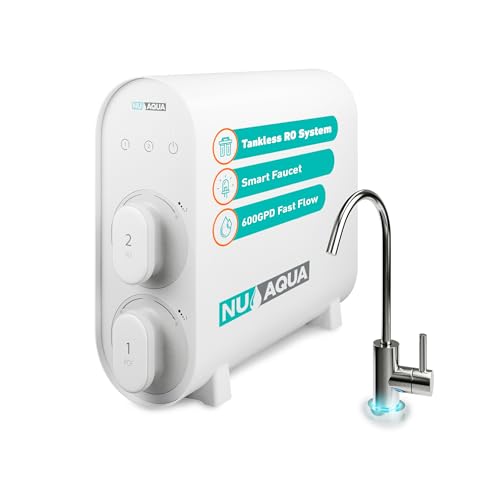
A tankless cabinet arrangement sets this seven-stage model apart from the other systems here. It includes an LED smart faucet that changes color to signal filter replacement, and its compact body measures 13.5 inches high, 15.5 inches long and 5.5 inches wide. The maker gives it a 600 GPD capacity and a 2:1 pure-to-drain ratio. Choose it when space for a storage tank is limited and the faucet-based reminder is useful. It does not include the included tank arrangement of NU Aqua 6-Stage Alkaline RO System or NU Aqua 7-Stage UV + Alkaline RO System, so buyers wanting stored water should select a tank model.
Bottom line: Choose this system for a tankless design and a faucet filter-change indicator.
NU Aqua 7-Stage RO System with Ice Maker Kit
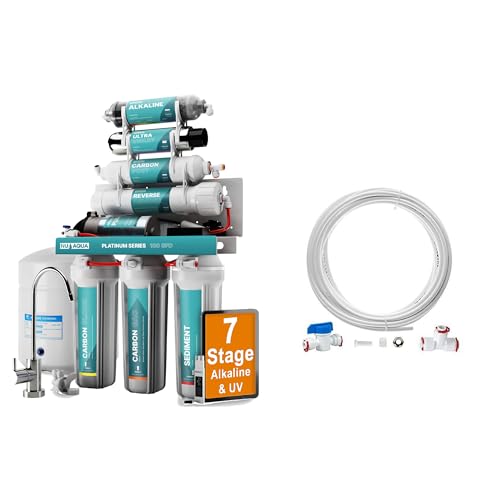
The included ice maker and refrigerator connection kit makes this seven-stage system the option to consider when routing filtered water to an appliance. It also includes a booster pump, faucet and storage tank, with a 100 GPD capacity. Its dimensions are 20 inches on each side, so compare that footprint with the available cabinet space before choosing it. This model suits kitchens needing the appliance connection; for alkaline remineralization or UV treatment, compare NU Aqua 6-Stage Alkaline RO System or NU Aqua 7-Stage UV + Alkaline RO System. The feature set emphasizes appliance hookup rather than the tankless configuration of NU Aqua 7-Stage Tankless RO System.
Bottom line: Choose this model if you need an included refrigerator or ice maker connection kit.
How to choose a NU Aqua reverse osmosis system
Start with the cabinet layout: decide whether a storage tank fits, then compare add-ons such as UV treatment, alkaline remineralization or an appliance connection. Tank systems store treated water, while tankless units make it on demand and need space for the filtration assembly and faucet connections. Reverse osmosis membranes reduce many dissolved substances, but filtration stages alone do not establish how much of a particular contaminant is removed. A useful decision rule is to choose a tankless design when the cabinet cannot accommodate a separate tank; choose a tank model when stored water is part of your preference. Confirm the system’s capacity and faucet arrangement against your household’s expected draw before settling on a model.
Under-sink space and installation fit
Measure cabinet height, width and depth before selecting a system, and leave room to reach shutoff valves and replace filters. Tank systems require space for both the filtration assembly and the storage tank; tankless units avoid a separate tank but still need room for their body and tubing. A typical under-sink RO installation also uses a drain connection and a dedicated faucet, so check whether the sink can accept a faucet opening or whether an existing opening is available. Keep tubing bends broad rather than pinched, because restricted flow can impair operation. If the cabinet has under 20 inches of clear height, compare the system dimensions carefully and verify the tank’s clearance separately.
What RO stages and add-ons mean
Stage counts describe the number of treatment steps, not a universal measure of filtration performance. A common RO arrangement combines sediment and carbon prefilters, an RO membrane and a postfilter; some systems add remineralization or UV treatment. Carbon can reduce chlorine and improve taste, while the membrane is the core barrier for many dissolved substances. UV treatment is a separate disinfection step and does not remove dissolved minerals. Remineralization adds minerals back after membrane treatment, changing the resulting water’s composition and taste. Compare the actual components and the contaminant-reduction claims for your water concern rather than assuming a seven-stage system necessarily outperforms a six-stage one.
| Need | Configuration to compare | Trade-off |
|---|---|---|
| Stored filtered water | Tank system | Requires space for the tank |
| No separate tank | Tankless system | Water is produced on demand |
| Added treatment step | UV or remineralization option | Addresses different needs |
| Filtered appliance water | Refrigerator connection kit | Requires compatible plumbing route |
RO filter upkeep and common mistakes
Prefilters commonly need replacement about every 6 to 12 months, while RO membranes often last 2 to 3 years; feed-water quality and daily use can shorten those intervals. Replacing filters on schedule helps protect the membrane from sediment and chlorine exposure. A common mistake is choosing by stage count without checking replacement-filter compatibility or the location of each housing. Another is ignoring drain flow: RO systems send reject water to a drain as they produce purified water, so a clear drain connection matters. Before installation, confirm that the feed-water pressure and fittings suit the system, and use the faucet’s indicator only as a reminder rather than a water-quality measurement.
Frequently Asked Questions
Does a reverse osmosis system remove minerals from water?
An RO membrane reduces many dissolved minerals along with other dissolved substances, though exact reduction varies by mineral and water conditions. A remineralization stage adds some minerals back after membrane treatment.
How often should reverse osmosis filters be replaced?
Prefilters commonly need replacement every 6 to 12 months, and an RO membrane often lasts 2 to 3 years. Sediment-heavy feed water and high daily use can shorten those intervals.
Can an RO system connect to a refrigerator?
Many systems can supply a refrigerator if the tubing route, pressure and appliance connection are compatible. Use a system that includes the needed connection parts or confirm the correct fittings before installation.
Does UV treatment remove dissolved contaminants?
No, UV treatment is used to inactivate microorganisms; it does not remove dissolved minerals or salts. RO membranes address many dissolved substances, so the two steps serve different purposes.