
Black Castor Oil Rosemary: 4 Options Compared

For a Jamaican black castor oil blend with rosemary for hair and scalp care, OKAY Jamaican Black Castor Oil with Rosemary is the clearest match because its product name specifies both oils and its uses include hair, scalp, brows and lashes. Choose another option if you want a larger-size bottle, a blend with peppermint, or an oil intended for locs and protective styles.
Black castor oil is a dark, thick carrier oil; rosemary may be included as an infused oil or essential oil, so check the label before applying it to skin.
We earn a commission if you buy through links on this page. As an Amazon Associate I earn from qualifying purchases. Products are compared on manufacturer specifications, not hands-on testing.
- Best overall: OKAY Jamaican Black Castor Oil with Rosemary – Pairs Jamaican black castor oil with rosemary and names hair, scalp, brows and lashes as uses.
- Best for protective styles: Jamaican Mango & Lime Black Castor Oil Rosemary – The product is specifically aimed at locs, braids, twists and natural hair.
- Best for hot-oil care: Sunny Isle Rosemary Jamaican Black Castor Oil – Its product features identify hot-oil treatment as a use.
- Best for added oils: Kreyol Essence Haitian Black Castor Oil – The Haitian black castor oil blend includes rosemary and peppermint.
| Product | Best for | Castor oil type | Other named oils | Package | Shop |
|---|---|---|---|---|---|
| OKAY Jamaican Black Castor Oil with Rosemary | Multi-area hair care | Jamaican black | Rosemary | 4 fl oz, 1 bottle | Check Price on Amazon |
| Jamaican Mango & Lime Black Castor Oil Rosemary | Protective styles | Jamaican black | Rosemary | Pack of 2 | Check Price on Amazon |
| Sunny Isle Rosemary Jamaican Black Castor Oil | Hot-oil treatment | Jamaican black | Rosemary | 8 fl oz, 1 bottle | Check Price on Amazon |
| Kreyol Essence Haitian Black Castor Oil | Rosemary and peppermint | Haitian black | Rosemary, peppermint | 2 fl oz, 1 bottle | Check Price on Amazon |
Black Castor Oil With Rosemary Options
Compare the castor oil type, additional oils and intended routine before choosing a blend.
OKAY Jamaican Black Castor Oil with Rosemary

For a blend that explicitly combines Jamaican black castor oil and rosemary, OKAY Jamaican Black Castor Oil with Rosemary names the broadest set of uses: hair, scalp, brows, lashes, face and skin. The 4-fl-oz glass bottle suits someone who wants one oil for several parts of a routine, and the product features also mention leave-in and hot-oil use. Its limitation is that the product name and features do not establish a rosemary concentration, so buyers who need a measured essential-oil dilution should check the ingredient label before applying it to skin.
Bottom line: Choose this if you want a Jamaican black castor oil blend for multiple hair and skin uses.
Jamaican Mango & Lime Black Castor Oil Rosemary

For locs, braids and twists, Jamaican Mango & Lime Black Castor Oil Rosemary is the option whose product features specifically address protective styles. The maker describes it as a hair and scalp oil for moisturizing and shine, with hot-oil treatment and skin use also mentioned. That focus makes it a better fit for maintaining textured styles than for someone seeking a general-purpose oil with a single-bottle size. The size fields conflict, so confirm the amount per container before ordering; the pack count alone does not resolve the volume.
Bottom line: Choose this when your routine centers on locs, braids, twists or other protective styles.
Sunny Isle Rosemary Jamaican Black Castor Oil
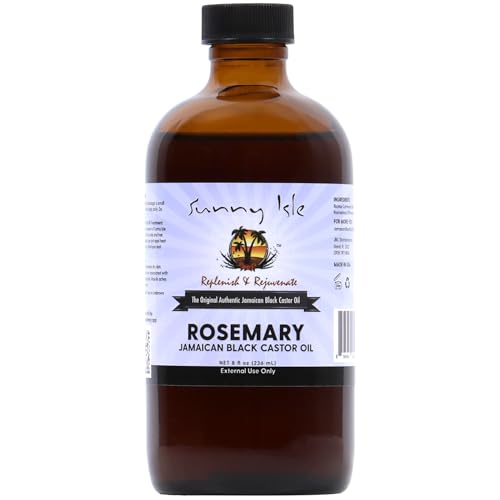
For a larger single-bottle option with hot-oil treatment called out, Sunny Isle Rosemary Jamaican Black Castor Oil combines rosemary and Jamaican black castor oil in an 8-fl-oz size. The product features also mention moisturizing hair and skin and massage, giving it a straightforward fit for a treatment-focused routine. The product makes hair-growth and acne-related claims; those outcomes should not be assumed from an oil blend.
Bottom line: Choose this if hot-oil care and an 8-fl-oz bottle are priorities.
Kreyol Essence Haitian Black Castor Oil

For buyers who want both rosemary and peppermint in a Haitian black castor oil blend, Kreyol Essence Haitian Black Castor Oil is the only option here with those two added oils named together. The product features describe scalp application, mixing with conditioner and a 30-to-60-minute hot-oil treatment; the product name identifies a 2-fl-oz amber glass bottle. The smaller stated bottle size may not suit someone who wants a larger amount for frequent use. The maker also cautions against use near the eyes, so keep this blend away from lashes and eyelids.
Bottom line: Choose this if you want Haitian black castor oil with both rosemary and peppermint.
How to choose black castor oil with rosemary
Choose by castor oil type, added ingredients and intended routine, not by hair-growth promises. Black castor oil is typically made from roasted castor beans; the roasting process gives it a darker color and distinct scent than pale, refined castor oil. Product names may say rosemary without clarifying whether it is an infusion or essential oil, and that distinction affects how suitable a blend is for direct skin application. Use the ingredient label to identify the form and concentration. For routine hair conditioning, a small amount worked through the lengths can coat strands; heavy oiling can weigh down fine hair and may leave buildup, especially on the scalp. A practical rule: if the label does not give a safe skin-use dilution, keep the product to hair lengths or verify the ingredients before scalp use.
How to apply rosemary castor oil safely
Patch test a new oil on a small area of skin and wait 24 hours before broader use; stop if irritation develops. Rosemary essential oil is concentrated, and general aromatherapy guidance commonly keeps essential oils around 1% to 2% in a carrier for adult skin use, but a finished blend should be used according to its own label. Keep oils away from eyes and do not apply them to broken or irritated skin. For a hair treatment, start with a small amount, distribute it over the scalp or hair as intended, and wash it out if residue or discomfort occurs. Hot-oil treatments should be warm, never hot: test the temperature on the inside of your wrist before applying, and do not heat a sealed bottle in a microwave.
Castor oil blends by routine
Match the blend to the job: protective styles benefit from targeted scalp and root application, while a conditioning treatment is easier to distribute through loose hair. Oils mainly coat and lubricate hair; they do not establish that new growth will occur. A simple choice guide helps separate routine needs from product claims.
| Routine | What to prioritize | Use condition |
|---|---|---|
| Locs, braids or twists | Scalp access and style-specific use | Apply sparingly to reachable scalp areas |
| Dry hair lengths | Conditioning or shine use | Begin with a few drops to avoid buildup |
| Skin application | Ingredient and dilution clarity | Patch test and avoid eyes |
How to avoid common oil-care mistakes
Using too much oil is a common mistake: castor oil is viscous, so a few drops can be enough for a small area, while excess can make hair difficult to rinse clean. Avoid treating an oil as a replacement for a shampoo or scalp-care routine; product buildup can make the scalp feel greasy or uncomfortable. Do not assume a blend is safe for brows or lashes merely because another castor oil is marketed for those areas—eye exposure is a separate concern, and the Haitian blend specifically says to avoid use near eyes. Keep bottles away from children, and wipe spills promptly because oil can make floors slippery. If a scalp reaction persists after stopping use, seek medical advice rather than trying another essential-oil blend.
Frequently Asked Questions
Does rosemary castor oil make hair grow faster?
No oil blend can guarantee faster hair growth. Castor oil can coat hair and help reduce friction, but that is different from proving new growth; see a clinician for persistent shedding or bald patches.
How often should I use castor oil on my scalp?
Start with once weekly and adjust only if your scalp stays comfortable and buildup is manageable. Thick castor oil can leave residue, so use a small amount and wash it out if your hair or scalp feels greasy.
Can rosemary castor oil be used on eyebrows or lashes?
Avoid applying oil blends near the eyes unless their label specifically gives safe directions for that area. Even a small amount can migrate into the eye, and one blend here explicitly warns not to use it near eyes.
How should I warm oil for a hot-oil treatment?
Warm a small amount indirectly in a heat-safe container and test it on your wrist before use; it should feel comfortably warm, never hot. Do not microwave a sealed bottle or apply oil that causes discomfort.
What is the difference between black and regular castor oil?
Black castor oil is typically made from roasted castor beans, which darkens the oil and gives it a distinct scent. Regular refined castor oil is usually lighter in color; both can feel thick on hair.