
Best Grease for Plastic Gears: 3 Options Compared

For most light-load plastic gears, WELLOCKS White Lithium Grease is the best fit because its maker names ABS, POM and nylon compatibility; verify the exact polymer before applying any grease.
We earn a commission if you buy through links on this page. As an Amazon Associate I earn from qualifying purchases. Products are compared on manufacturer specifications, not hands-on testing.
- Best overall: WELLOCKS White Lithium Grease – Names compatibility with ABS, POM and nylon and targets light-load gear mechanisms.
- Best for low-noise use: Plastic Gear Grease, 1 oz – Its maker claims quiet operation and a -70°F to 260°F operating range.
- Best for specified motors: EM-30L Synthetic Grease, 1 kg – A 1 kg synthetic grease intended for compatible electric motors and plastic gears.
| Product | Best for | Pack size (g) | Grease type | Named applications | Shop |
|---|---|---|---|---|---|
| WELLOCKS White Lithium Grease | Common engineering plastics | 30 g | Lithium-based | Light-load gears; ABS, POM, nylon | Check Price on Amazon |
| Plastic Gear Grease, 1 oz | Quiet household mechanisms | 28.35 g | Lithium-based; mineral oil | Toys, appliances, instruments | Check Price on Amazon |
| EM-30L Synthetic Grease, 1 kg | Specified motor assemblies | 1,000 g | Synthetic | Electric motors; plastic gears | Check Price on Amazon |
Grease for plastic gears compared
Match the lubricant to both the plastic and the mechanism before choosing by pack size or application.
WELLOCKS White Lithium Grease
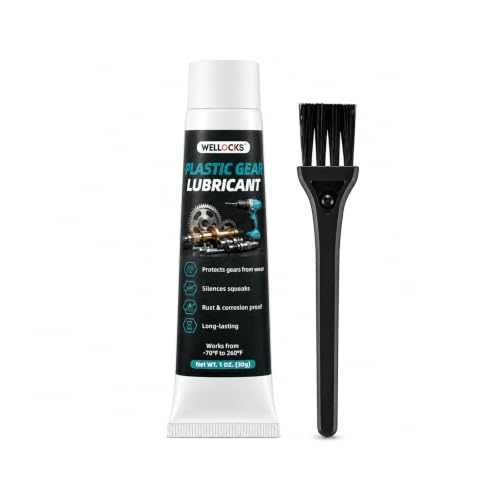
WELLOCKS stands out for naming ABS, POM and nylon compatibility, making it the clearest match when a gear is made from one of those plastics. The 30 g pack uses a white lithium-based grease intended for light-load gears and sliding mechanisms; its maker says the adhesive film helps reduce friction and noise. It also names appliances, 3D printers, office equipment, hinges, drawer slides and toys. The limitation is that compatibility with every plastic is not established, so identify the exact polymer and check the equipment maker’s lubricant requirement before use.
Bottom line: Pick this for a light-load mechanism made from a named compatible plastic.
Plastic Gear Grease, 1 oz

For buyers prioritizing an operating range, this 1 oz grease is the only option here with a numeric temperature span: its maker claims stability from -70°F to 260°F. The formula uses mineral oil and a lithium-based thickener, and the maker says it is intended to reduce gear noise and wear in toys, household appliances and precision instruments. That range and performance are maker claims, not a guarantee for every assembly. The key limitation is that the specifications do not identify compatible plastic types, so verify the polymer and equipment requirements before applying it to a gear.
Bottom line: Choose this when quiet operation and its claimed temperature span fit the assembly.
EM-30L Synthetic Grease, 1 kg

EM-30L is the large-pack option for assemblies that explicitly specify this grease, with uses in electric motors and plastic gears. Its synthetic formulation is intended for compatible mechanical and electrical components, and the 1 kg size suits work requiring more grease than the small tubes provide. The specifications do not establish a temperature range or identify compatible plastic polymers, so this is not a material-matching shortcut. Confirm the exact EM-30L requirement and plastic compatibility for the assembly before use, especially when substituting for a lubricant named in equipment documentation.
Bottom line: Pick it when the motor or gear assembly specifically calls for EM-30L.
How to choose grease for plastic gears
Start with the exact plastic and the lubricant requirement, not the grease color or the word “plastic” on a package. ABS, POM (acetal) and nylon are distinct polymers; compatibility with one does not establish compatibility with all plastics, elastomers or coatings. Lightly loaded, enclosed gears often need a thin, plastic-compatible grease film rather than a heavy coating that can add drag. When a machine specifies a lubricant, use that requirement as the decision rule; if the polymer is unknown, identify it before applying grease. Avoid mixing formulations, since the base oil and thickener can differ and compatibility of the mixture is not assured.
Plastic gear fit and application
Apply only enough grease to form a light, continuous film on the gear teeth; packing a small gearbox full can increase churning and heat. Clean out old lubricant and debris before adding a different formulation, and keep grease away from electrical contacts, switches and friction surfaces unless the equipment calls for it. Plastic gear compatibility is not interchangeable with O-ring compatibility: a lubricant suitable for a seal may not be the right choice for a load-bearing gear mesh. For a mechanism with an identified polymer and a named grease requirement, matching both is a more reliable decision than choosing by color or general-purpose claims.
Grease types and their intended jobs
Grease combines a base fluid with a thickener; lithium and synthetic describe formulation choices, while silicone grease is often selected for seal and water-exposure tasks. Neither label alone proves suitability for a particular plastic. Use this distinction to avoid substituting a seal lubricant for gear lubricant.
| Need | Suitable product direction | Check before use |
|---|---|---|
| Light-load plastic gear mesh | Gear-specific grease with polymer match | Exact polymer and equipment requirement |
| Motor assembly with named grease | Specified synthetic grease | Exact grease designation |
| Dive-gear O-ring care | Seal-oriented silicone grease | Seal material and equipment guidance |
When to reapply plastic gear grease
There is no universal mileage or calendar interval for plastic gear lubrication: small gearboxes differ in sealing, speed, load and duty cycle. Inspect serviceable assemblies when they are opened for scheduled maintenance or when noise, visible contamination or dry gear teeth appear, and replace contaminated grease rather than layering new material over grit. High speed, heavy load, dust and water exposure can change service needs, so equipment guidance takes precedence. A sealed gearbox should not be opened solely to add grease unless its maintenance procedure calls for it; excess lubricant can create drag instead of improving motion.
Frequently Asked Questions
Can white lithium grease damage plastic gears?
Compatibility depends on the plastic formulation, so the words “white lithium” alone are not enough to decide.
How much grease should I put on plastic gears?
Use a thin, continuous film on the tooth surfaces rather than filling the gearbox. Excess grease can increase churning and drag, particularly in a small, fast-running mechanism.
Is silicone grease suitable for plastic gear teeth?
Not automatically; silicone grease is often used for seals and water-exposed fittings, which is the focus of the dive-gear product here. Check both the gear polymer and the equipment’s lubricant requirement before using it on gear teeth.
How often should plastic gears be regreased?
There is no single interval because speed, load, sealing and contamination differ by assembly. Inspect serviceable gears during scheduled maintenance or when grease is contaminated or the mechanism shows new noise, and use the equipment’s maintenance interval when provided.
Can I mix two greases in a plastic gearbox?
Avoid mixing formulations unless compatibility is confirmed, because grease bases and thickeners can differ. Remove the old grease before changing types, and use only a lubricant that matches the polymer and assembly requirement.