
Best Cord for Stretch Bracelets: 3 Options Compared

For most stretch bracelets, Stretch Magic 0.5 mm Clear Cord is a versatile pick because its 0.5 mm diameter can fit through many small bead holes while still being elastic. Choose a thicker cord if your beads have larger holes or you want a more substantial strand; match the cord diameter to the narrowest bead hole first.
Stretch bracelet cord is elastic string made to expand over a hand and contract around the wrist. Check the hole size of every bead before choosing, since a single tight hole can stop the cord from passing through.
We earn a commission if you buy through links on this page. As an Amazon Associate I earn from qualifying purchases. Products are compared on manufacturer specifications, not hands-on testing.
- Best overall: Stretch Magic 0.5 mm Clear Cord – Its 0.5 mm diameter suits many small-hole beads, and the polyurethane cord is latex-free.
- Best for clear, fine cord: JULIMAIDONG 0.8 mm Clear Cord – The 0.8 mm clear polyester-spandex cord comes on a 200-foot roll.
- Best for wider beads: Paxcoo Flat Elastic Cord – The flat cord measures 1 mm wide by 0.7 mm thick and comes in a 328-foot roll.
| Product | Best for | Cord size | Material | Spool length | Shop |
|---|---|---|---|---|---|
| Stretch Magic 0.5 mm Clear Cord | Small-hole beads | 0.5 mm | Polyurethane | 32.8 ft | Check Price on Amazon |
| JULIMAIDONG 0.8 mm Clear Cord | Long clear spool | 0.8 mm | Polyester spandex | 200 ft | Check Price on Amazon |
| Paxcoo Flat Elastic Cord | Flat cord projects | 1 mm wide × 0.7 mm thick | Polyester spandex | 328 ft | Check Price on Amazon |
Best cord for stretch bracelets
Compare cord diameter, shape and spool length to find a match for your beads and bracelet projects.
Stretch Magic 0.5 mm Clear Cord

The thinnest round option here, Stretch Magic 0.5 mm Clear Cord has a 0.5 mm diameter that may pass through bead holes too small for thicker cord. The clear polyurethane cord comes on a 10-meter (32.8-foot) spool, and its consistent diameter is useful when you need a predictable fit along a strand. The maker says the material is non-fraying, elastic and resilient; it is also latex-free. This size suits fine beads and a less bulky look. Its limitation is the narrow diameter, which may be less suitable when a project calls for thicker cord or the beads have generous holes.
Bottom line: Choose this for small-hole beads and a fine, clear strand.
JULIMAIDONG 0.8 mm Clear Cord

JULIMAIDONG 0.8 mm Clear Cord offers a middle-ground 0.8 mm diameter and a 200-foot (60-meter) spool, making it the long-spool choice among these cords. The round, clear polyester-spandex string is intended for bracelets, beadwork and other jewelry projects, and its fine profile can help conceal a knot among beads. It suits makers who want clear cord in a size between the thinner 0.5 mm option and the wider flat cord. The main limitation is bead-hole fit: 0.8 mm needs a larger opening than 0.5 mm, so test it against your smallest-hole bead before starting.
Bottom line: Pick this when you want clear, round cord on a long spool.
Paxcoo Flat Elastic Cord
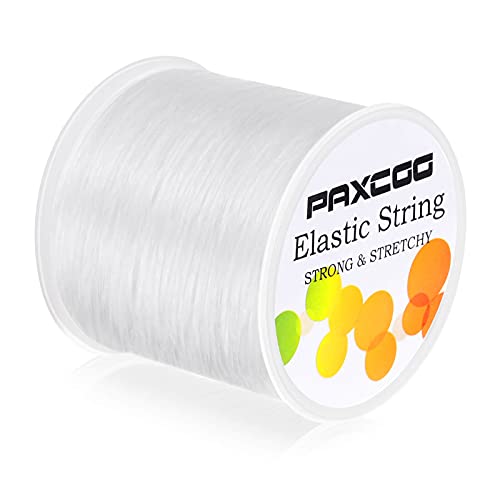
Paxcoo Flat Elastic Cord differs from the round cords because its elastic string is flat, measuring about 1 mm wide and 0.7 mm thick. The white polyester-spandex material comes in a 100-meter (328-foot) roll, the longest spool in this comparison. The product is suited to projects where flat cord and a white strand are appropriate; its flexible shape is also described as easy to knot and thread through different bead sizes. Flat cord does not have the same profile as round cord, so check that each bead hole can accommodate its 1 mm width before choosing it.
Bottom line: Choose this for flat, white cord and a longer supply.
How to choose cord for stretch bracelets
Start with bead-hole clearance, then choose cord thickness and material. Cord diameters in this selection run from 0.5 mm to 1 mm, but bead-hole dimensions—not a general size label—decide whether a strand will pass through. With holes under 0.8 mm, try the 0.5 mm round cord first; for larger openings, consider thicker cord or the flat option. Bead shape and hole alignment can also affect threading, so test a short length through the tightest bead before stringing a full bracelet.
Round elastic gives a familiar profile, while flat elastic has a wider, thinner cross-section. Match the shape to the holes as well as the look you want. Stretch cord can be pulled too hard while tying or wearing; avoid sharp tools against the strand, since cuts and abrasion can weaken elastic.
Stretch cord sizes and bead-hole fit
For these three options, choose by the cord’s largest cross-section: round cord is sized by diameter, while flat cord needs both width and thickness considered. A bead hole must clear the full cord profile, and a tight or angled opening may need more room than its nominal measurement suggests. If you cannot pass the cord through by hand without forcing it, move to a thinner size or use beads with larger holes.
The table is a quick sizing reference; verify the narrowest hole in your own bead mix before committing to a full bracelet.
| Bead-hole situation | Cord direction |
|---|---|
| Small or uncertain opening | Try 0.5 mm round cord |
| Room for a medium round profile | Consider 0.8 mm round cord |
| Opening accommodates a 1 mm width | Consider flat cord, 1 mm wide |
Round and flat elastic cord compared
Round cord has a circular cross-section, so its diameter is the clearest starting point for matching beads. Flat cord is wider than it is thick, which can make it a different fit even when its thickness looks small. The bead hole must accept the full cross-section in either case; do not select flat cord based only on its thickness.
Material also differs: the options here use polyurethane or polyester spandex. The maker describes elastic performance for each product, but cord type alone does not determine bracelet lifespan. Abrasion from rough holes, sharp edges and repeated overstretching can all shorten wear. For a bracelet that will be stretched frequently, smooth the bead path and avoid pulling the cord beyond what is needed to put it on.
Knotting and caring for a stretch bracelet
Secure a stretch bracelet with a firm knot suited to elastic cord, then seat the knot gently rather than yanking hard on the strand. Some makers add a small amount of jewelry adhesive, but compatibility depends on the cord material; check adhesive guidance before applying it. Hide the knot only after checking that it stays secure under a gentle pull.
Store elastic bracelets away from prolonged direct sunlight, heat and rough surfaces, which can contribute to wear. Remove a bracelet by rolling it over the hand rather than repeatedly pulling one section hard. Inspect the strand for thinning, fraying or cracking before wearing; replace damaged cord rather than relying on a weakened section. Keep small beads and cut cord away from young children, since they can be choking hazards.
Frequently Asked Questions
What cord diameter works for stretch bracelets?
A practical selection spans about 0.5 mm to 1 mm, depending on the bead holes and desired strand profile. Choose the thickest cord that passes comfortably through the smallest hole in the bracelet.
How much larger should bead holes be than cord?
The holes need enough clearance for the cord to pass without forcing or scraping it. Test cord through the tightest bead in the set, because angled or irregular holes can be more restrictive than their apparent opening.
Is round or flat cord better for stretch bracelets?
Round cord is straightforward to match by diameter, while flat cord must fit by both width and thickness. Choose based on the bead-hole shape and size, not on thickness alone.
Should elastic cord be stretched before stringing beads?
Gently pre-stretching elastic cord can reduce slack after a bracelet is tied. Avoid pulling it to its limit, which can strain the material before the bracelet is worn.
How can I tell when stretch bracelet cord needs replacing?
Replace cord when it shows thinning, fraying, cracks or loss of snap-back. Check the strand periodically, especially if rough-edged beads or frequent stretching have worn against it.