
Humidifier for Reptile Tank: 4 Types Compared

For a 50- to 100-gallon terrarium, Coospider 4.2L Top Fill Humidifier is the clearest match because its maker recommends that enclosure range and its top fill reservoir holds 4.2 liters. Choose another option if you need a smaller tank recommendation, sensor-based humidity control, or scheduled spray rather than continuous fog.
A reptile-tank humidifier adds moisture as fog or droplets; the right delivery style depends on the species and how your enclosure manages ventilation and moisture.
We earn a commission if you buy through links on this page. As an Amazon Associate I earn from qualifying purchases. Products are compared on manufacturer specifications, not hands-on testing.
- Best overall: Coospider 4.2L Top Fill Humidifier – Its 4.2-liter reservoir and stated 50-100-gallon recommendation suit larger terrariums.
- Best for 10-40 gallons: Coospider 3.8L Reptile Fogger – The maker recommends this 3.8-liter fogger for single-compartment terrariums in that range.
- Best for timed spraying: Moistenland Automatic Reptile Mister – Its timer allows spray durations up to 5 minutes and intervals from 1 hour to 30 days.
| Product | Best for | Reservoir | Enclosure fit | Moisture delivery | Shop |
|---|---|---|---|---|---|
| Coospider 4.2L Top Fill Humidifier | Large terrariums | 4.2 L | 50-100 gallons | Fogger with hose | Check Price on Amazon |
| Coospider 3.8L Reptile Fogger | Small terrariums | 3.8 L | 10-40 gallons | Fogger with hose | Check Price on Amazon |
| MRREPTILE 2.8L Reptile Fogger | Dry-run protection | 2.8 L | — | Fogger | Check Price on Amazon |
| Moistenland Automatic Reptile Mister | Scheduled spraying | External reservoir | — | Timed spray nozzles | Check Price on Amazon |
Humidifiers for reptile tanks
Compare reservoir capacity, recommended enclosure size, and how each device delivers moisture.
Coospider 4.2L Top Fill Humidifier

For larger enclosures, this 4.2-liter top fill fogger is recommended by its maker for 50- to 100-gallon terrariums. The reservoir fills from the top, and the removable lid is intended to make cleaning and maintenance easier. Its adjustable hose extends from 1.5 to 6.3 feet, with two suction cups to secure the tube. A rotary control adjusts mist output. The larger capacity and stated enclosure range distinguish it from the smaller-tank fogger in this group. Its bulkier reservoir may be more than needed for a compact enclosure, so match the recommendation to your tank size.
Bottom line: Choose this for a larger terrarium where a 4.2-liter reservoir and top filling are useful.
Coospider 3.8L Reptile Fogger
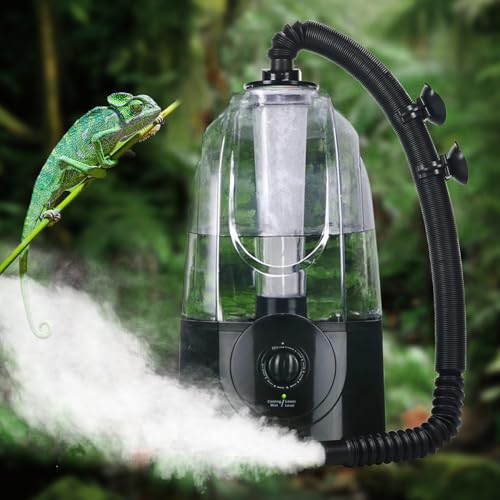
For a single-compartment tank in the 10- to 40-gallon range, this fogger has a maker-recommended enclosure size and a 3.8-liter reservoir. Its hose adjusts from 1.5 to 6.3 feet, and two suction cups help hold the tube in place. A single knob controls mist output. The maker says the unit shuts off when its water runs dry and gives refill estimates of up to 26 hours at medium output or 10 hours at maximum output. Those durations depend on the selected setting; buyers with a larger tank should compare the 50- to 100-gallon recommendation of another model here.
Bottom line: Pick this for a single-compartment 10- to 40-gallon tank with adjustable hose routing.
MRREPTILE 2.8L Reptile Fogger

This fogger pairs a 2.8-liter reservoir with automatic shutoff intended to prevent dry running. Unlike the models with an explicit gallon recommendation, its capacity is the main sizing clue, so it suits buyers who want that protection without relying on a published tank-size range. The maker also describes a seal design intended to prevent leaks and quiet misting. Those are maker claims rather than a substitute for checking the unit during setup. Since no enclosure range accompanies this model, confirm that its output can serve your tank and species before choosing it over a size-matched fogger.
Bottom line: Choose this if dry-run shutoff is a priority and you can verify its output suits your enclosure.
Moistenland Automatic Reptile Mister
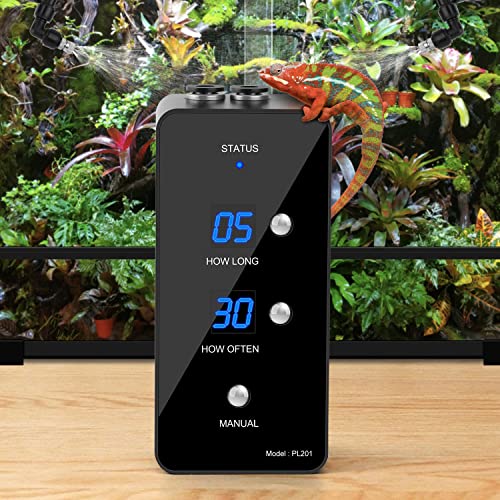
Unlike reservoir-based foggers, this system sprays through two adjustable 360-degree nozzles and uses a timer for scheduled moisture. The maker says spray duration can be set up to 5 minutes and intervals from 1 hour to 30 days. It does not include a water container, so you need a separate bottle or bucket as its reservoir. Installation may also require holes in a mesh top if the enclosure lacks wire openings. This design fits buyers seeking timed droplets across a terrarium; those who need an all-in-one tank or continuous fog should choose a reservoir fogger instead.
Bottom line: Pick this for scheduled nozzle spraying when you can provide a separate reservoir.
How to choose a reptile tank humidifier
Choose by enclosure volume, delivery style, and the humidity target required by the species. Foggers send mist through a tube, while a mister applies droplets through nozzles; neither replaces a hygrometer for checking conditions inside the enclosure. A separate digital hygrometer placed near the animal’s usual zone gives a useful reading, and a second reading near the opposite end can reveal uneven moisture. Match the device’s maker-recommended tank range where one is given: a recommendation for 10-40 gallons is not interchangeable with one for 50-100 gallons. If your enclosure falls outside the range, verify the needed output before buying rather than assuming reservoir capacity alone determines suitability.
Foggers and misters deliver moisture differently
Foggers make a visible mist and route it through a hose, while nozzle systems spray liquid droplets onto enclosure surfaces. A fogger’s adjustable hose can help direct output, but airflow and ventilation affect how long moisture remains in the habitat. A timed nozzle system can schedule brief sprays, yet the added surface water may not behave like airborne fog. Use the table to match a delivery style to your setup, then track humidity with a hygrometer rather than judging by visible mist alone.
These are general device categories; the right target humidity remains species-specific.
| Need | Delivery style | Useful distinction |
|---|---|---|
| Route fog into an enclosure | Fogger and hose | Reservoir capacity and hose reach |
| Schedule surface spraying | Timer and nozzles | Separate water reservoir may be needed |
| Maintain a selected setting | Sensor-controlled mist | Small reservoir may limit runtime |
Match capacity to terrarium size
Use a gallon recommendation as a starting point, not as a universal guarantee of humidity. A 3.8-liter unit is recommended for 10-40-gallon single-compartment terrariums, while a 4.2-liter model is recommended for 50-100 gallons. Those ranges give buyers a measurable way to narrow options; for tanks below or above them, check that the device output can meet the species’ needs. A larger reservoir means fewer refills in principle, but runtime also changes with mist setting and conditions. Leave space around the humidifier and route hoses without kinks so the equipment can operate as intended.
Keep moisture equipment clean and safe
Clean the reservoir and water path regularly because standing water and warm, damp surfaces can encourage biofilm and mold. Empty unused water, rinse the tank, and let washable parts dry before refilling; frequency depends on use and visible buildup, so do not let a fixed interval replace inspection. Keep electrical bases and charging connections away from splashes, and place the humidifier on a stable, dry surface outside the enclosure unless its design explicitly supports another arrangement. Prevent direct spray from soaking substrate or creating pooled water, which can make the habitat persistently wet. For rechargeable models, unplug the charging cable when fully charged as directed by the maker.
Frequently Asked Questions
How do I measure humidity inside a reptile tank?
Use a digital hygrometer in the enclosure, positioned near the animal’s usual activity zone and away from direct mist. Readings at two ends of a long tank can expose uneven humidity that one sensor misses.
Should a reptile humidifier run all day?
Not by default; operation should follow the species’ humidity needs and measured enclosure conditions. Make changes in short increments and check the hygrometer, since ventilation, substrate, and mist output all affect how quickly humidity changes.
How often should I clean a reptile fogger?
Inspect the reservoir and hose at each refill, and clean them whenever film, debris, or odor appears. Standing water can support biofilm, so empty unused water and let cleaned parts dry before refilling.
Can fogging make a reptile enclosure too wet?
Yes, excess mist can keep substrate and surfaces wet or create pooled water. Reduce output or runtime if water accumulates, then recheck humidity and ventilation rather than relying on visible fog.
Is a fogger or mister better for a terrarium?
A fogger routes airborne mist through a tube, while a mister sprays droplets from nozzles. Choose based on whether your setup needs directed fog or scheduled surface spraying, and measure the resulting humidity with a hygrometer.