
Large Hole Hole Punch: 3 Sizes Compared by Fit

For a large 3/8-inch hole in paper or PVC, 3/8-Inch Heavy-Duty Single Hole Punch is the closest match because its punch is sized for that diameter and its center sits 1 inch from the edge. Choose Koogel 3-Piece Circle Punch Set instead if you need several circle sizes, including a 1-inch cut; Swingline 74017 Single Hole Punch makes a smaller 1/4-inch hole.
A single hole punch cuts one round opening at a time, while craft circle punches are useful when the cutout itself needs to be a chosen size.
We earn a commission if you buy through links on this page. As an Amazon Associate I earn from qualifying purchases. Products are compared on manufacturer specifications, not hands-on testing.
- Best overall: 3/8-Inch Heavy-Duty Single Hole Punch – Cuts a 3/8-inch hole and specifies a 1-inch center-to-edge distance.
- Best for multiple diameters: Koogel 3-Piece Circle Punch Set – Includes 1-inch, 5/8-inch and 3/8-inch circle punches.
- Best for standard-size holes: Swingline 74017 Single Hole Punch – Cuts a 1/4-inch hole and holds scraps in a hinged compartment.
| Product | Best for | Hole diameter | Sheet capacity | Shop |
|---|---|---|---|---|
| 3/8-Inch Heavy-Duty Single Hole Punch | Larger single holes | 3/8 in | 15–20 A4 sheets | Check Price on Amazon |
| Koogel 3-Piece Circle Punch Set | Craft circle sizes | 1 in, 5/8 in, 3/8 in | — | Check Price on Amazon |
| Swingline 74017 Single Hole Punch | Small paper holes | 1/4 in | 20 sheets | Check Price on Amazon |
Large Hole Hole Punch Options
Compare the cutting diameter and capacity first, then match the punch style to your paper or craft task.
3/8-Inch Heavy-Duty Single Hole Punch
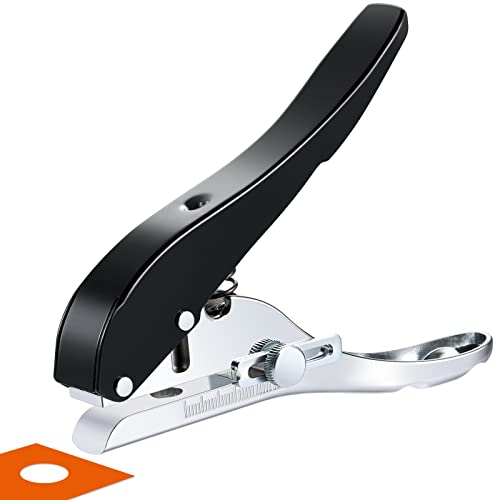
The 3/8-inch opening and fixed 1-inch center-to-edge position distinguish this handheld punch from standard smaller-hole models. The maker says it can punch paper or PVC and gives maximum material thicknesses of 0.098 inch for paper, 0.06 inch for PVC and 0.078 inch for leather; those limits make thickness worth checking before stacking sheets. Its compact body measures about 5.1 by 3.54 by 0.78 inches. Choose it when you need a larger hole at a repeatable edge position, but not when the job requires a 1-inch circle or a different hole location.
Bottom line: Pick this when a repeatable 3/8-inch hole and 1-inch edge offset suit the project.
Koogel 3-Piece Circle Punch Set

The range of three circle diameters sets this craft punch set apart: it cuts 1-inch, 5/8-inch and 3/8-inch circles rather than offering only one hole size. That range can help when a project calls for layered paper circles or tags in more than one dimension. The maker describes the lever handle as reducing the force needed for a clean cut. This is the better fit for shape-making and varied craft sizes, not for a job that needs a precisely positioned hole near a sheet edge; the features do not give a center-to-edge measurement.
Bottom line: Choose this for craft work that needs more than one circle diameter.
Swingline 74017 Single Hole Punch

The 1/4-inch hole is smaller than the other options’ largest cuts, making this a fit for routine paper punching rather than oversized craft openings. Its plier-style handle is designed to reduce effort, and a hinged compartment catches the paper chads for disposal. The maker gives a capacity of up to 20 sheets per press. A solid-metal construction and compact 7.8-inch length suit a desk or hand-held task, but choose another option if the project specifically calls for a hole larger than 1/4 inch.
Bottom line: Pick this for repeated paper punching when a 1/4-inch hole is sufficient.
How to Choose a Large Hole Punch
Start with the diameter of the opening the project needs: these choices range from 1/4 inch to 1 inch. A larger cut removes more material and leaves less paper between the hole and an edge, so confirm both the required diameter and the available margin before punching. For a single repeatable hole near an edge, a punch with a fixed center-to-edge distance can simplify alignment; for varied craft shapes, multiple diameters offer more flexibility. Sheet capacity is a separate limit from material thickness: a punch rated for a stack of paper may have a lower limit for PVC or leather. If the project uses layered or unusually thick stock, work within the thickness limits rather than assuming the sheet count applies.
Hole Diameter and Edge Placement
Hole diameter and distance from the edge are different measurements, and both affect fit. A 3/8-inch hole has a 3/16-inch radius, so its center must sit at least 3/16 inch from an edge just to keep the circle inside the sheet; leaving more margin reduces the chance of tearing. A punch that positions its center 1 inch from the edge places the hole much farther in. Use a ruler or test scrap when the hole must line up with a template, ring, or other opening. The sizes below compare the products by cut diameter and intended task; a circle punch may make a circle cutout rather than a registration hole, so verify its mechanism against the project’s purpose.
| Need | Diameter | Choice |
|---|---|---|
| Small paper opening | 1/4 in | Swingline 74017 Single Hole Punch |
| Single larger hole | 3/8 in | 3/8-Inch Heavy-Duty Single Hole Punch |
| Several craft circles | 3/8, 5/8, 1 in | Koogel 3-Piece Circle Punch Set |
Paper Stack and Material Limits
Paper punch capacity is not universal: the models here range from a 15–20 A4 sheets to a 20-sheet maximum, while the craft set gives no sheet count. Sheet count also depends on stock thickness, so use thinner stacks when the paper is heavy or layered. For the 3/8-inch punch, the maximum thickness differs by material: 0.098 inch for paper, 0.06 inch for PVC and 0.078 inch for leather. Those are not interchangeable limits. Test a scrap piece first when the material is valuable, and do not force a lever through a stack beyond its capacity; a jammed punch can damage the cut edge or your hand.
Clean Cuts and Safe Use
A clean hole starts with flat material, a stable surface and a punch suited to the stock. Keep fingers clear of the cutting head and lever joint, especially when a punch uses a force-multiplying handle. For paper, align the mark before applying pressure and empty collected chads when the compartment fills; loose scraps can obstruct a punch. For thicker stock, cut one layer or a small stack at a time if the material resists. Avoid using a paper punch on hard items such as metal or rigid plastic unless its maker explicitly identifies that material; the material limits here cover only paper, PVC and leather for 3/8-Inch Heavy-Duty Single Hole Punch.
Frequently Asked Questions
What size hole counts as a large paper punch hole?
Large is relative to the task, but a 3/8-inch hole is larger than the 1/4-inch opening on many single hole punches. For craft circles, a 5/8-inch or 1-inch diameter is larger still.
How much space should remain around a punched hole?
Leave at least half the hole diameter between the hole center and the paper edge to keep the circle fully inside the sheet. For a 3/8-inch hole, that minimum is 3/16 inch; extra margin helps reduce tearing.
Can a hole punch cut several sheets at once?
Capacity depends on the punch and paper thickness: the models here specify 15–20 A4 sheets and up to 20 sheets, respectively. Thicker paper or layered stock can require a smaller stack.
Can a paper hole punch cut PVC or leather?
Some punches are designed for those materials, but the limit varies by stock. The 3/8-inch model gives maximum thicknesses of 0.06 inch for PVC and 0.078 inch for leather; do not assume another punch has the same capability.
How do I keep a hole punch from jamming?
Use flat material within the punch’s capacity and avoid forcing thick stacks through the cutting head. Empty collected paper chads regularly, since trapped scraps can interfere with the next cut.