
Nu Finish Car Polish: 3 Formulas Compared

For most drivers, Nu Finish NF-76 Liquid Polish is the straightforward Nu Finish car polish choice because it is the single-bottle liquid formula with no-buffing application. Choose Nu Finish 3-in-1 Ceramic Polish instead if you want the formula that also features ceramic technology, or Nu Finish NF-76 Liquid Polish, 2-Pack if you need two bottles of the traditional polish.
We earn a commission if you buy through links on this page. As an Amazon Associate I earn from qualifying purchases. Products are compared on manufacturer specifications, not hands-on testing.
- Best overall: Nu Finish NF-76 Liquid Polish – A single 16-ounce liquid polish with no-buffing application.
- Best for ceramic technology: Nu Finish 3-in-1 Ceramic Polish – Combines polish and sealant with 3-in-1 ceramic technology.
- Best for multiple vehicles: Nu Finish NF-76 Liquid Polish, 2-Pack – Supplies two 16-ounce bottles of the traditional liquid polish.
| Product | Best for | Package size | Formula | Application | Shop |
|---|---|---|---|---|---|
| Nu Finish NF-76 Liquid Polish | Single bottle | 16 oz | Zinc polymer emulsions | No buffing required | Check Price on Amazon |
| Nu Finish 3-in-1 Ceramic Polish | Ceramic feature | 16 fl oz | 3-in-1 ceramic technology | No rubbing or buffing | Check Price on Amazon |
| Nu Finish NF-76 Liquid Polish, 2-Pack | Two-bottle supply | 2 × 16 oz | Zinc polymer emulsions | Direct-sun application | Check Price on Amazon |
Nu Finish car polish options
Compare the formula, package quantity and application claims before choosing a bottle.
Nu Finish NF-76 Liquid Polish

Nu Finish NF-76 Liquid Polish is the traditional Nu Finish liquid polish in a single 16-ounce bottle, unlike the ceramic-featured formula and two-bottle pack. Its maker says the zinc cross-linking polymer emulsions help the polish last longer and calls it a once-a-year polish; the maker also says it can be applied in direct sunlight. The product is described as requiring no buffing, making it a fit for drivers who want a simple application routine. Choose another option if you specifically want ceramic technology or more than one bottle.
Bottom line: Pick this for a single bottle of traditional Nu Finish liquid polish.
Nu Finish 3-in-1 Ceramic Polish

Nu Finish 3-in-1 Ceramic Polish stands apart by pairing polish and sealant with 3-in-1 ceramic technology in a 16-fluid-ounce bottle. Its maker says the formula helps repair fine scratches, swirls and scuffs, renew shine, form a protective barrier and repel water. The product also says it needs no rubbing or buffing. This option suits buyers looking for the ceramic-featured formula rather than the classic zinc-polymer liquid. The scratch and protection statements are maker claims, not a substitute for checking whether a mark is only in the clear coat or has reached the paint.
Bottom line: Choose this if ceramic technology is a priority.
Nu Finish NF-76 Liquid Polish, 2-Pack
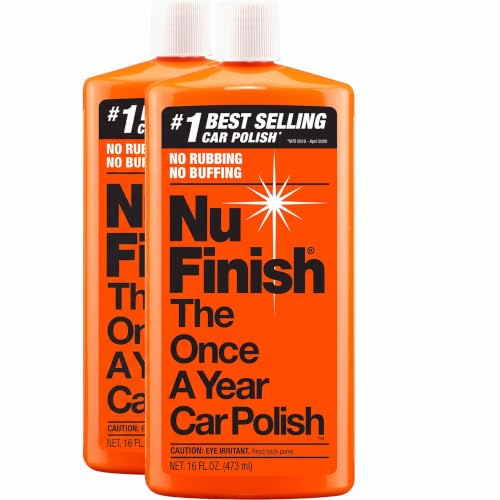
Nu Finish NF-76 Liquid Polish, 2-Pack provides two 16-ounce bottles of the same traditional Nu Finish liquid polish, making quantity its practical distinction from the single-bottle option. The maker describes the formula as zinc cross-linking polymer emulsions and says it can be applied in direct sunlight; the product name identifies it as NF-76. It suits buyers maintaining more than one vehicle or keeping a spare bottle on hand. A two-pack is unnecessary if you only want to try the formula or have one small area to polish.
Bottom line: Pick this when you want two bottles of the traditional formula.
How to choose a Nu Finish car polish
Start by deciding whether you want a traditional polish, a ceramic-featured polish and sealant, or simply a larger quantity. A polish is used to address paint appearance; a sealant is intended to leave a protective layer, so the terms do not mean the same job. Nu Finish NF-76 Liquid Polish and Nu Finish NF-76 Liquid Polish, 2-Pack share the traditional zinc-polymer formula, while Nu Finish 3-in-1 Ceramic Polish is the option whose maker identifies 3-in-1 ceramic technology. If you want one bottle, choose the single 16-ounce formula; if you specifically want ceramic technology, choose that formula. For larger marks, first assess whether the damage is superficial: polish cannot restore paint that has been removed down to primer or metal.
Polishing paint without common mistakes
Work on a clean surface: grit trapped under a pad or cloth can create additional fine scratches as you move it across paint. Many car-care instructions recommend working in shade on cool panels because heat can make products dry quickly and harder to remove; the maker’s direct-sun application claim for the traditional formula does not remove the need to keep the surface clean. Use a small test area and a clean applicator before covering a full panel. Avoid aggressive pressure or repeated passes over one spot, since abrasive polishing removes a small amount of clear coat. Stop if a scratch catches a fingernail or exposes a different color; that damage may need paint repair rather than polish.
Polish, sealant and scratch remover compared
Choose the product type by the task, not just by its name. A polish works on the paint surface to improve appearance, while a sealant is meant to protect the finish; some products combine functions. Scratch removers target localized marks and should not be confused with a general polish. The included comparison is limited to the polish formulas: Nu Finish NF-76 Liquid Polish and Nu Finish NF-76 Liquid Polish, 2-Pack are the traditional liquid formula, and Nu Finish 3-in-1 Ceramic Polish adds the ceramic feature. For lasting paint protection, a clean, smooth finish matters because contamination can interfere with an even protective layer.
| Need | Product type | Decision cue |
|---|---|---|
| General finish care | Polish | Pick a formula based on application and quantity |
| Paint protection focus | Sealant | Look for a formula that explicitly includes protection |
| One isolated surface mark | Scratch remover | Use only for suitable surface-level marks |
When a paint scratch needs more than polish
A scratch that cuts through the clear coat cannot be polished away safely; polishing removes material rather than filling missing paint. Wash and dry the area, then inspect it in bright, indirect light so dirt or water does not disguise the mark. A scratch that catches a fingernail is a useful warning that it may be deeper than a light surface defect, though it is not a precise depth test. If a contrasting primer or bare metal is visible, avoid repeated polishing and seek a compatible touch-up or body repair. Keep polishing pads and compounds away from unpainted textured trim unless their directions explicitly allow that surface.
Frequently Asked Questions
Can Nu Finish polish be applied in direct sunlight?
The maker says the traditional Nu Finish formula can be applied in direct sunlight. Still, clean the paint first and use a small test area; hot panels can make many car-care products dry faster.
Does car polish remove deep scratches?
No; polishing can only refine the surface and remove a small amount of clear coat. A scratch that catches a fingernail or exposes primer or metal may need paint repair instead.
How is car polish different from a sealant?
Polish is used to improve the appearance of paint, while a sealant is intended to leave a protective layer. Some formulas combine both functions, so choose based on whether surface correction or protection is your priority.
How often should I polish a car?
Polish only when the finish needs correction, rather than on a fixed schedule; each polishing pass removes some clear coat. Wash and inspect the paint first, and stop once the desired appearance is reached.
Should I polish a car before waxing it?
If the paint needs correction, polish before applying a separate wax or sealant so the protective layer goes over the cleaned finish. If the finish is already smooth, skip unnecessary polishing to preserve clear coat.