
Whip It Stabilizer for Whipping Cream: 4 Options

Dr. Oetker Whipped Cream Stabilizer is the closest fit for shoppers seeking Whip It stabilizer for whipping cream, with a six-pack and an ingredient list of dextrose, modified corn starch and phosphate. Choose Oetker Whip It Stabilizer, 2 Pack for a smaller two-pack, or consider Crait Whipped Cream Stabilizer, 2.8 oz if you want a powder marketed for frosting as well as whipped cream.
We earn a commission if you buy through links on this page. As an Amazon Associate I earn from qualifying purchases. Products are compared on manufacturer specifications, not hands-on testing.
- Best overall: Dr. Oetker Whipped Cream Stabilizer, 6 Pack – The six-pack is the named Dr. Oetker stabilizer and its ingredients are provided.
- Best for a small pack: Oetker Whip It Stabilizer, 2 Pack – The two-pack contains two 10-gram packets.
- Best for frosting: Crait Whipped Cream Stabilizer, 2.8 oz – The powder is marketed for whipped cream and frosting and says it makes 4 cups.
| Product | Best for | Package size | Pack count | Ingredients | Shop |
|---|---|---|---|---|---|
| Dr. Oetker Whipped Cream Stabilizer, 6 Pack | Six-pack supply | 0.35 oz each | 6 | Dextrose, modified corn starch, phosphate | Check Price on Amazon |
| Oetker Whip It Stabilizer, 2 Pack | Two packet supply | 0.35 oz each | 2 | — | Check Price on Amazon |
| Crait Whipped Cream Stabilizer, 2.8 oz | Frosting use | 2.8 oz | 1 | — | Check Price on Amazon |
| Pastry Star Stabilizer, 20 lb Case | Bulk kitchen use | 80 oz per bag | 4 bags | Instant gelatin; non-GMO raw materials | Check Price on Amazon |
Whip It stabilizer for whipping cream options
Compare package formats and intended uses before choosing a stabilizer for a batch or decorating project.
Dr. Oetker Whipped Cream Stabilizer, 6 Pack

The six-pack is the named Dr. Oetker option, and its ingredients are dextrose, modified corn starch and phosphate. Each packet is 0.35 ounce, so the format gives you multiple separate portions rather than one bulk bag. That makes it a practical match for bakers who want the same stabilizer on hand for several batches.
Bottom line: Choose this if you want the Dr. Oetker stabilizer in a six-pack.
Oetker Whip It Stabilizer, 2 Pack
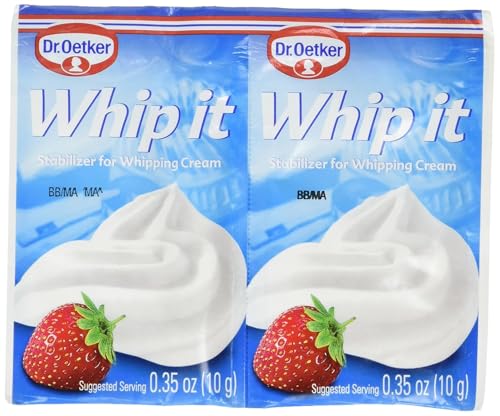
The two-packet format is the smallest Dr. Oetker option here, with each packet sized at 10 grams, or about 0.35 ounce. It suits someone who wants a smaller quantity than the six-pack without switching to a different stabilizer brand. A stabilizer supports cream structure, but it does not replace correct whipping: stop at the texture your recipe needs to avoid turning cream grainy.
Bottom line: Pick this for a compact two-packet quantity of the named stabilizer.
Crait Whipped Cream Stabilizer, 2.8 oz

The Crait powder is positioned for both whipped cream and frosting, making it the broadest use among these small-format powders. Its package says it makes 4 cups and is intended for cake, pie, pastry and cupcake applications; the maker also says the mixture can be prepared ahead and kept refrigerated. That makes it a fit for decorating that needs chilled holding rather than only an immediate topping. It is not the named Dr.
Bottom line: Choose this if you want a powder marketed for frosting as well as cream.
Pastry Star Stabilizer, 20 lb Case

The Pastry Star case is a bulk alternative, packaged as four 5-pound bags for a total of 20 pounds. Its maker says the stabilizer contains added instant gelatin and is gluten-free, making this format more suited to high-volume kitchens than occasional home batches. Separate bags can help divide a large supply for storage or work areas. The product is not Dr.
Bottom line: Choose this for large-scale kitchen use when a bulk case fits your needs.
How to choose a whipped cream stabilizer
Choose by intended use, batch size and whether the ingredient list suits your recipe. Whipping cream sold as whipping cream generally contains 30% to 36% milkfat; heavy cream is at least 36% milkfat, which helps it whip into a stable foam. A stabilizer can support shape retention, but it does not correct cream that is too warm or overbeaten. Chill the cream, bowl and beaters before whipping, especially in a warm kitchen. For a small home batch, individual packets are easier to portion than a multi-pound bag; for repeated food-service production, bulk packaging can reduce repurchasing. Always follow the packet’s own ratio rather than estimating from package weight alone.
When to add stabilizer to whipped cream
Add powdered stabilizer according to its package directions, typically while the cream is being whipped rather than after it has reached stiff peaks. Dry powders can clump if poured into an already dense foam, so whisking or sifting them with a small amount of sugar first can distribute them more evenly. Whip cold cream at medium speed and watch the texture: soft peaks bend over, while stiff peaks stand upright. Stop before the cream looks grainy or separates, since excess beating can turn the fat into butter. For a decorating batch that must hold, test the quantity and timing in a small batch before scaling it up for a cake.
Stabilizer types and package sizes
Packet powders, home-size tubs and bulk bags address different batch volumes, so compare the actual quantity and directions rather than assuming every scoop performs alike. Starch-based mixes and gelatin-based mixes can thicken cream differently, and one cannot be substituted by weight without checking its recipe ratio. The table helps match format to the scale of the job; it does not indicate equivalent dosing or performance between formulas.
| Format | Useful for | Check before mixing |
|---|---|---|
| Individual packets | Occasional small batches | Packet-to-cream ratio |
| Small powder container | Repeated home decorating | Serving yield and ingredients |
| Multi-pound bags | Frequent high-volume baking | Bulk dosing and storage |
Keep opened dry stabilizer sealed and dry; moisture can make powders clump and complicate measuring. Use a scale for bulk quantities instead of relying on volume scoops.
Keeping whipped cream safe and shaped
Keep whipped cream refrigerated at 40°F or below, and return a decorating bowl to the refrigerator when it is not in use. Stabilization is not a food-safety step: it does not make cream safe at room temperature for an extended period. Perishable foods should not sit out longer than 2 hours, or 1 hour when the temperature is above 90°F. For a cake or pie that must be held, refrigerate it and allow time for the chilled topping to firm before transporting. Avoid leaving a finished dessert in a warm car; heat softens whipped cream even when a stabilizer has been added.
Frequently Asked Questions
How much stabilizer goes into a cup of cream?
Use the ratio printed on the stabilizer packet or container, because powders differ in strength and formulation. Measure cream by volume or weight consistently, and do not assume that a packet meant for one batch scales directly to a larger bowl.
What kind of cream whips into firm peaks?
Cream with at least 30% milkfat can be sold as whipping cream, while heavy cream has at least 36% milkfat. Colder, higher-fat cream generally forms a sturdier foam than warm cream with less fat.
Can stabilized whipped cream sit out all afternoon?
No; stabilization helps the topping hold its shape but does not remove the need for refrigeration. Keep cream at 40°F or below, and do not leave perishable foods out longer than 2 hours, or 1 hour above 90°F.
How can I prevent whipped cream from becoming grainy?
Stop whipping when the cream reaches the peak firmness your recipe needs; overbeating can make it grainy and eventually separate into butter and liquid. Chilling the cream and bowl first also helps it whip efficiently.
Should stabilizer be mixed into warm or cold cream?
Use cold cream unless the product’s directions say otherwise, since chilled cream whips more readily into a foam. Add the powder at the timing directed on its package and distribute it evenly to reduce clumping.