
Best Solar Powered Fan for Shed: 5 Models Compared

Dual-Panel 10-Inch Solar Exhaust Fan suits most shed owners because its maker claims 760–980 CFM and 8–16 hours of battery runtime. Choose a different setup if you need temperature-triggered control, an AC adapter, or ventilation for a small space rather than higher airflow.
A solar shed fan moves hot or stale air outdoors; its usefulness depends on airflow, sun exposure, and a clear path for replacement air to enter.
We earn a commission if you buy through links on this page. As an Amazon Associate I earn from qualifying purchases. Products are compared on manufacturer specifications, not hands-on testing.
- Best overall: Dual-Panel 10-Inch Solar Exhaust Fan – Its maker claims 760–980 CFM and 8–16 hours of battery runtime, with two 25W panels.
- Best for automatic control: 25W Solar Fan with Battery and Thermostat – It has a temperature sensor, three operating modes, and a 2,550mAh battery.
- Best for outlet backup: 8-Inch Solar Exhaust Fan with Adapter – It includes a power adapter and a 25W panel, plus a claimed 430 CFM airflow.
| Product | Best for | Airflow | Battery runtime | Solar panel | Shop |
|---|---|---|---|---|---|
| Dual-Panel 10-Inch Solar Exhaust Fan | Higher airflow | 760–980 CFM | 8–16 hours | Two 25W panels | Check Price on Amazon |
| 25W Solar Fan with Battery and Thermostat | Automatic control | — | 6–8 hours | 25W | Check Price on Amazon |
| 8-Inch Solar Exhaust Fan with Adapter | Outlet backup | 430 CFM | — | 25W | Check Price on Amazon |
| 9.8-Inch Solar Fan with Battery and Timer | Small sheds | 420 CFM | 15 hours | — | Check Price on Amazon |
| MARBERO Dual Solar Fan Kit | Basic solar ventilation | — | No battery | — | Check Price on Amazon |
Solar Powered Fans for Sheds
Compare airflow, backup power, and controls to match a fan to your shed and operating schedule.
Dual-Panel 10-Inch Solar Exhaust Fan
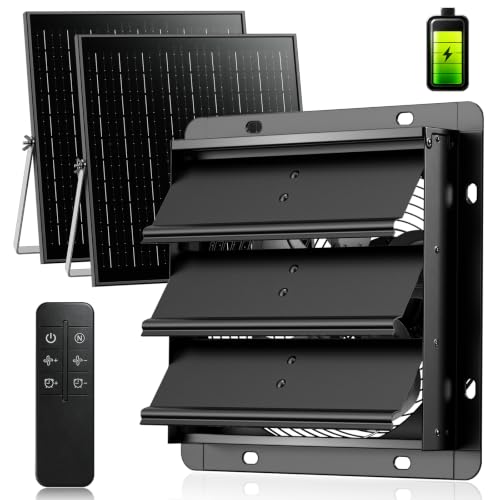
For a larger shed or a stronger airflow target, this model stands apart with two 25W panels and a built-in rechargeable battery. The maker claims 760 CFM at its default Level 8 setting and up to 980 CFM at 1,420 RPM, with 8–16 hours of battery runtime. Its 16-foot cable allows panel placement away from the fan. It suits owners who want several speed settings and overnight operation; the trade-off is a 5.7-pound unit, so confirm that the mounting surface can support it before installation.
Bottom line: Pick this if you want higher claimed airflow and battery-backed operation.
25W Solar Fan with Battery and Thermostat

Temperature-triggered operation sets this fan apart: its built-in sensor and LCD offer timer, temperature-control, and continuous modes. The maker claims its 2,550mAh battery runs for 6–8 hours, giving it a defined overnight window without relying only on direct sun. This setup suits a shed where ventilation should start automatically at a chosen temperature. Its dimensions are compact, but the specifications do not give an airflow figure, so it is harder to match to a specific shed volume than models with a CFM rating.
Bottom line: Choose this when temperature-based automatic control matters more than an airflow rating.
8-Inch Solar Exhaust Fan with Adapter

An included power adapter distinguishes this 8-inch fan from solar-only setups, providing another power option when sunlight is limited. The maker claims 430 CFM, 2,300 RPM, and 36-decibel operation; its 25W panel has an adjustable bracket, and a 16.4-foot cord supports roof placement. It suits owners who can use an adapter and want a specified airflow figure.
Bottom line: Pick this if you want an adapter option and a 430 CFM rating.
9.8-Inch Solar Fan with Battery and Timer
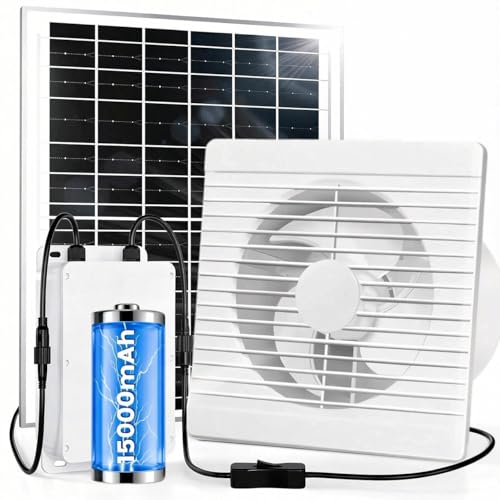
For a compact shed, the use area of up to 4 × 6 feet gives this fan a more specific fit than the higher-airflow models. The maker claims up to 420 CFM and 15 hours of continuous operation on cloudy or rainy days and at night, using its built-in battery. A timer and battery-status light add basic operating cues. This is a sensible match for a small space; its coverage should not be treated as a guarantee for a larger shed or one with heavy heat loads.
Bottom line: Choose this for a small shed within its 4 × 6-foot use area.
MARBERO Dual Solar Fan Kit

This kit differs from the battery-equipped fans by using direct solar power without built-in backup. The maker says it provides intake and exhaust ventilation for sheds and other small spaces, and its 13-foot cable offers some flexibility in panel placement. It suits a shed that needs airflow only when sunlight is available. The maker warns that output can fall on cloudy days or in shade, and that the fan will not run at night or in rainy weather; choose a battery-backed option if those periods matter.
Bottom line: Pick this for daytime ventilation where shade and overnight operation are not concerns.
How to Size a Shed Fan by Airflow
Start with shed volume and the number of air changes you want per hour. Multiply length × width × ceiling height in feet, then multiply that volume by the desired air changes per hour and divide by 60 to estimate CFM. For example, a 10 × 12 × 8-foot shed is 960 cubic feet; at 10 air changes per hour, the target is 160 CFM. Heat from equipment, people, or direct sun can justify more airflow, while leaky construction can make airflow less predictable. Use a measurable rule: if your calculated target exceeds a fan’s rated CFM, choose a higher-capacity unit or more than one fan. Keep intake openings clear so exhaust flow has replacement air.
Solar Panels, Shade, and Battery Backup
Direct, unshaded sun matters because a solar panel produces less power in shade and on cloudy days; even partial shade across a panel can limit output. Aim panels toward the strongest available sun and avoid placing them where roof edges, trees, or nearby buildings cast shadows. Battery capacity changes when a fan can keep running: a battery-backed model can operate after sunlight drops, while a direct-solar fan cannot provide overnight airflow. A power adapter is a separate option from a battery, so do not assume an adapter stores energy. For any shed that must ventilate after dark, select a model with a battery runtime and plan panel placement around the shed’s sun exposure.
Choosing Between Solar Fan Types
Direct-solar fans are simplest when daytime ventilation is enough, while battery-backed fans extend operation beyond peak sunlight. Adapter-equipped models add a grid-power option, and thermostat-controlled models can automate when ventilation starts. Match the type to the shed’s schedule rather than treating these features as interchangeable.
| Need | Fan type to consider | Trade-off |
|---|---|---|
| Daylight-only airflow | Direct-solar fan | Depends on available sun |
| Ventilation after sunset | Battery-backed fan | Runtime is limited by battery capacity |
| Outlet available | Fan with adapter | Adapter use requires a suitable power source |
| Automatic temperature response | Fan with temperature control | Check that its airflow matches the shed |
Choose automatic controls when shed temperature varies while unattended, but do not rely on a thermostat to replace adequate fan sizing. A larger panel can support stronger daytime operation, yet panel wattage alone does not tell you the fan’s airflow or overnight runtime.
Installation and Ventilation Mistakes to Avoid
Mount an exhaust fan where hot air collects, usually high on a wall or near the roofline, and provide a lower intake opening on another side of the shed. Without replacement air, a fan cannot move its rated volume effectively. Keep the fan outlet clear of obstructions and route cables so doors, sharp edges, and standing water cannot damage them. For a shed used around animals or stored materials, plan airflow so exhaust does not blow directly onto occupants or draw fumes into an adjacent space. Check the mounting dimensions and panel cable reach before drilling, then verify the shed’s available sun and interior clearances. Do not climb onto an unstable roof to position a panel.
Frequently Asked Questions
How many CFM does a shed fan need?
Estimate CFM by multiplying shed volume in cubic feet by air changes per hour and dividing by 60. A 960-cubic-foot shed at 10 air changes per hour needs about 160 CFM; increase the target if heat sources add a significant load.
Can a solar shed fan run at night?
A direct-solar fan needs sunlight and will not run after dark unless it has stored power or another power source. Battery-backed models can continue after sunset, but compare their runtime with the hours you need.
Where should I install a shed exhaust fan?
Place an exhaust fan high on a wall or near the roofline, with a separate lower intake opening for replacement air. Keep both openings unobstructed so air can cross the shed rather than circulate near the fan.
Does a solar fan work in cloudy weather?
Solar output drops with clouds and shade, so a direct-solar fan may slow or stop when panel light is weak. A battery can extend operation, but its runtime depends on the capacity and the fan’s load.
How much space should be left around a shed fan?
Keep the fan inlet, outlet, and any separate intake opening unobstructed; blocked airflow reduces ventilation. Before cutting an opening, measure the fan body and mounting area, since the fan diameter alone may not equal its required cutout.