
Spot Free Rinse at Home: 5 Systems Compared

For spot free rinse at home, Aquatic Life Dual DI Rinse System is the clearest fit because its dual-cartridge DI kit is designed for the final rinse after a normal wash and gives a per-cartridge TDS capacity.
Choose an inline hose filter for a simpler hose-connected setup, or a larger cart system if you want its 1,200-gallon capacity; confirm replacement-resin availability for the system you choose.
We earn a commission if you buy through links on this page. As an Amazon Associate I earn from qualifying purchases. Products are compared on manufacturer specifications, not hands-on testing.
- Best overall: Aquatic Life Dual DI Rinse System – A dual DI unit with two resin cartridges and an approximate 1,800–2,000 TDS capacity per cartridge.
- Best for inline use: WaterSentinel SF-20W Inline DI Filter – A compact inline filter with a reinforced transparent hose extension and reusable caps.
- Best for cart setup: iSpring WGB22BD Rolling Cart DI System – A rolling cart system with a capacity of 1,200 gallons.
| Product | Best for | Format | Included resin | Capacity | Shop |
|---|---|---|---|---|---|
| Aquatic Life Dual DI Rinse System | Final-rinse routine | Dual DI housing | 2 cartridges | 1,800–2,000 TDS per cartridge | Check Price on Amazon |
| WaterSentinel SF-20W Inline DI Filter | Inline hose use | Inline filter and hose | DI media | — | Check Price on Amazon |
| Portable Spotless Resin System, 2 Extra Sets | Extra resin included | Portable DI system | 2 extra replacement sets | — | Check Price on Amazon |
| iSpring WGB22BD Rolling Cart DI System | Cart-mounted setup | Rolling cart system | — | 1,200 gallons | Check Price on Amazon |
| Clearly MaD Dual DI Rinse System | Hose-ready kit | Dual DI housing | 2 cartridges | — | Check Price on Amazon |
Spot Free Rinse at Home Systems
Compare these deionized-water systems by setup style, resin included and the capacity figures provided.
Aquatic Life Dual DI Rinse System
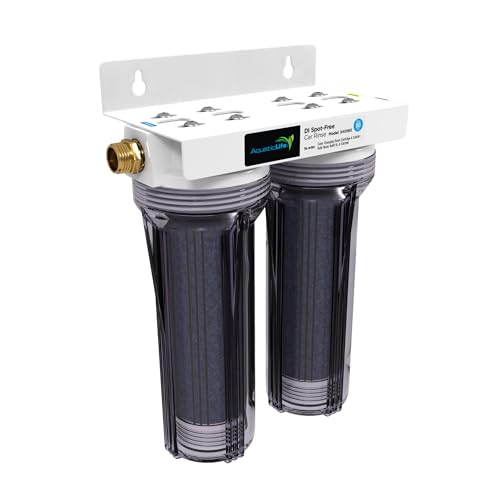
The Aquatic Life system is specifically arranged for a final rinse after the vehicle has been washed and rinsed normally. Its kit combines a dual DI housing and mounting bracket with two resin cartridges, adapters, a flow regulator, plumber’s tape, wrench and instructions. The maker says each cartridge removes approximately 1,800–2,000 TDS before replacement is needed. That capacity is useful for planning resin changes, but it is not a gallon figure; actual service life depends on incoming water and how much rinse water passes through the cartridges.
Bottom line: Choose this for a dedicated final-rinse setup with a per-cartridge TDS measure.
WaterSentinel SF-20W Inline DI Filter

The WaterSentinel SF-20W stands apart as an inline filter with a transparent braided hose extension rather than a dual-housing kit. It is 12 inches long and about 2.5 inches wide and high, with brass crimped ends and reusable caps. The maker says its sediment packs reduce chlorine, dust, rust, sand and silt, while its deionized media removes ions for a spot-free finish. The compact format suits someone who wants a hose-connected unit, but the maker gives no resin capacity figure for estimating replacement intervals.
Bottom line: Choose this for an inline hose arrangement and compact dimensions.
Portable Spotless Resin System, 2 Extra Sets

The portable Spotless Water System is the only option here that explicitly includes two extra sets of replacement resin filters in addition to its system. Its dimensions are 15.35 inches long, 11.41 inches wide and 7.08 inches high. The maker says the DI resin removes dissolved minerals such as calcium and magnesium and positions the unit for cars, RVs, motorcycles, boats and window cleaning. The extra resin may suit frequent use, though no cartridge TDS or gallon capacity is given to estimate how long those sets will last.
Bottom line: Choose this if extra replacement resin is a priority.
iSpring WGB22BD Rolling Cart DI System

The iSpring WGB22BD differs from the smaller hose-ready formats with a rolling cart and a 1,200-gallon capacity. The system measures 36 inches long, 19 inches wide and 11 inches high and weighs 43.2 pounds. The maker describes its water as 100% DI and says the system is intended to help prevent mineral residue when water dries during a wash.
Bottom line: Choose this for the 1,200-gallon capacity and cart format.
Clearly MaD Dual DI Rinse System

The Clearly MaD system is a hose-ready dual DI kit that includes a mounting bracket, two cartridges, adapters, flow regulator, plumber’s tape, wrench and instructions. Its size is regular without a hose, so it is suited to buyers who already have a garden hose and want the included connection parts rather than a bundled hose. The maker presents the unit for rinsing vehicles and windows followed by air drying.
Bottom line: Choose this for a dual-cartridge kit intended to use an existing hose.
How to choose a spot free rinse system
Choose by the point in your wash where you want deionized water and by the capacity measure you can use. DI resin exchanges dissolved ions for hydrogen and hydroxide ions, reducing dissolved mineral residue in the rinse water; it is commonly used for the final rinse after soap and ordinary rinsing. A TDS reading, measured in parts per million, helps indicate when resin is becoming depleted, while a gallon rating estimates treated volume under the maker’s conditions. Those measures are not interchangeable: incoming water with more dissolved solids generally consumes resin sooner. If you rinse regularly, favor a system whose capacity matches how you track use; if you want a hose-connected unit, compare its connection format and dimensions.
When to use deionized water for a final rinse
Use DI water after washing away soap and loose dirt, not as a substitute for the wash itself. A car-wash routine normally removes grime first, then uses the low-mineral final rinse to reduce water spots if droplets dry on the surface. Work in shade and on cool panels when possible: direct sun and warm paint accelerate evaporation and can leave residue before the rinse is complete. A flow regulator can limit water flow, but a slow rinse still needs enough volume to clear remaining soap. For a large vehicle such as an RV, plan the rinse in sections so each area is cleared before it dries.
Understanding resin capacity and replacement
Resin replacement depends on feed-water TDS and treated volume, so the same cartridge can last for different numbers of washes in different homes. A cartridge rating expressed as TDS removal is not a gallon count; test water with a TDS meter if the system’s instructions support that check, and replace resin when the output no longer meets your spot-free goal. Dual housings can accommodate two cartridges, but they do not automatically mean double service life unless the system’s flow path and capacity figures support that calculation. Record the source and output readings at the same sampling point each time for a useful comparison.
Preventing hard-water spots during a home wash
Mineral spots form when water evaporates and leaves dissolved solids behind, so a low-TDS rinse helps most when it reaches every washed surface before droplets dry. Keep a separate wash mitt and rinse tools free of grit; trapped particles can scratch paint regardless of rinse-water quality. Do not let soap dry on the finish, and avoid spraying DI rinse onto a dusty vehicle before removing dirt, since water treatment does not replace mechanical washing. On glass and solar panels, use a gentle stream and avoid abrasive tools; follow the equipment maker’s cleaning guidance for coated or delicate surfaces.
Frequently Asked Questions
Does a spot free rinse replace washing with soap?
No. DI water is most useful for the final rinse after ordinary washing and rinsing have removed dirt and soap. It does not lift road film or grit by itself.
How can I tell when DI resin needs replacement?
Compare incoming and treated-water TDS with a meter if your system supports that check. A rising output reading indicates the resin is losing its ability to remove dissolved solids.
Will deionized water prevent spots in direct sun?
Low-mineral water reduces residue from evaporation, but direct sun and hot panels make water dry faster. Washing in shade and rinsing in manageable sections helps keep droplets from drying before the full rinse.
Can I use a car rinse system on windows?
Several systems here are described for window cleaning, but use a gentle stream and nonabrasive tools. Coated glass or specialty glazing may require specific cleaning methods.
What does a TDS capacity mean for car washing?
TDS capacity describes how much dissolved-solids removal a cartridge can provide, not automatically how many gallons it treats. Higher TDS in the source water generally uses resin capacity faster.