
Assistance Getting Out of Bed: 4 Bed Rails Compared

For assistance getting out of bed, the KingPavonini rail suits people who want a 380-pound capacity and adjustable height; its measurements help match a rail to the bed. Choose another option if a motion light, wider stated fit, or a different grip design matters more.
Bed assist rails sit alongside or beneath a mattress and give a user a handhold while sitting up or standing. Match the rail to the bed and the user’s mobility needs, and use a support rail only as intended.
We earn a commission if you buy through links on this page. As an Amazon Associate I earn from qualifying purchases. Products are compared on manufacturer specifications, not hands-on testing.
- Best overall: KingPavonini BM03-1 Large – Its 380-pound capacity is the highest among these options, and the rail adjusts in height and horizontal length.
- Best for nighttime visibility: Lunderg Bed Assist Rail – A motion-activated light turns on for 60 seconds in AUTO mode.
- Best for curved grip: BigDolphin GS07 Medium – The medium model has a 30-degree curved handle and a 350-pound capacity.
| Product | Best for | Capacity | Height | Weight | Shop |
|---|---|---|---|---|---|
| KingPavonini BM03-1 Large | Higher capacity | 380 lb | 17.6–20.9 in adjustable | 5.5 lb | Check Price on Amazon |
| BigDolphin GS07 Medium | Curved handle | 350 lb | 40.5 in | 6.4 lb | Check Price on Amazon |
| Lunderg Bed Assist Rail | Nighttime lighting | — | 20.6 in | 5.64 lb | Check Price on Amazon |
| YrHeiper Bed Rail with Support Leg | Broad bed fit | 350 lb | 36 in | — | Check Price on Amazon |
Bed assist rails for assistance getting out of bed
Compare capacity, dimensions, grip features, and nighttime lighting before choosing a rail for a specific bed and user.
KingPavonini BM03-1 Large

The KingPavonini BM03-1 stands out with a 380-pound capacity and adjustable height and horizontal reach. The large model extends from 28.6 to 34.7 inches horizontally, while its height adjusts from 17.6 to 20.9 inches. Those ranges can help buyers match the handhold to the bed and the user’s reach. The maker says the rail is ASTM-approved and has a non-slip ergonomic handle; it also includes a storage bag and tool-free setup. Its maximum height is lower than the 40.5-inch figure given for the BigDolphin, so compare rail position with the mattress and user’s preferred grip before choosing.
Bottom line: Choose this if a 380-pound stated capacity and adjustable reach are priorities.
BigDolphin GS07 Medium
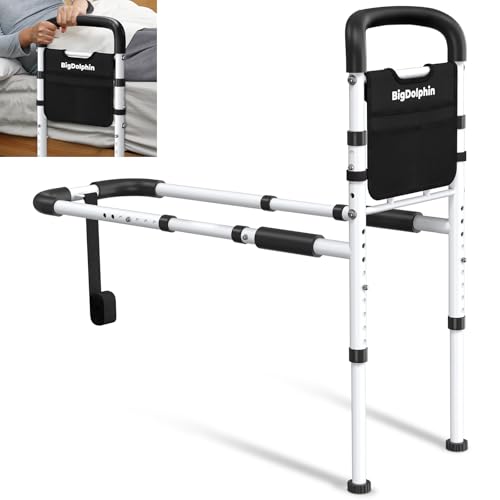
The BigDolphin GS07 is the option here with a specifically described 30-degree curved handle, intended by the maker to align with natural movement. It has a 350-pound capacity, a medium size, and a 40.5-inch height. Its non-slip grip and storage bag support bedside use, and the maker describes the assembly as tool-free and the rail as ASTM compliant. The 40.5-inch height differs substantially from the other heights, so check that the handle position suits the bed and the user’s arm reach. This model has a lower stated capacity than the KingPavonini.
Bottom line: Pick this for the curved handle and taller stated height.
Lunderg Bed Assist Rail

The Lunderg rail is distinguished by a motion-activated safety light rather than a weight capacity. The maker says AUTO mode keeps the light on for 60 seconds after movement and that its rechargeable battery lasts weeks. It also has a non-slip grab bar and a tool-free setup described as taking five minutes. At 20.6 inches high and 25.4 inches wide, its dimensions differ from the other rails here. Because the maker gives no capacity figure, this is not the clearest choice when capacity is a deciding factor; verify the rail’s rated capacity before selecting it for a user.
Bottom line: Choose this when an integrated motion light is a priority, after confirming capacity.
YrHeiper Bed Rail with Support Leg

The YrHeiper rail is the one in this comparison whose product name explicitly identifies compatibility with king, queen, full, and twin beds. Its features give a 350-pound capacity, a stabilizing support leg, a non-slip foam grip, and a mesh pocket for bedside items. The height is 36 inches. The maker says the rail meets ASTM F3186-17. The dimensions do not establish how the rail positions under different mattress setups, so check the attachment and support leg placement against the bed before choosing it. It does not include the motion light described for the Lunderg.
Bottom line: Pick this if the compatibility across four common bed sizes fits your setup.
How to choose a bed rail for getting out of bed
Start with the user’s weight, the rail’s rated capacity, and the handhold position—not the accessory features. Measure from the floor to the mattress top and consider how far the user must reach to grasp the handle. A rail that is too high or too low can make the transfer awkward. Choose an adjustable model when the height range matches the user’s reach; otherwise, compare actual dimensions to the bed. For a user who needs substantial lifting help rather than a balance handhold, a rail may not be the right aid.
Bed rail fit, mattress placement, and compatibility
Fit depends on the mattress, bed frame, rail base, and whether the support can be secured as intended. A name claiming compatibility with twin, full, queen, and king beds does not replace checking how the rail sits under a particular mattress. Measure the mattress height and the distance from its edge to the frame or foundation, then confirm the rail’s base can lie flat without shifting. For adjustable bases, verify the rail is expressly compatible before use; a moving bed can change the rail’s position. Keep the mattress and bedding arranged so they do not obstruct the grip or create gaps around the rail. Do not use a rail whose frame or fastening cannot be stabilized.
Bed assist rail features compared
Capacity, adjustment, grip shape, and lighting are distinct features, so choose by the user’s transfer needs. A capacity figure is a maximum support rating, not a measure of how much lifting assistance a rail can provide. Adjustable height and reach can help align the handhold, while a curved handle may suit a different grasp than a straight or foam-covered grip. A motion light addresses visibility at night but does not replace clear pathways or safe transfers. Use the table to identify which listed feature matches the main need, then confirm fit and capacity before use.
| Need | Feature to compare | Decision rule |
|---|---|---|
| Greater stated capacity | Capacity rating | Compare the rating with the user’s weight and required margin. |
| Handle alignment | Height and reach adjustment | Choose a range that places the grip within comfortable reach. |
| Nighttime guidance | Motion light | Prefer an integrated light if low-light trips are the main concern. |
| Bed-size compatibility | Fit and base placement | Confirm the rail stabilizes on the specific bed setup. |
Safe use and checks before relying on a bed rail
Bed rails are handholds, not substitutes for assistance with a transfer that the user cannot perform safely. Before relying on one, confirm that the frame is stable, any securing method is engaged, and the mattress does not leave an accessible entrapment gap around the rail. Recheck stability after moving the bed, changing the mattress, or adjusting the rail. Keep cords, loose bedding, and bedside items clear of the grip area. Users with limited mobility, confusion, or difficulty following safety directions may need an individualized assessment before a rail is used; a poorly matched rail can create a hazard instead of reducing risk. Ask a clinician or equipment professional when the user’s transfer needs are uncertain.
Frequently Asked Questions
How do I measure for a bed assist rail?
Measure the mattress top from the floor and note the mattress edge and frame arrangement before choosing a rail. Compare those measurements with the rail’s height and base placement so the handhold is reachable and the frame can stabilize.
Can a bed rail fit an adjustable bed?
Compatibility depends on the rail and the adjustable base; do not assume a rail designed for a standard bed will remain stable as the base moves. Confirm compatibility with the bed manufacturer and test stability through the full movement range before use.
What capacity should a bed assist rail have?
Choose a rail whose rated capacity exceeds the user’s weight, and consider the forces created while sitting, standing, or repositioning. The options here with explicit ratings are 350 or 380 pounds; confirm the rating when it is not supplied.
Are bed rails safe for people with dementia?
A rail may create entrapment or climbing hazards for someone who is confused or may try to leave the bed independently. Get an individualized assessment before use, and keep any gaps between the mattress, rail, and bed frame inaccessible.
How often should I check a bed rail?
Check stability before use and again after moving the bed, replacing the mattress, or changing the rail adjustment. Stop using the rail if its frame shifts, its securing method loosens, or the mattress setup changes its fit.