
Hydro Steel Hose: 4 Metal Hoses Compared

The Hydrosteel hose is the closest match for shoppers seeking a Hydro Steel hose, and its 600 PSI rating and 5/8-inch diameter help define the choice.
We earn a commission if you buy through links on this page. As an Amazon Associate I earn from qualifying purchases. Products are compared on manufacturer specifications, not hands-on testing.
- Best overall: Hydrosteel 50-Foot Metal Garden Hose – It is the named Hydrosteel hose and gives a 5/8-inch diameter and 600 PSI rating, though its length needs confirmation.
- Best for 75-foot reach: Bionic Steel 75-Foot Garden Hose – Its 75-foot size gives more reach than the 50-foot option without the 100-foot reach.
- Best for 50-foot reach: Bionic Steel 50-Foot Hose – Its name specifies 50 feet and 5/8-inch diameter, with a 500 PSI rating.
| Product | Best for | Length | Hose diameter | Shop |
|---|---|---|---|---|
| Hydrosteel 50-Foot Metal Garden Hose | Named Hydrosteel hose | 50 ft title; 100 ft size | 5/8 in | Check Price on Amazon |
| Bionic Steel 75-Foot Garden Hose | Longer yard reach | 75 ft | — | Check Price on Amazon |
| Bionic Steel 50-Foot Hose | Compact yard reach | 50 ft | 5/8 in | Check Price on Amazon |
| Ainpota 100-Foot Metal Garden Hose | Maximum listed reach | 100 ft | About 1/2 in ID | Check Price on Amazon |
Hydro Steel metal garden hoses
Compare the hose lengths and specifications first, then match the reach to your yard and faucet setup.
Hydrosteel 50-Foot Metal Garden Hose
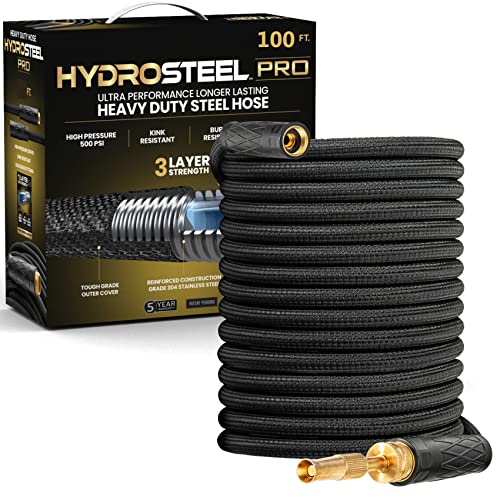
The Hydrosteel is the named hose in this comparison, with a 5/8-inch diameter and a 600 PSI rating. Its three-layer construction pairs a rubber inner tube with a 304 stainless steel outer wrap and polyester weave, and the package includes a nozzle. The maker says its interlocking design is flexible and resistant to rust, leaks and punctures.
Bottom line: Pick this if you want the named Hydrosteel hose and can confirm the length.
Bionic Steel 75-Foot Garden Hose

The 75-foot Bionic Steel reaches farther than the 50-foot alternative while avoiding the 100-foot length of the Ainpota. It uses commercial-grade 304 stainless steel, and the maker describes the design as kink- and tangle-resistant and under 3 pounds. That combination suits a yard where a shorter hose may not reach the far beds but a 100-foot run would be unnecessary. The product name does not give a hose diameter or pressure rating, so buyers who need either specification to match a faucet or sprayer should verify it before choosing.
Bottom line: Choose this when a 75-foot metal hose best matches your watering area.
Bionic Steel 50-Foot Hose

The 50-foot Bionic Steel is the shorter, specification-forward alternative, with a 5/8-inch diameter and 500 PSI rating. Its name also identifies it as non-expandable and says a sprayer nozzle is included; the maker describes its stainless steel construction as kink- and tangle-resistant. It suits smaller watering areas where 50 feet is enough and a fixed-length hose is preferable. The 500 PSI figure is lower than the Hydrosteel’s 600 PSI, and pressure rating alone does not tell you the flow a faucet will deliver.
Bottom line: Choose this when 50 feet is enough and the size and rating fit your setup.
Ainpota 100-Foot Metal Garden Hose

The Ainpota is the longest clearly sized option here at 100 feet, and its maker gives an approximate 1/2-inch inside diameter. It comes with a sprayer and nozzle, and the specifications describe stainless steel construction and 3/4-inch metal connectors with a rubber gasket. This length can suit a larger yard when a single run is useful. Its approximate inside diameter is narrower than the 5/8-inch hoses, so shoppers prioritizing water flow should compare their faucet and nozzle needs rather than choosing by length alone.
Bottom line: Choose this if you need 100 feet and an approximately 1/2-inch inside diameter.
How to choose a Hydro Steel hose
Choose hose length by measuring the route from faucet to the farthest watering point, then allow a little slack for turning around beds and obstacles. A longer hose can add drag and leave more line to coil, so avoid buying extra length without a reach need. Hose diameter also matters: 5/8-inch is a common garden hose size, while smaller inside diameters can constrain flow, especially on long runs. The pressure rating is a maximum hose specification, not a promise of faucet flow or spray strength. Match the connector to a standard U.S. garden hose thread connection and keep the washer seated at the faucet to reduce leaks.
| Need | Choice to compare |
|---|---|
| Shorter run | 50 ft |
| Middle reach | 75 ft |
| Long run | 100 ft |
Hose length and fit around the yard
Measure the actual hose path rather than the straight-line distance; corners, shrubs and raised beds use extra length. A useful rule is to choose the shortest hose that reaches the farthest point with slack, since unused hose adds weight to move and coil. For narrow side yards or small patios, 50 feet may be enough; 75 feet suits a longer route, while 100 feet is for the longest runs in this group. Metal outer wraps do not remove the need to protect a hose from sharp edges or repeated pinching. Keep connectors aligned when attaching the hose so the faucet threads are not cross-threaded.
Metal garden hoses and water flow
Metal garden hoses use a flexible metal exterior around a water-carrying inner tube; the metal wrap is not the water passage itself. Inside diameter, hose length, faucet flow and the nozzle setting all affect how much water reaches the end. A 5/8-inch hose is a common general-purpose choice, while a narrower bore may deliver less flow over a long run. Pressure ratings such as 500 or 600 PSI describe the pressure capacity, not gallons per minute. Turn the faucet on gradually and check the hose and connections for leaks before leaving water running unattended.
Connectors, storage and common mistakes
U.S. garden hose connections commonly use 3/4-inch garden hose thread, but fitting material and washer condition still affect a seal. A flat washer should sit inside the female connector; tightening harder cannot compensate for a missing or damaged washer and can damage threads. Drain the hose before storage, avoid sharp bends at the fittings, and coil it without forcing tight loops. Do not leave a pressurized hose exposed to freezing conditions, because trapped water can expand and damage the inner tube or connectors. For hoses marketed as pet- or puncture-resistant, treat those claims as resistance rather than permission to leave a pressurized hose where animals can chew it.
Frequently Asked Questions
Does a 5/8-inch garden hose fit a standard faucet?
Most U.S. outdoor faucets use 3/4-inch garden hose threads, and 5/8 inch refers to the hose’s inside diameter rather than its connector thread. A washer in the hose-end fitting helps seal the connection.
Is a higher PSI rating better for garden watering?
Not by itself: PSI is a pressure limit, while flow depends on the faucet, hose diameter and length, and nozzle. Compare the rating as a capacity figure, not a measure of spray strength.
How much hose should I buy for a yard?
Measure the hose route to the farthest watering point and choose the shortest length that reaches with slack. For example, a route comfortably under 50 feet does not call for a 100-foot hose.
Why does garden hose diameter affect water flow?
A smaller inside diameter creates more flow restriction, and the effect is more noticeable over a long hose run. A 5/8-inch hose is a common general-purpose size, but faucet supply and nozzle choice also matter.
How should I store a metal garden hose?
Drain the hose before storing it and coil it without tight bends, especially near the fittings. Keep it out of freezing conditions when water may remain inside, since ice expansion can damage hose components.