
Best Chair Floor Protectors: 4 Options by Fit

For most chairs, OASUM Silicone Caps with Felt Pads, Large is the most adaptable pick because its caps fit round legs from 1-5/16 to 2 inches in diameter and square legs from 1-3/16 to 1-9/16 inches per side. These protectors are silicone caps with felt bottoms for hard floors; choose adhesive felt pads instead if a cap will not fit your chair legs.
Measure each leg before choosing: a close fit helps a cap stay on, while adhesive pads need a flat, clean contact area.
We earn a commission if you buy through links on this page. As an Amazon Associate I earn from qualifying purchases. Products are compared on manufacturer specifications, not hands-on testing.
- Best overall: OASUM Silicone Caps with Felt Pads, Large – Its cap sizing covers both round and square legs within the ranges.
- Best for square legs: Ansible Silicone Felt Caps, Square L – Its square caps fit leg sides from 1-1/16 to 1-5/8 inches.
- Best for mixed furniture: Yelanon Mixed Felt Pads, 182-Piece – The pack includes nine felt-pad sizes, from 3/8-inch rounds to larger shapes.
- Best for simple round pads: X-Protector Round Felt Pads, 1-Inch – The 48-piece pack contains 1-inch round felt pads.
| Product | Best for | Pad type | Count | Stated leg fit or pad sizes | Shop |
|---|---|---|---|---|---|
| OASUM Silicone Caps with Felt Pads, Large | Round or square legs | Silicone cap with felt pad | 32 | Round: 1-5/16–2 in diameter | Check Price on Amazon |
| Ansible Silicone Felt Caps, Square L | Larger square legs | Silicone cap with felt pad | 24 | Square: 1-1/16–1-5/8 in sides | Check Price on Amazon |
| Yelanon Mixed Felt Pads, 182-Piece | Mixed furniture sizes | Self-stick felt pads | 182 | 9 sizes: 3/8–1-1/2 in rounds and assorted | Check Price on Amazon |
| X-Protector Round Felt Pads, 1-Inch | One-inch flat feet | Self-stick felt pads | 48 | 1 in round pads | Check Price on Amazon |
Best Chair Floor Protectors
Match the protector style and dimensions to your chair legs and floor before choosing a pack.
OASUM Silicone Caps with Felt Pads, Large

Unlike the other options, these caps are sized for both round and square legs, making them useful when chair shapes vary. The 32-piece set uses silicone covers with felt pads integrated into the base, and the maker says the caps install without tools. The fit spans round legs 1-5/16 to 2 inches in diameter and square legs 1-3/16 to 1-9/16 inches per side. They suit hard floors where scraping noise or scratches are a concern. Their limitation is the defined size range: measure each leg because an oversized cap may not stay secure.
Bottom line: Choose these if your chairs have round or square legs within the size ranges.
Ansible Silicone Felt Caps, Square L

These square silicone caps offer a narrower shape-specific choice than the multi-shape set, with a side-length fit from 1-1/16 to 1-5/8 inches. Each cap has a felt pad, and the maker says the design protects hard surfaces and reduces scraping noise. The 24-piece set suits chairs with square legs when adhesive pads are less convenient. The maker says these are not designed for carpet, so choose a different solution if the chair sits on carpet. Check the leg side length before selecting this size.
Bottom line: Choose this set for square chair legs in its range on hard floors.
Yelanon Mixed Felt Pads, 182-Piece

The broad size assortment distinguishes this set: its 182 pads include nine sizes, from small round pieces to larger rectangular shapes. That variety can help when one household has chair feet and other furniture legs in different dimensions. The maker says the self-stick pads are intended to protect wood, laminate, or tile flooring. Unlike silicone caps, these pads adhere directly to the furniture foot, so they suit legs that do not match a cap shape. Adhesive pads depend on a clean, flat contact surface; curved or rough feet may make application less reliable.
Bottom line: Choose this pack when multiple furniture pieces need different felt-pad sizes.
X-Protector Round Felt Pads, 1-Inch
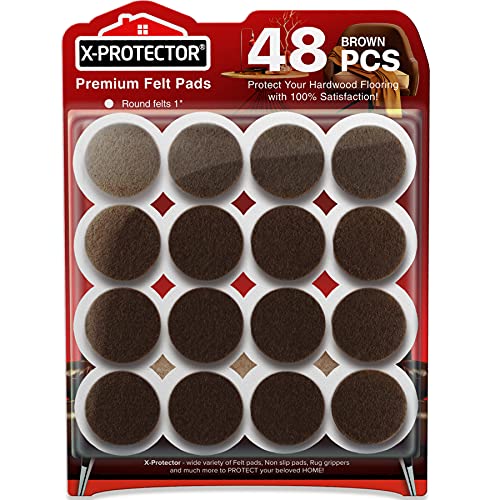
These 1-inch round felt pads keep the choice simple compared with the assortment pack: all 48 pieces have the same size. Each pad is 1/5 inch thick, and the maker says the adhesive is designed to hold on furniture feet. They are a fit for flat chair-leg bottoms that can take a round adhesive pad, including many smooth hard-floor setups. The limitation is the fixed size and direct-adhesive format; a curved foot or a leg that needs a larger contact area may be better served by a fitted cap or mixed-size pack.
Bottom line: Choose these when a 1-inch adhesive felt pad matches your chair feet.
How to choose chair floor protectors
Start with leg shape and floor type: caps wrap around a leg, while adhesive felt pads stick to its bottom. Measure the leg at the point where a cap will sit, and compare the width or diameter with the fit; for a square leg, measure each side. For a flat foot, measure the bottom contact area and choose a pad that covers it without hanging far over the edge. Felt is commonly used on hard floors because it creates a softer sliding contact than bare furniture feet. A cap can be useful when a leg shape fits one, while an adhesive pad is more flexible across different furniture shapes. Avoid assuming a universal fit: the size difference between 1-inch round pads and caps designed for legs up to 2 inches is substantial.
Caps and adhesive felt pads compared
Caps are the wraparound option; adhesive pads are the stick-on option. A cap’s fit depends on matching the leg’s shape and dimensions, while a pad depends on a flat enough surface for adhesive contact. The table compares the practical choice by chair-foot condition, not by a claim that one style works for every floor or chair.
| Chair-foot condition | Style to consider | Fit check |
|---|---|---|
| Leg matches a round or square range | Silicone cap with felt base | Measure diameter or each square side |
| Flat bottom with a suitable contact area | Adhesive felt pad | Measure the bottom and compare pad size |
| Several furniture feet vary in size | Mixed-size felt pack | Sort sizes against individual feet |
Either style still needs periodic inspection. Replace a pad or cap when felt is worn through, debris is trapped underneath, or the protector has shifted, since grit can scratch a hard floor.
Measure chair legs before fitting
Measure each leg rather than assuming all chairs in a set are identical. For round legs, use the outside diameter where a cap will grip; for square legs, measure side length, since diagonal width does not describe the fit. Check tapered legs near the bottom if the protector is meant to stop there. A snug cap should cover the contact point without being stretched beyond its fit range. For adhesive pads, a clean, dry, level surface gives the adhesive a better chance to bond than dusty or uneven wood. A common mistake is choosing by the pad’s nominal diameter alone and overlooking the leg shape or the available flat area.
Keep felt protectors working on hard floors
Inspect floor protectors as part of routine floor care, especially on dining chairs that slide frequently. Felt can collect grit and wear down, so brush debris away and replace a protector once its felt is thin, detached, or no longer covering the foot. Recheck caps after moving furniture; a loose or twisted cap can expose a hard edge. Do not drag a chair with a missing protector across hardwood, laminate, tile, or vinyl, because a small particle under a bare leg can leave a scratch. On carpet, felt caps may not glide as intended, and one product here specifically says it is not designed for carpet use. Match the protector to both the flooring surface and the chair leg.
Frequently Asked Questions
How do I measure a chair leg for a floor protector?
Measure the leg where a cap will sit: use outside diameter for a round leg and side length for a square one. For a stick-on pad, measure the flat bottom area and choose a pad that fits without excessive overhang.
Do felt pads work on hardwood floors?
Felt pads are commonly used on hardwood because they separate furniture feet from the floor during movement. Keep the felt free of grit and replace it when worn through, since trapped debris can scratch the finish.
Are chair leg caps better than adhesive pads?
Neither style fits every chair: caps need a matching leg shape and size, while adhesive pads need a suitable flat contact area. Choose caps for legs within a fit range and pads for flat feet that can hold adhesive.
How often should chair floor protectors be replaced?
Replace a protector when its felt is worn through, debris is embedded, or it no longer stays attached. Chairs that move often generally need more frequent checks than furniture that rarely shifts.
Can chair felt protectors be used on carpet?
Felt pads and caps are primarily useful for creating a softer contact on hard floors, and their glide behavior differs on carpet. One cap set here says it is not designed for carpet, so confirm suitability for your surface before fitting.