
Tire Foam Fill Kit: Sealants and Foam Compared

For a tire repair, TireJect Off-Road Sealant, 20 oz is the closest fit because it is a tire sealant kit for tubeless off-road tires and covers punctures up to 3/8 inch. A tire sealant works inside a pneumatic tire; expanding pour foam is a different material for filling and reinforcing voids, not tire repair.
Choose TireJect Lawn Mower Kit, 30 oz for the specified lawn mower sizes, or TireJect Off-Road Sealant, Gallon Kit for larger-volume off-road use.
We earn a commission if you buy through links on this page. As an Amazon Associate I earn from qualifying purchases. Products are compared on manufacturer specifications, not hands-on testing.
- Best overall: TireJect Off-Road Sealant, 20 oz – A 20-ounce kit for tubeless off-road tires addresses tread and sidewall punctures up to 3/8 inch.
- Best for lawn mowers: TireJect Lawn Mower Kit, 30 oz – The kit covers four mower tires up to 24×12 rear and 16×7 front.
- Best for larger applications: TireJect Off-Road Sealant, Gallon Kit – The gallon kit is intended for up to 16 ATV tires and large tractors or farm equipment.
| Product | Best for | Package size | Tire fit | Shop |
|---|---|---|---|---|
| TireJect Off-Road Sealant, 20 oz | Tubeless off-road tires | 20 oz | Tubeless off-road | Check Price on Amazon |
| TireJect Lawn Mower Kit, 30 oz | Lawn mower tires | 30 oz | Mower tires | Check Price on Amazon |
| TireJect Off-Road Sealant, Gallon Kit | Farm equipment tires | 1 gal | ATV, tractor, farm equipment | Check Price on Amazon |
| TireJect Off-Road 4-Tire Pack, 40 oz | Four off-road tires | 40 oz | Tubeless off-road | Check Price on Amazon |
Tire Foam Fill Kits and Tire Sealant Alternatives
These options include tire sealants for pneumatic tires and a separate expanding foam for void-filling work.
TireJect Off-Road Sealant, 20 oz

Among these choices, TireJect Off-Road Sealant, 20 oz is the most direct match for someone searching for a tire fill repair kit: it is a sealant installed through the valve stem, not a foam fill. The 20-ounce kit targets tubeless ATV, UTV, side-by-side, riding mower, tractor, golf cart, and wheelbarrow tires. TireJect says its liquid rubber, recycled tire particles, and Aramid fibers seal tread and sidewall punctures up to 3/8 inch, along with bead and slow leaks and minor dry rot. The main limitation is fit: the product is not compatible with TPMS tire sensors, so sensor-equipped tires need another solution.
Bottom line: Pick this for a tubeless off-road tire without a TPMS sensor.
TireJect Lawn Mower Kit, 30 oz

Unlike the general off-road kit, TireJect Lawn Mower Kit, 30 oz gives a tire-size ceiling for mower applications: up to 24×12 rear and 16×7 front tires, with enough sealant for four tires. It installs through the valve stem using the included injector, and the maker says it handles tread and sidewall punctures up to 3/8 inch, bead leaks, slow leaks, and minor dry rot. It can also be pre-installed for flat protection for up to two years, according to TireJect. This is a narrower choice than a general-purpose off-road sealant; mower owners outside those maximum sizes should confirm tire fit before ordering.
Bottom line: Choose this when all four mower tires are within the specified sizes.
TireJect Off-Road Sealant, Gallon Kit

For larger-volume work, TireJect Off-Road Sealant, Gallon Kit comes as a gallon kit intended to cover up to 16 ATV tires, large tractors, and farm equipment; the other sealant choices here are smaller packages or aimed at a specific mower size. Its injector attaches to the valve stem, and the kit includes a metal valve-core remover. TireJect says the formula seals tread and sidewall punctures up to 3/8 inch, bead and slow leaks, and minor dry rot, with one year of flat prevention after application. Its large quantity is less suited to a one- or two-tire repair where most of the container would remain unused.
Bottom line: Pick this for multiple ATV tires or larger off-road and farm equipment.
TireJect Off-Road 4-Tire Pack, 40 oz
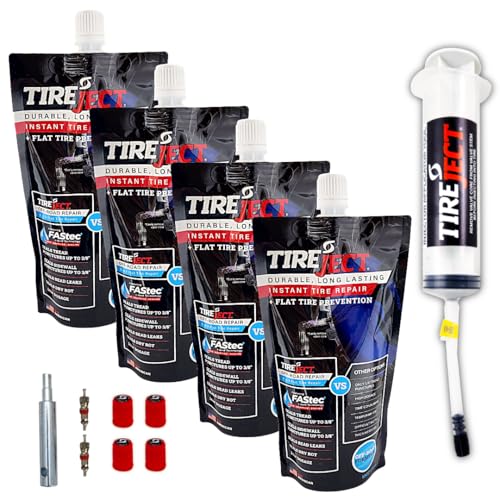
TireJect Off-Road 4-Tire Pack, 40 oz is a four-tire pack for buyers who want to treat a complete set rather than select a mower-specific kit or gallon container. The product is an off-road tubeless tire sealant, not expanding foam, and its uses include preventing flats and addressing punctures up to 3/8 inch, slow leaks, bead leaks, and minor dry rot. The formula includes liquid rubber, recycled tire particles, and Aramid fiber. The product text cuts off before giving all application instructions, so this option is best for buyers already familiar with installing valve-stem sealant and verifying the proper amount for each tire.
Bottom line: Choose this for treating four compatible off-road tires.
How tire sealant differs from foam fill
Tire sealant and pour foam solve different problems: sealant circulates inside an air-filled tire to close some punctures, while expanding polyurethane foam cures into a solid material for void filling. Sealants commonly contain latex or other rubber compounds and fibers; these products list liquid rubber, recycled tire particles, and Aramid fibers. A tire sealant cannot restore a damaged casing or replace a proper repair for a large cut. For a tire with a puncture larger than the 3/8-inch limit, a visible bulge, or damage near the bead, stop and have the tire assessed rather than relying on sealant. Pour foam belongs in a stationary void or reinforcement project, not inside a tire that must flex and retain air.
How to choose a tire sealant kit
Match the kit to the tire type and the quantity of tires, not just the word “foam.” TireJect Off-Road Sealant, 20 oz covers broad tubeless off-road uses; TireJect Lawn Mower Kit, 30 oz names mower tire size limits and a four-tire application; TireJect Off-Road Sealant, Gallon Kit supplies a gallon for larger-volume use; and TireJect Off-Road 4-Tire Pack, 40 oz is packaged as a four-tire set. A practical decision rule is to reject any kit whose maximum tire size is below your tire’s size or whose coverage does not match the number of tires. Measure tire size from its sidewall and check whether the tire is tubeless. Sealant can affect pressure monitoring or balancing systems, so verify compatibility with the vehicle or equipment manufacturer before use.
What puncture size can tire sealant handle
The puncture limit for the TireJect tire sealants here is up to 3/8 inch in the tread or sidewall. That limit is not a promise that every puncture of that diameter is repairable: location, tire construction, and damage shape matter. A puncture in the tread is generally a better repair candidate than a cut in the shoulder or sidewall; industry guidance commonly treats sidewall damage as non-repairable because the casing flexes there. Do not use sealant as a substitute for inspection after a loss of pressure, or to mask exposed cords, a bulge, or a split. Follow the tire maker’s repair rules and have questionable casing damage inspected by a tire professional.
How to use valve-stem tire sealant safely
Valve-stem kits require removing the valve core, injecting the measured sealant, reinstalling the core, and inflating the tire to its specified cold pressure. Keep the valve opening clean and avoid getting sealant on the tire-pressure sensor; some sealants are incompatible with TPMS, and TireJect Off-Road Sealant, 20 oz explicitly excludes TPMS tires. Tire pressure is a safety-critical setting: use the vehicle or equipment placard or manual, not the maximum pressure molded on the tire sidewall. After application, inspect for continuing air loss and arrange a proper tire inspection; sealant does not make a tire with structural damage safe. Wear eye protection and gloves when handling liquid sealant, and clean spills before they dry.
Frequently Asked Questions
Can expanding foam be used inside a tire?
No; expanding polyurethane pour foam cures into a rigid material rather than remaining flexible as a pneumatic tire needs. Use a tire-rated sealant only within its tire and puncture limits.
How large a puncture can tire sealant seal?
The TireJect sealants in this group state coverage up to 3/8 inch. Puncture location and casing condition still matter, and cuts or shoulder damage require professional evaluation.
Are tire sealants compatible with TPMS sensors?
Compatibility depends on the specific sealant and tire system; TireJect Off-Road Sealant, 20 oz specifically says it is not compatible with TPMS sensors. Check compatibility before injecting any sealant into a sensor-equipped tire.
Should a tire be repaired after using sealant?
Yes, arrange an inspection and permanent repair as soon as practical after using emergency sealant. Many puncture repairs are limited to the tread area, and damage to the sidewall or shoulder is generally not repairable.
What pressure should I inflate the tire to?
Inflate to the vehicle or equipment maker’s specified cold tire pressure, usually shown on a placard or in the manual. Do not use the tire sidewall’s maximum pressure as the operating target.