
Sea Foam Motor Treatment: 4 Formats Compared

For routine fuel and oil treatment in a multi-bottle pack, Sea Foam Motor Treatment 16 oz, 6-Pack suits most buyers: it has six 16 oz bottles and is described for gasoline and diesel use. Choose Sea Foam Motor Treatment and Intake Spray Combo if you also want intake spray, or a larger format if you need more treatment at once.
Sea Foam Motor Treatment is an additive for fuel systems and crankcase oil; its companion spray is applied through an air intake or carburetor throat. Persistent rough running or warning lights need diagnosis, not repeated dosing.
We earn a commission if you buy through links on this page. As an Amazon Associate I earn from qualifying purchases. Products are compared on manufacturer specifications, not hands-on testing.
- Best overall: Sea Foam Motor Treatment 16 oz, 6-Pack – Six 16 oz bottles are described for gasoline and diesel fuel as well as engine oil.
- Best for intake cleaning: Sea Foam Motor Treatment and Intake Spray Combo – The combo adds a 14 oz spray cleaner for upper-engine areas fuel cleaners cannot reach.
- Best for bulk use: Sea Foam SF128 Motor Treatment, 1 Gallon – The 1-gallon container suits buyers who want a larger single container.
| Product | Best for | Package format | Container size | Intended use | Shop |
|---|---|---|---|---|---|
| Sea Foam Motor Treatment 16 oz, 6-Pack | Routine fuel and oil | Six bottles | 16 oz each | Fuel and oil | Check Price on Amazon |
| Sea Foam Motor Treatment SF16, 16 oz, 12-Pack | Large multi-vehicle supply | Twelve bottles | 16 oz each | Fuel, oil, storage | Check Price on Amazon |
| Sea Foam SF128 Motor Treatment, 1 Gallon | Bulk container use | One gallon | 1 gallon | Fuel systems | Check Price on Amazon |
| Sea Foam Motor Treatment and Intake Spray Combo | Treatment plus spray | Combo pack | 16 oz and 14 oz | Fuel, oil, intake | Check Price on Amazon |
Sea Foam Motor Treatment Formats
Compare the package sizes and included treatment types before choosing a format for your vehicle or stored equipment.
Sea Foam Motor Treatment 16 oz, 6-Pack

For buyers who want several standard-size bottles, this six-pack contains 16 oz containers of Sea Foam Motor Treatment. The maker says it is for gasoline and diesel fuel systems and crankcase oil, and gives a fuel-tank interval of every 3,000 miles. It suits owners maintaining more than one vehicle or keeping treatment on hand for recurring use. The pack is less suited to someone who only needs intake-valve spray: no separate spray cleaner is included. Add only the amount and use the method specified on the product label for the vehicle and application.
Bottom line: Choose this if you want multiple 16 oz bottles for gasoline or diesel fuel and oil use.
Sea Foam Motor Treatment SF16, 16 oz, 12-Pack

The twelve-bottle format offers more individual 16 oz containers than the six-pack, making it a fit for a workshop, fleet, or long-term supply. The maker says the treatment cleans fuel-system residues, addresses crankcase sludge, and stabilizes gasoline or diesel for up to two years. That storage claim is relevant when preparing fuel for equipment that will sit, but it does not mean every vehicle should receive the same dose or interval. This pack contains treatment rather than the separate intake spray, so choose another format if you need a spray applied through an air intake.
Bottom line: Choose this when you need a larger supply of individual bottles and want the fuel-stabilizing use.
Sea Foam SF128 Motor Treatment, 1 Gallon
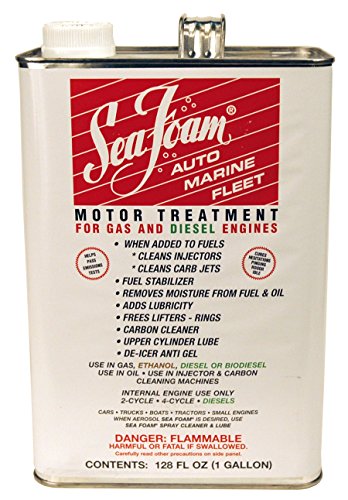
The SF128 is the bulk-container option, with one gallon of Sea Foam Motor Treatment rather than multiple 16 oz bottles. The maker says it is intended to dissolve fuel deposits and sticky residues in gasoline and diesel injectors, carburetors, and combustion chambers, and to stabilize stored fuel for up to two years. It may suit a shop or equipment owner who can measure treatment into separate applications. A gallon container is less convenient for occasional use than smaller bottles, and buyers should check the label for application amounts before transferring or dosing it.
Bottom line: Choose this if a single gallon container fits your storage and measuring needs.
Sea Foam Motor Treatment and Intake Spray Combo

Unlike the treatment-only packs, this combo pairs a 16 oz bottle of Sea Foam Motor Treatment with a 14 oz Sea Foam Spray. The maker says the liquid treatment can be used in fuel and oil systems, while the spray is intended for upper-engine areas that fuel cleaners cannot reach, including on gasoline direct-injection engines. This combination suits someone specifically seeking both forms of application. It is not a bulk supply of the same treatment: the spray has its own application method, so follow its label and vehicle guidance rather than pouring it into the tank or crankcase.
Bottom line: Choose this if you want both the liquid treatment and a separate intake spray.
How to choose a Sea Foam Motor Treatment format
Choose by application first, then by the amount of product you can use and store. The standard treatment is described for fuel and crankcase oil; the combo adds a spray for intake application, which is a different route and should not be substituted for tank treatment. Among the packs here, 16 oz bottles come in six- and twelve-count formats, while the bulk option is one gallon. A single gallon equals 128 fluid ounces, so it contains the equivalent of eight 16 oz measures before allowing for packaging or measuring loss. If you only need intake spray, verify that the package includes it before choosing a treatment-only format.
| Need | Format to compare |
|---|---|
| Fuel and oil treatment in separate bottles | 16 oz multi-pack |
| Fuel treatment plus intake spray | Combo pack |
| One large container for measuring | 1-gallon container |
Fuel additive dosing and vehicle fit
Fuel-additive dosing is based on the product label and fuel quantity, not simply on engine size or the number of cylinders. For perspective, a 16 oz bottle is a volume measure, not a universal dose; do not pour an entire bottle into a small tank unless the label calls for that quantity. These formats identify gasoline and diesel use, but they do not make a fuel additive a repair for a failed injector, ignition problem, or clogged filter.
For an engine with a persistent misfire, low oil pressure, or a warning light, diagnose the fault first instead of relying on an additive to resolve it.
Fuel treatment, oil treatment, and intake spray compared
Fuel, crankcase oil, and intake cleaning are distinct applications with different delivery paths. A fuel treatment enters through the tank and travels with the fuel; an oil treatment is added to engine oil; intake spray is applied through the air intake or carburetor throat. Gasoline direct-injection engines can have intake-valve deposits because fuel does not wash across those valves, which is why a spray aimed at upper-engine areas is a separate product role. Do not combine these methods or use a product in a system solely because it is a Sea Foam product; check that the specific container label names the intended application.
Fuel-stabilizing claims concern stored fuel, not an engine-cleaning schedule. The 12-pack and gallon specifications state fuel stability up to two years; storage conditions, a sealed fuel container, and local fuel formulation can affect how well fuel keeps.
Safe handling and common additive mistakes
Keep fuel and solvent products away from flames, sparks, and hot surfaces, and work with good ventilation; gasoline vapors ignite readily. Use a spray only by the route on its label, since an intake application is not interchangeable with adding liquid to fuel or oil. A common mistake is assuming more product always means better results: follow the container’s dose for the fuel or oil quantity, and do not exceed it. Another is treating a symptom repeatedly without checking maintenance basics such as air-filter condition, correct oil level, and scheduled service.
Store containers closed and upright, away from children and pets, and follow the label’s disposal directions. If a vehicle has an active drivability problem, use diagnostic steps before repeating chemical treatments.
Frequently Asked Questions
Can Sea Foam Motor Treatment be used in diesel engines?
Use the dose on the specific container label for the tank size and application, rather than assuming a gasoline dose is suitable for diesel.
How often does the six-pack say to treat fuel?
Its maker gives an interval of every 3,000 miles for fuel-tank use. Follow the container label for the amount per tank, since the interval alone does not specify a dose.
Does fuel additive clean intake valves on direct-injection engines?
Fuel added to the tank does not wash over the intake valves in a gasoline direct-injection engine. The combo includes a separate spray described for upper-engine areas, and its label should govern the application method.
How long can treated fuel be stored?
Keep stored fuel sealed in an appropriate container and away from ignition sources; storage conditions can affect fuel quality.
Can Sea Foam Motor Treatment fix rough idling?
A fuel-system cleaner may address residue-related issues, but rough idling can also come from ignition, air, sensor, or mechanical faults. If the idle remains rough after the specified treatment, diagnose the cause instead of repeating doses.