
Best Glue for Plaster: 4 Adhesives Compared

The DAP Bonding Liquid is the best fit for most plaster bonding because its maker says it is suitable for applications involving plaster and cement. Choose a general-purpose adhesive only for a small attachment where its material compatibility is confirmed; plaster bonding agents are intended for joining plaster or cement layers.
We earn a commission if you buy through links on this page. As an Amazon Associate I earn from qualifying purchases. Products are compared on manufacturer specifications, not hands-on testing.
- Best overall: DAP Bonding Liquid & Floor Leveler Additive – Its maker identifies plaster among the intended applications for the acrylic-latex bonding agent.
- Best for clear gap filling: Gorilla Max Strength Construction Adhesive – The clear construction adhesive is described as waterproof, paintable, and gap-filling.
- Best for broad material bonding: Gorilla Original Glue, 18 oz – The polyurethane glue bonds concrete and several other materials, but is not identified for plaster.
| Product | Best for | Formula | Color | Container size | Shop |
|---|---|---|---|---|---|
| DAP Bonding Liquid & Floor Leveler Additive | Plaster bonding | Acrylic latex | White | 16 fl oz | Check Price on Amazon |
| Gorilla Max Strength Construction Adhesive | Clear gap filling | Construction adhesive | Clear | 2.5 oz, 2-pack | Check Price on Amazon |
| Gorilla Original Glue, 18 oz | Concrete connections | Polyurethane | Brown | 18 oz | Check Price on Amazon |
| Gorilla Clear Glue, 1.75 oz | Small clear repairs | All-purpose liquid | Clear | 1.75 fl oz | Check Price on Amazon |
Best glue for plaster
Choose by whether the repair needs a plaster bonding agent or a general-purpose adhesive for a small attachment.
DAP Bonding Liquid & Floor Leveler Additive

Unlike the other options, this acrylic-latex bonding liquid is specifically identified for applications involving plaster, making it the clearest match for plaster-related bonding work. The maker says it bonds new concrete to old and can also be used as a floor leveler additive to improve adhesion and flexibility. It is suited to repair or reconstruction work where the goal is to bond mineral-based material rather than attach a small object.
Bottom line: Choose this for plaster-related bonding or cement repair work.
Gorilla Max Strength Construction Adhesive

Unlike the plaster-specific bonding liquid, this clear construction adhesive is positioned as a gap-filling adhesive for general projects. The maker says it is waterproof, paintable, and suitable for indoor or outdoor use. That makes it a possible option for a localized attachment where the surfaces are compatible, rather than a broad plaster-to-substrate bond. The specifications do not identify plaster as a supported surface, so confirm compatibility with both materials before relying on it for plaster work. Its small squeeze tubes suit limited applications better than coating a large wall area.
Bottom line: Choose it for a small, compatible attachment where clear gap filling matters.
Gorilla Original Glue, 18 oz

This polyurethane adhesive is the only general-purpose option here that explicitly names concrete among the materials it bonds. The maker says its water-activated formula expands into materials and becomes waterproof when cured, so its use case is a tight bond between compatible materials rather than an invisible plaster finish. The expansion and brown color can leave visible squeeze-out, which matters on a repair that will remain exposed. Plaster is not named as a supported material, so confirm suitability for the exact plaster and adjoining surface before using it.
Bottom line: Choose it for a compatible concrete connection, not a visible plaster finish.
Gorilla Clear Glue, 1.75 oz
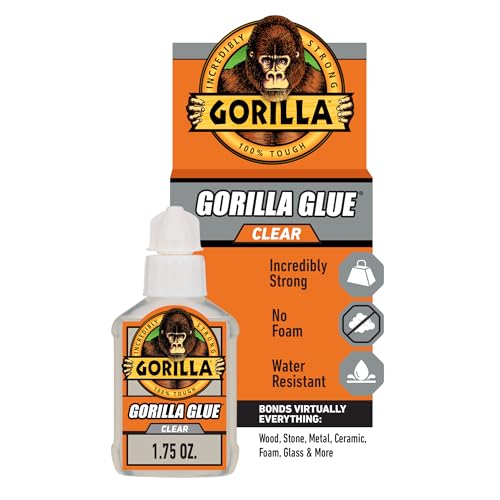
This clear liquid glue is aimed at small, discreet repairs across materials such as stone, ceramic, glass, and wood, unlike the plaster-oriented DAP bonding liquid. Its maker calls the formula water resistant and non-foaming, which may help when a small bond line needs to stay unobtrusive. Plaster is not named among its supported materials, however, so this is not a substitute for a bonding agent when joining plaster layers or patching a wall. Use it only after checking that the specific plaster and mating surface are suitable.
Bottom line: Choose it for a small, clear repair only when surface compatibility is confirmed.
Choose plaster bonding agent by repair type
For plaster-to-substrate bonding, start with an agent intended for plaster rather than a glue marketed mainly for wood or general repairs. Plaster can be gypsum-based, lime-based, or cement-based, and those materials do not all use the same repair system. A bonding liquid helps a new layer adhere to an existing surface; it is different from a patching compound that fills a missing section. For a hairline crack or a deeper hole, choose a compatible patch material and use a bonding agent only where its label calls for one. If the repair spans a broad area, match the material to the existing plaster and check the required surface preparation before application.
Match the plaster surface and adjoining material
Plaster bonding depends on the materials meeting at the repair: old plaster, masonry, concrete, paint, or another finish may call for different preparation. A useful decision rule is to use a plaster-compatible bonding agent for a plaster-to-mineral surface repair, and reserve general-purpose glue for small attachments only when both materials are confirmed compatible. Loose, dusty, or flaking material weakens adhesion, so remove unsound material and clean the surface before applying a bonding product. Do not assume a glue that bonds stone or concrete will bond every plaster formulation. Check the repair material and substrate together, especially on painted or previously sealed plaster.
Bonding agent, construction adhesive, and general glue
These products serve different jobs: a bonding liquid is intended to help building materials adhere, while general glue and construction adhesive target broader object-to-surface bonds. The distinction matters because plaster repairs often cover a surface area and need compatibility with the existing wall, not just a sticky bond. Use the table to identify the role, then verify the product is suitable for the actual plaster and adjoining surface.
| Product type | Typical purpose | Best decision cue |
|---|---|---|
| Plaster bonding liquid | Joining plaster or cement layers | Plaster is named for the intended application |
| Construction adhesive | Localized attachment or gap filling | Both bonded surfaces are compatible |
| General-purpose glue | Small repairs across selected materials | The material list matches both surfaces |
Prepare plaster safely before bonding
Plaster dust can irritate eyes and lungs, so use eye protection and a suitable dust mask when scraping or sanding a repair. Remove loose material without enlarging the damaged area unnecessarily, then follow the chosen bonding agent’s surface-preparation and cure directions. Keep wet products away from skin and eyes, and ventilate the work area when applying adhesives indoors. Do not use a waterproof or gap-filling claim as evidence that an adhesive is right for plaster; waterproof describes resistance after curing, not compatibility with every wall surface. For a large, crumbling, or damp area, address the underlying cause before covering it with a new bond.
Frequently Asked Questions
Can wood glue bond plaster to a wall?
Wood glue is formulated for wood and wood composites, so it is not a suitable default for plaster-to-wall repairs. For a broad plaster bond, choose a product identified for plaster and confirm that it matches the adjoining surface.
Should plaster bonding agent go on wet or dry plaster?
Surface condition depends on the specific bonding product; do not assume every agent should be applied to wet plaster. Clean off dust and loose material first, then check whether the product calls for a dry or damp substrate.
How do I fix a hole in plaster?
For a small hole, remove loose edges and use a patching material compatible with the existing plaster. A bonding agent may be needed for some repairs, but it does not replace filler; larger or crumbling areas may need a different repair approach.
Can construction adhesive be used on painted plaster?
Only if the adhesive is suitable for both the paint and plaster, since the bond can fail at the paint layer rather than in the plaster itself. Test compatibility on a small area and remove loose or peeling paint before bonding.
Does waterproof glue work for plaster repairs?
Water resistance alone does not establish plaster compatibility. Use waterproof glue only when the product also suits the plaster and adjoining material, and address any moisture source before repairing the surface.