
Best Brace for Cubital Tunnel Syndrome: 5 Compared

For most people seeking a cubital tunnel brace with day-and-night options, 3-in-1 Cubital Tunnel Elbow Brace stands out because its removable splints allow three elbow positions. Choose a different style if you need a specific size, angle control or flexible stays.
Cubital tunnel braces support the elbow and can limit bending, which may reduce pressure on the ulnar nerve during sleep; fit and comfort matter because a brace should not cause tingling or restrict circulation.
We earn a commission if you buy through links on this page. As an Amazon Associate I earn from qualifying purchases. Products are compared on manufacturer specifications, not hands-on testing.
- Best overall: 3-in-1 Cubital Tunnel Elbow Brace – Two removable splints provide three elbow positions, and the fit range is 12 to 17 inches.
- Best for angle control: Multi-Angle Cubital Tunnel Elbow Brace, M – A lever selects 120°, 150° or 180° positions, or limits movement across 120°–180°.
- Best for flexible daytime support: CODIAO 2-in-1 Cubital Tunnel Brace – It includes rigid aluminum splints for night use and flexible polymer stays for daytime mobility.
| Product | Best for | Support structure | Elbow positions | Fit | Shop |
|---|---|---|---|---|---|
| 3-in-1 Cubital Tunnel Elbow Brace | Day and night | 2 removable metal splints | 90°, 150°, 180° | 12–17 in. | Check Price on Amazon |
| Multi-Angle Cubital Tunnel Elbow Brace, M | Angle adjustment | Angle-control immobilizer | 120°, 150°, 180°; range limit | Medium | Check Price on Amazon |
| CODIAO 2-in-1 Cubital Tunnel Brace | Daytime mobility | 2 rigid aluminum + 2 flexible polymer stays | Night and day modes | Left or right arm | Check Price on Amazon |
| Hurmoya Night Elbow Brace, Medium | Night splinting | 2 removable metal splints | Straightening support | Medium | Check Price on Amazon |
| Upgraded Cubital Tunnel Brace, XL | Flexible support | 4 removable elastic support bars | Subtle movement | X-Large | Check Price on Amazon |
Best braces for cubital tunnel syndrome
Compare each brace’s support style and adjustability against when and how you plan to wear it.
3-in-1 Cubital Tunnel Elbow Brace

Three support positions distinguish this brace: both metal splints provide straight fixation, one removed allows a gentle bend, and both removed allow greater mobility. Two wide hook-and-loop straps and interior anti-slip strips are included, and the maker says the fit range is 12 to 17 inches. This option suits someone who wants one brace for sleep and some daytime tasks. Its limitation is that the product’s size range may not suit an arm outside that interval, so measure before choosing it.
Bottom line: Choose this if you want removable splints and your arm measures within its fit range.
Multi-Angle Cubital Tunnel Elbow Brace, M

Lever-based angle control sets this brace apart: choose fixed positions at 120°, 150° or 180°, or a mode that limits movement within 120°–180°. That makes it a fit for someone who wants a defined elbow range rather than removable stays. The product is a medium size and is described for either arm. Its limitation is that a single size may not fit every wearer; check arm fit and ensure the lever setting feels comfortable without forcing the elbow into position.
Bottom line: Pick this if selectable elbow angles are more important than removable splints.
CODIAO 2-in-1 Cubital Tunnel Brace

Separate rigid and flexible stays give this brace a distinct day-and-night setup: aluminum splints are intended for nighttime anti-bending support, while polymer stays allow more daytime movement. Three adjustable straps wrap the upper arm, elbow and forearm, and it fits either arm. This is a practical option for someone who wants to switch support styles rather than use one rigid setup all day. The specifications does not give a size range, so confirm fit before choosing if your arm measurements are outside common sleeve sizes.
Bottom line: Choose this if you want both rigid night stays and flexible daytime stays.
Hurmoya Night Elbow Brace, Medium
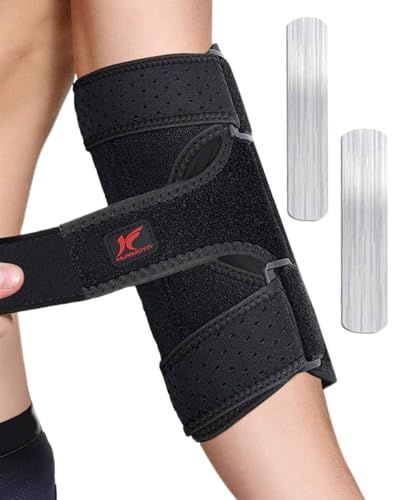
Two removable metal splints make this medium brace a straightforward choice for nighttime elbow support; removing them changes the brace to a less rigid protective sleeve. The product is described for men and women and includes compression. This option suits a buyer who mainly wants a sleep-oriented splint with a removable-support mode. Its limitation is that the size is medium, without a measurement range, so confirm the fit before relying on it overnight; a brace that is too tight can aggravate numbness.
Bottom line: Pick this for a medium night brace with removable metal supports.
Upgraded Cubital Tunnel Brace, XL

Four removable elastic support bars distinguish this XL brace from designs built around rigid metal splints. The maker says the bars provide support while allowing subtle arm movement, and the product is described for either arm. It may suit someone looking for a less rigid feel or a larger size.
Bottom line: Choose this if you want an XL brace with flexible support bars rather than rigid angle control.
How to choose a cubital tunnel brace
Choose by the hours you plan to wear it and how much elbow motion you need. Many people start with nighttime support because sustained elbow bending during sleep can increase pressure on the ulnar nerve; daytime braces are more useful when a specific task reliably provokes symptoms. A rigid splint limits movement more than flexible stays, while a removable or adjustable design lets you change support. No brace should create new tingling, pain, skin discoloration or hand coldness. Loosen or remove it if those occur. A clinician can help select an elbow position, especially after surgery or when weakness is present; do not force the elbow straight just because a brace permits it.
Elbow angle and nighttime fit
A comfortable position matters more than locking the elbow at full extension. Prolonged deep flexion is a common concern with cubital tunnel symptoms, but forcing a painful or uncomfortable straight position can make a brace impractical to wear. Adjustable braces vary in their available angles, so compare the settings with any position recommended for you. Strap tension should hold the brace in place without compressing the forearm or hand. A simple check is to slip a finger under a strap and make sure the hand stays warm and normally colored; remove the brace if numbness worsens. If symptoms continue despite avoiding bent-elbow positions, seek clinical guidance rather than tightening the brace.
Rigid splints versus flexible stays
Rigid splints restrict elbow movement more, while flexible stays permit more motion. The useful choice depends on whether the priority is limiting overnight bending or maintaining mobility for routine daytime tasks. A brace with removable pieces can bridge those uses, but changing the configuration also changes how much movement it allows. Use this comparison to identify a style, then match size and fit:
| Need | Support style | Tradeoff |
|---|---|---|
| Limit bending during sleep | Rigid splint | More restriction |
| Move during daytime tasks | Flexible stays | Less fixed positioning |
| Switch between uses | Removable or adjustable support | Requires changing configuration |
Do not assume a brace marketed for cubital tunnel syndrome has a particular medical clearance or clinical outcome unless that qualification is documented separately.
When to stop using an elbow brace
Stop and reassess the fit if a brace causes worsening numbness, pins and needles, increasing pain, skin irritation or a cool or discolored hand. Compression around the elbow or forearm can itself be uncomfortable, so straps should secure the brace without being pulled as tight as possible. Persistent numbness, new hand weakness or difficulty spreading the fingers deserves medical evaluation; a brace does not establish the cause of nerve symptoms. If symptoms began after an injury, surgery or a sudden change in strength, get professional advice before relying on an over-the-counter support. Night braces also need regular skin checks, particularly if sensation is reduced.
Frequently Asked Questions
Should a cubital tunnel brace keep my elbow completely straight?
Not necessarily; a comfortable position that avoids prolonged deep bending is the practical goal. Do not force full extension if it causes pain or worsens tingling, and ask a clinician about a target angle if you have been given one.
Can I wear an elbow brace while I sleep?
Night use is common for braces intended to limit elbow bending during sleep. Check your skin and hand after the first use, and remove the brace if numbness, pain or coolness increases.
How tight should an ulnar nerve brace feel?
The brace should stay in place without squeezing the arm or hand. Loosen or remove it if the hand becomes cold, discolored, more numb or increasingly painful.
When should cubital tunnel symptoms be checked by a doctor?
Get medical advice for persistent numbness or new hand weakness, especially difficulty spreading the fingers. Sudden symptoms after injury or surgery also merit prompt professional guidance.
Do flexible stays hold the elbow in a fixed position?
Choose a rigid or angle-adjustable design if limiting a defined range is your main need.