
Best Atomic Clock With Indoor Outdoor Temperature

WallarGe 14.5-Inch Atomic Clock suits most people because its 14.5-inch display pairs indoor and outdoor temperature readings with a wireless sensor range of up to 330 feet. Choose LFF 15-Inch Atomic Clock instead if you want humidity on the display, or WallarGe Extra Large Backlit Atomic Clock if a backlight matters more than a larger screen.
These clocks use a radio signal to set the time and a separate wireless sensor to report outdoor temperature; sensor placement and signal reception affect setup.
We earn a commission if you buy through links on this page. As an Amazon Associate I earn from qualifying purchases. Products are compared on manufacturer specifications, not hands-on testing.
- Best overall: WallarGe 14.5-Inch Atomic Clock – Its 14.5-inch display and stated 330-foot sensor range offer a useful combination for larger rooms.
- Best for humidity: LFF 15-Inch Atomic Clock – It displays indoor and outdoor humidity alongside temperature, time, and calendar information.
- Best for backlighting: WallarGe Extra Large Backlit Atomic Clock – Its backlit display adds visibility in dimmer rooms.
| Product | Best for | Display size | Sensor range | Additional display feature | Shop |
|---|---|---|---|---|---|
| WallarGe 14.5-Inch Atomic Clock | Larger rooms | 14.5 in | 330 ft | Date and weekday | Check Price on Amazon |
| WallarGe 12.5-Inch Atomic Clock | Compact display | 12.5 in | 100 ft | 2.5-in digits | Check Price on Amazon |
| LFF 15-Inch Atomic Clock | Humidity readings | 15 in | — | Indoor/outdoor humidity | Check Price on Amazon |
| WallarGe Extra Large Backlit Atomic Clock | Dim rooms | 11.3 in | — | Backlit display | Check Price on Amazon |
Atomic clocks with indoor and outdoor temperature
Compare display size, sensor range, and extra readouts to match a clock to your room and monitoring needs.
WallarGe 14.5-Inch Atomic Clock

WallarGe 14.5-Inch Atomic Clock offers the longest sensor range among these clocks, making it a practical match when the outdoor sensor needs to sit farther from the display. Its 14.5-inch screen shows time, date, day, and indoor and outdoor temperature. The maker says the clock synchronizes with the WWVB radio broadcast, and notes that the display has no backlight. That limitation matters if you need to read the screen in a dark room; choose a backlit model for that setting. Keep the sensor within its range and away from direct sun for more representative outdoor readings.
Bottom line: Pick this for a larger display and a longer stated sensor range.
WallarGe 12.5-Inch Atomic Clock

WallarGe 12.5-Inch Atomic Clock is the smaller WallarGe option, with 2.5-inch digits and a 100-foot sensor range. The clock can be used on a wall or desk, so it suits a classroom, office, or garage where placement flexibility matters. The maker says it receives daily WWVB updates and stays accurate to within one second; it has no backlight. Its shorter sensor range than WallarGe 14.5-Inch Atomic Clock makes sensor-to-clock placement the key constraint, especially across walls or between floors. Choose it when a 12.5-inch display is enough and the sensor can remain relatively close.
Bottom line: Choose this for a smaller screen and flexible wall-or-desk placement.
LFF 15-Inch Atomic Clock
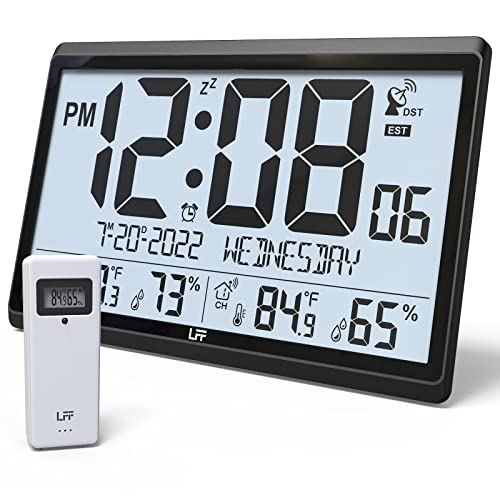
LFF 15-Inch Atomic Clock adds indoor and outdoor humidity readings, so it provides more than temperature at a glance. Its 15-inch display also includes time, calendar, day of week, and an alarm, and it can be used as a wall or desk clock. The screen has no backlight, which may be inconvenient in a dark bedroom or hallway. The features do not give a sensor range, so confirm the needed sensor-to-clock distance before choosing it for a faraway outbuilding. Its humidity readout makes it the clearest fit when monitoring moisture is part of the goal.
Bottom line: Pick this when indoor and outdoor humidity readings matter.
WallarGe Extra Large Backlit Atomic Clock

WallarGe Extra Large Backlit Atomic Clock is the option to consider when display illumination matters: it has a backlit screen with 3-inch digits, plus day, date, and indoor/outdoor temperature. The clock and outdoor sensor use AA batteries, which supports cordless placement but means batteries must be available for both units. Its 11.3-inch display is smaller than the 14.5- and 15-inch options, so buyers who prioritize screen area should compare those models instead. The maker says the clock syncs with WWVB and supports selectable US time zones.
Bottom line: Choose this for a backlit display and large digits in a dim room.
How to choose an atomic temperature clock
Start with the outdoor sensor’s placement distance, then decide which readings need to remain visible. Radio-controlled clocks receive time from WWVB, while a separate wireless sensor sends outdoor temperature; these are two distinct signals with different jobs. A sensor range is a maximum, not a guarantee through every wall or floor. For a sensor more than 100 feet away, WallarGe 14.5-Inch Atomic Clock gives the clearest range figure among these choices. If humidity is useful alongside temperature, LFF 15-Inch Atomic Clock includes indoor and outdoor humidity. If the display will be viewed in low light, choose a backlit screen rather than assuming every LCD is illuminated. Record where the sensor will sit before comparing display size or extra functions.
Where to place the outdoor temperature sensor
Place an outdoor thermometer sensor in shade, away from direct sun, exterior heat vents, and hot pavement; solar heating can make its reading warmer than the surrounding air. A north-facing wall is a common placement choice in the Northern Hemisphere because it receives less direct sun, though local shade matters more than compass direction. Keep the sensor within its radio range, and avoid assuming a manufacturer’s open-air maximum will work unchanged through masonry or multiple floors. Mount it where rain exposure and airflow match the device’s intended use, and avoid enclosing it in a sealed box that traps heat. Before mounting permanently, test the clock and sensor in their intended positions.
Atomic time signal and display features
WWVB is the U.S. time-signal service transmitted from Colorado on a 60 kHz radio carrier. Reception can be affected by distance, building materials, and electrical interference, so a clock may need time and a suitable signal path to synchronize. If automatic setting does not occur immediately, move the clock away from large metal objects and electronics and allow another reception opportunity. Display format also matters: a large wall clock can be easier to read across a room, while a desk-capable model fits a nearer viewing position. For dim rooms, select a model that explicitly has a backlight; a large LCD without backlighting can be hard to read after lights are off.
Match the clock to the room and readings
Choose by the constraint that would be hardest to change later: sensor distance, visibility, or the readings you need. This guide summarizes the practical decision path.
| Need | Choose | Reason |
|---|---|---|
| Sensor farther away | WallarGe 14.5-Inch Atomic Clock | Stated range reaches 330 feet |
| Humidity with temperature | LFF 15-Inch Atomic Clock | Indoor and outdoor humidity shown |
| Dim viewing area | WallarGe Extra Large Backlit Atomic Clock | Backlit display |
| Desk or wall placement | WallarGe 12.5-Inch Atomic Clock | Supports either clock position |
Room lighting and sensor distance should be assessed separately: a readable display does not extend the sensor’s wireless range, and a longer range does not guarantee a clear signal through every building layout. Choose the model that meets the less flexible requirement first.
Frequently Asked Questions
How far can an outdoor sensor be from its clock?
The usable distance depends on the model and the path between units. WallarGe 14.5-Inch Atomic Clock gives a range of 330 feet, while WallarGe 12.5-Inch Atomic Clock gives 100 feet; walls and floors can reduce real-world reception.
Where should I put an outdoor temperature sensor?
Mount it in a shaded, ventilated spot away from direct sunlight and heat vents. A north-facing wall is often useful in the Northern Hemisphere, but persistent shade is the main goal.
Why is my atomic clock not setting itself?
WWVB reception can be disrupted by building materials, distance, and nearby electrical interference. Move the clock away from metal objects and electronics, then allow another chance to receive the signal.
Can an atomic clock display temperature in a dark room?
Only a model with a backlit display provides illumination for dark conditions. A larger LCD without a backlight may still be difficult to read when the room lights are off.
Does an outdoor sensor need protection from rain?
Use the sensor according to its weather-exposure design, since water resistance differs by model. Keep it ventilated and shaded rather than sealing it in a container that can trap heat.