
Twisting Board for Exercise: 3 Models Compared

For most people, DUMOS Ab Waist Twister is the most versatile twisting board for exercise because it combines a 300-pound capacity with included resistance bands. Choose MERACH Two-Pedal Waist Twister if its two-pedal design and 264-pound limit fit your needs, or PAVYN Waist Twister with LED Monitor if you want a display that tracks rotations and workout time.
A twist board is a standing exercise platform that rotates as you shift your weight. Pick a different style if you want a broad balance board for floor exercises rather than a waist-twisting platform.
We earn a commission if you buy through links on this page. As an Amazon Associate I earn from qualifying purchases. Products are compared on manufacturer specifications, not hands-on testing.
- Best overall: DUMOS Ab Waist Twister – The 300-pound capacity and included resistance bands suit a wider range of routines.
- Best for tracking: PAVYN Waist Twister with LED Monitor – Its digital display records rotations and workout time.
- Best for two-pedal stance: MERACH Two-Pedal Waist Twister – The two-pedal design supports standing with feet apart.
| Product | Best for | Max user weight | Stability or add-ons | Shop |
|---|---|---|---|---|
| DUMOS Ab Waist Twister | Band-assisted workouts | 300 lb | Dual pedals; resistance bands | Check Price on Amazon |
| PAVYN Waist Twister with LED Monitor | Workout tracking | 300 lb | Resistance cords | Check Price on Amazon |
| MERACH Two-Pedal Waist Twister | Apart-foot stance | 264 lb | Two pedals | Check Price on Amazon |
Twisting Boards for Exercise
Compare each board’s capacity and workout features against the way you plan to exercise.
DUMOS Ab Waist Twister
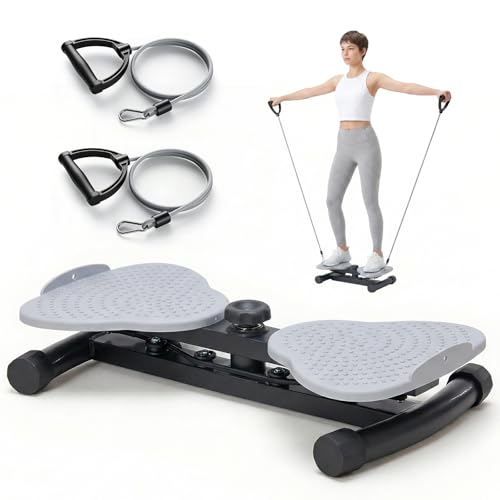
The 300-pound capacity and included resistance bands distinguish this board from options without bands. Its dual pedals are designed for a shoulder-width stance, while the side pull cords add a resistance exercise alongside twisting. That combination suits people who want to alternate between standing twists and cord work without changing equipment. The capacity is the key limit: choose another option if your body weight exceeds 300 pounds. The features do not establish a resistance level for the cords, so anyone who needs a specific tension should verify it before choosing.
Bottom line: Choose this if you want a higher stated capacity and resistance-band options.
PAVYN Waist Twister with LED Monitor

The digital monitor sets this board apart by recording rotations and workout time. Its display also includes mode and reset controls and shows battery level; the dual elastic resistance cords add a way to work against tension while twisting. This suits exercisers who want a simple count of session duration and turns rather than relying on memory. The 300-pound maximum capacity is the boundary to check before use. The features do not give a cord tension value, so this is a less suitable choice if you need a particular resistance level.
Bottom line: Pick this if tracking turns and session time matters to your routine.
MERACH Two-Pedal Waist Twister

The two-pedal layout is the defining feature of this board, allowing a feet-apart stance while twisting. MERACH gives it a maximum user weight of 264 pounds and describes a double anti-slip surface and noiseless use. That makes the capacity the main decision point: users above 264 pounds should select a board with a higher stated limit. The product’s exercise guidance calls for gentle, controlled movement within your ability and stopping if pain or unusual symptoms occur. Its feature set does not include a rotation or time display, so it is not the pick for people who want workout tracking.
Bottom line: Choose this if the two-pedal stance suits you and 264 pounds covers your weight.
How to Choose a Twisting Board for Exercise
Start with the board’s maximum user weight, then compare stance and add-ons. A board’s capacity is a hard ceiling, not a workout target; select one rated for at least your body weight and stop using it if the platform is damaged or unstable. Standing twist boards rotate underfoot, so controlled, small weight shifts are a more sensible starting point than fast or forceful turns. Resistance cords add upper-body pulling, but cord tension and movement range affect how demanding an exercise feels. If you want to count sessions, choose a model with a display; if you want a wider range of floor exercises, a balance board is a different category.
Twist Board Stance and Floor Setup
Set a standing twist board on a firm, level, nonslip surface with clear space around your feet and arms. A smooth or sloped floor can let a board shift unexpectedly, while nearby furniture creates a collision hazard if balance is lost. Wear shoes or use bare feet only if the board’s surface and your footing feel secure; avoid socks on a slick platform. Keep your knees softly bent and your torso upright rather than forcing your lower back through a large rotation. Begin with a few slow turns, pause if you feel pain or dizziness, and increase duration only while you can maintain control.
Twist Boards and Balance Boards Compared
A twist board is designed for rotational standing movement, while a balance board challenges stability through tilting or rocking. The distinction matters because a broad balance board can support floor movements such as planks, but it is not a substitute for a rotating platform when the goal is standing twists. Check the product’s use and shape before deciding; labels alone can blur the categories. The comparison below maps the basic design to a common use.
| Board type | Main movement | Useful for |
|---|---|---|
| Standing twist board | Rotates underfoot | Controlled standing twists |
| Balance board | Tilts or rocks | Balance drills and floor exercises |
Choose by movement first, then check the capacity and available floor area.
Safe Twisting and Common Mistakes
Keep twisting controlled and within a comfortable range; rapid, excessive rotation can strain the back or muscles. A standing board is a balance challenge as well as a rotation tool, so start near a stable support and avoid using it when the floor is wet or crowded. Resistance cords should stay under control throughout each repetition; do not let a stretched cord snap back toward your face or body. Stop immediately for pain or unusual symptoms, and follow the board’s capacity limit. A common mistake is assuming a twist board alone guarantees a particular body-shaping result; equipment cannot promise that outcome.
Frequently Asked Questions
How much space does a twisting board need?
Leave enough clear floor space to stand securely and move your arms without hitting furniture or walls. Measure the board’s footprint and add room around it for a stable stance; a crowded corner is not a safe setup.
Can beginners use a twist board?
Beginners can start with slow, small movements while keeping a stable stance. Practice near a fixed support and stop if you feel pain, dizziness or unusual symptoms.
Should I use shoes on a twist board?
Use footwear only if it grips the board securely and does not slide during gentle movement. Socks on a slick surface can reduce traction, so test footing before beginning and keep the floor dry.
Are twist boards and balance boards the same?
No. A twist board rotates under the feet, while a balance board typically tilts or rocks. Choose based on whether you want standing rotation or balance drills such as floor-based exercises.
How do resistance cords change a twist workout?
Resistance cords add a pulling movement to the standing twist and can make the routine involve the arms as well as the torso. Use only a controllable tension and keep the cord from recoiling toward your face.