
Uni Kuru Toga Advance Upgrade Models Compared

The Uni Kuru Toga Advance Upgrade in 0.5 mm suits most writers who want a standard lead size and a non-slip punching grip. Choose the 0.3 mm model instead if you prefer finer lead; the 0.5 mm versions differ by body color.
Mechanical pencils advance lead through a click mechanism, and these models also rotate the lead as you write.
We earn a commission if you buy through links on this page. As an Amazon Associate I earn from qualifying purchases. Products are compared on manufacturer specifications, not hands-on testing.
- Best overall: Uni Kuru Toga Advance Upgrade 0.5 mm, Gun Metallic – Its 0.5 mm lead and non-slip punching grip suit everyday writing.
- Best for fine lines: Uni Kuru Toga Advance Upgrade 0.3 mm, Black – It pairs 0.3 mm lead with double-speed lead rotation.
- Best for navy color: Uni Kuru Toga Advance Upgrade 0.5 mm, Navy – It offers the same 0.5 mm size and grip in a navy body.
| Product | Best for | Lead diameter | Body color | Grip | Shop |
|---|---|---|---|---|---|
| Uni Kuru Toga Advance Upgrade 0.5 mm, Gun Metallic | Everyday writing | 0.5 mm | Black | Non-slip punching | Check Price on Amazon |
| Uni Kuru Toga Advance Upgrade 0.5 mm, Navy | Navy finish | 0.5 mm | Navy | Non-slip punching | Check Price on Amazon |
| Uni Kuru Toga Advance Upgrade 0.3 mm, Black | Fine handwriting | 0.3 mm | Black | Perforated metal | Check Price on Amazon |
Uni Kuru Toga Advance Upgrade Mechanical Pencils
Compare the lead sizes, colors and grip details to choose the model that suits your writing.
Uni Kuru Toga Advance Upgrade 0.5 mm, Gun Metallic
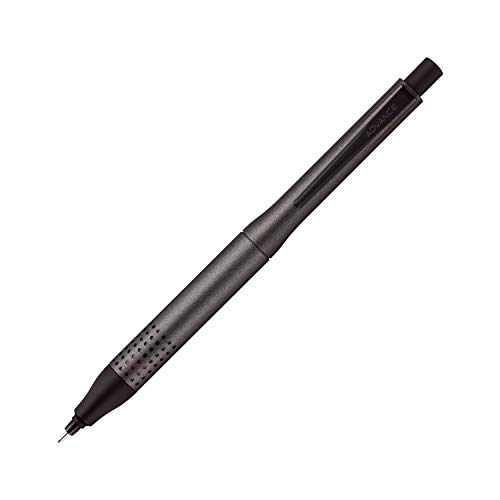
Uni Kuru Toga Advance Upgrade 0.5 mm, Gun Metallic is the 0.5 mm option with a black, gun metallic body and non-slip punching grip. Its lead-rotation mechanism is intended to keep the lead turning during writing, while the 0.5 mm diameter is a common middle ground for notes and general handwriting. The pencil measures about 5.6 inches long. Choose it if you want the standard lead size in this group and do not need the finer 0.3 mm point. Its color is the main distinction from the navy 0.5 mm alternative.
Bottom line: Pick this model for a 0.5 mm lead and black body.
Uni Kuru Toga Advance Upgrade 0.5 mm, Navy

Uni Kuru Toga Advance Upgrade 0.5 mm, Navy provides the same 0.5 mm lead size and non-slip punching grip as the black option, but has a navy body. The pencil uses lead-rotation technology and measures about 5.6 inches long. A 0.5 mm lead generally balances line visibility with a relatively fine point, making this a practical choice for routine writing rather than especially tiny lettering. Choose it when the navy finish is your preference; it does not offer the finer lead diameter or stated double-speed rotation of the 0.3 mm alternative.
Bottom line: Choose this version if you want the 0.5 mm model in navy.
Uni Kuru Toga Advance Upgrade 0.3 mm, Black

Uni Kuru Toga Advance Upgrade 0.3 mm, Black stands apart with 0.3 mm lead and double-speed automatic lead rotation, making it the fine-point choice in this group. Its grip is precision metal-processed with perforations, and its low center of gravity is designed for stability. The barrel uses painted ABS resin, with a brass-finish grip, and the pencil has a tip-slide-pipe mechanism. Choose it for small handwriting or narrow lines; 0.3 mm lead is more delicate than 0.5 mm, so it may be less suited to heavy pressure. The black model measures 5.6 inches long.
Bottom line: Pick this model for fine lines and its perforated metal grip.
Choosing a Kuru Toga Advance Upgrade lead size
Choose 0.5 mm for general writing and 0.3 mm when finer lines matter more. Mechanical pencil lead diameters commonly include 0.3, 0.5, 0.7 and 0.9 mm; smaller leads make narrower marks but are more vulnerable to pressure and side-loading. A lighter hand helps reduce breakage with 0.3 mm lead. Consider the writing you do most: small annotations favor a fine point, while everyday notes often benefit from the sturdier 0.5 mm size. These options include both 0.3 mm and 0.5 mm leads, so match the diameter to the line width you want rather than assuming the mechanisms are interchangeable.
Comparing rotation and grip features
Lead rotation is the defining mechanism shared by these pencils, while the 0.3 mm version specifies double-speed rotation. Rotation can help distribute wear around the lead tip as writing changes direction; it does not eliminate the need to advance lead or prevent every break. Grip details also differ: the two 0.5 mm models have a non-slip punching grip, while the 0.3 mm model specifies a precision metal-processed perforated grip. Choose based on comfort and the lead size you need, not the assumption that a more elaborate grip necessarily fits every hand. The model descriptions do not provide grip circumference or texture measurements.
| Writing need | Lead size to consider | Tradeoff |
|---|---|---|
| General notes | 0.5 mm | Broader line, sturdier lead |
| Fine handwriting | 0.3 mm | Narrow line, needs lighter pressure |
Matching the pencil to your writing
For small labels or compact handwriting, choose 0.3 mm only if you can write with modest pressure; for longer notes or a firmer hand, 0.5 mm is the safer starting point. Mechanical pencil lead is graded by darkness and hardness as well as diameter: HB is a common general-purpose grade, while softer grades such as B make darker marks but can smudge more readily. Lead grade and diameter are separate choices, so confirm both when replenishing lead. Avoid pressing hard or writing at a steep angle with a fine lead, since sideways force increases breakage risk. The black and navy 0.5 mm versions share the same lead diameter and grip type, leaving finish as their practical distinction.
Using and maintaining a mechanical pencil
Advance only enough lead to write comfortably; an exposed length of roughly 1 to 2 mm reduces leverage and helps limit snapping. Keep replacement lead in its tube and use the diameter marked for the pencil, because mismatched lead can jam or feed poorly. Clear a jam gently rather than forcing the knock mechanism, which can damage the feed. Mechanical pencil erasers are small, so a separate eraser may be more practical for extensive corrections. Store the pencil with its lead retracted when carrying it, especially if the tip is exposed, and avoid dropping a fine-lead pencil tip-first. These habits matter most with the 0.3 mm model because its narrower lead tolerates less bending force.
Frequently Asked Questions
What is the difference between 0.3 mm and 0.5 mm lead?
A 0.3 mm lead makes a finer line, while 0.5 mm is a more general-purpose size. Use a light touch with 0.3 mm because its narrower lead is more prone to snapping under pressure.
How much lead should extend when writing?
About 1 to 2 mm of exposed lead is a useful starting point for a mechanical pencil. A shorter exposed length reduces bending leverage and can help prevent breakage, particularly with 0.3 mm lead.
Can I use 0.5 mm lead in the 0.3 mm pencil?
No; use lead that matches the pencil’s diameter. The 0.3 mm and 0.5 mm sizes are not interchangeable, and mismatched lead may feed poorly or jam.
What lead grade works for everyday writing?
HB is a common general-purpose grade for everyday writing. Softer grades such as B usually make darker marks but can smudge more readily, and grade is separate from lead diameter.