
Best Hidden Curtain Tracks in the Ceiling: 5 Options

White Recessed Aluminum Track, 14 ft suits most people seeking a hidden curtain track in the ceiling because its recessed, ultra-thin rail is designed to blend into the ceiling and comes in a 14-foot size. Choose a double track option instead if you need separate rails for sheers and blackout curtains.
A ceiling curtain track guides gliders along a rail mounted overhead; a recessed track sits within a ceiling channel, while a pelmet hides the rail behind a valance.
We earn a commission if you buy through links on this page. As an Amazon Associate I earn from qualifying purchases. Products are compared on manufacturer specifications, not hands-on testing.
- Best overall: White Recessed Aluminum Track, 14 ft – Its recessed aluminum design hides the rail, and the size is 14 feet.
- Best for layered curtains: Double Ceiling Track, 3–6 ft – Two separate rows let sheers and blackout curtains move independently.
- Best for a concealed valance: Aluminum Curtain Pelmet, Double Track – The pelmet covers rails and hooks while providing two curtain tracks.
| Product | Best for | Mounting/design | Track rows | Length | Shop |
|---|---|---|---|---|---|
| White Recessed Aluminum Track, 14 ft | Recessed ceiling fit | Recessed ceiling | Single | 14 ft | Check Price on Amazon |
| Double Ceiling Track, 3–6 ft | Two curtain layers | Ceiling mount | Double | 3–6 ft | Check Price on Amazon |
| Aluminum Curtain Pelmet, Double Track | Valance concealment | Wall or ceiling pelmet | Double | 7.2 ft | Check Price on Amazon |
| FELIDESIGN Ceiling/Wall Track, 6–9 ft | Flexible mounting | Ceiling or wall mount | Single | 6–9 ft | Check Price on Amazon |
| Cbsroro Double-Row Ceiling Track, 9 ft | Long double layer | Ceiling mount | Double | 9 ft | Check Price on Amazon |
Hidden Curtain Tracks in the Ceiling
Compare the mounting style, track configuration, and length to find a system that fits your ceiling and curtains.
White Recessed Aluminum Track, 14 ft

The recessed profile sets this rail apart from surface-mounted tracks, making it the closest match for a built-in ceiling look. The white aluminum rail is 14 feet long and 1.2 inches high and wide. The maker says its PVC soundproof strips and rollers support quiet movement and gives a capacity of 80 pounds per 3 feet. Choose this option when you can accommodate a recessed channel and want one curtain layer; it is not the pick for separate sheer and blackout panels on independent rails.
Bottom line: Pick this for a long, single-layer run that can fit a recessed ceiling channel.
Double Ceiling Track, 3–6 ft

Two independent rows distinguish this ceiling-mounted system, which can hold sheers and blackout curtains separately. Its size range is 3 to 6 feet, and the white aluminum rails have a low-profile design. The maker describes the gliders as quiet and smooth and the rail as waterproof and rustproof. This is a practical choice when the window needs two curtain layers but the span is short; the 6-foot maximum makes it unsuitable for longer openings unless the installation plan accommodates multiple runs.
Bottom line: Choose this for a short ceiling run with separate sheer and blackout curtains.
Aluminum Curtain Pelmet, Double Track
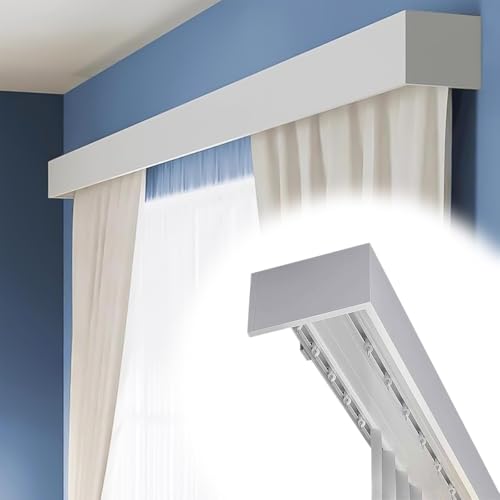
The front pelmet distinguishes this system from a bare ceiling rail by covering the rails, hooks, and mounting hardware. It includes two aluminum tracks for independently arranged sheer and blackout layers and measures 7.2 feet long, with a 4-inch side height. The maker says the valance can reduce visible light gaps near the curtain top. This suits buyers who want a concealed finish without cutting a recess into the ceiling; its pelmet is a visible fascia, so it is not as flush as a track recessed into the ceiling.
Bottom line: Choose this when you want a covered rail and two curtain layers without a recessed channel.
FELIDESIGN Ceiling/Wall Track, 6–9 ft

Ceiling or wall installation gives this single-row track more mounting flexibility than a recessed-only rail. The white aluminum set adjusts across a 6-to-9-foot range and includes roller hooks and a saw. The maker gives a capacity of up to 60 pounds and says pre-drilled holes allow direct ceiling mounting; wall brackets are also included. This suits a room divider or sliding-door span where either mounting surface is useful. The track itself is surface-mounted rather than concealed inside the ceiling, so it does not provide a fully hidden recessed finish.
Bottom line: Pick this for a single curtain layer when ceiling or wall mounting flexibility matters.
Cbsroro Double-Row Ceiling Track, 9 ft

The 9-foot length and double-row layout set this ceiling-mounted rail apart for longer openings that need two curtain layers. It is made of aluminum and measures 4.3 inches high and wide. The maker says the system supports up to 110 pounds per meter and uses self-lubricating rollers for quiet movement. Consider it for a wide window or room divider where separate sheer and blackout curtains are useful. Unlike a recessed track, the rail mounts on the ceiling surface, so buyers prioritizing a flush hidden channel should choose a recessed design instead.
Bottom line: Choose this for a 9-foot ceiling run with two curtain layers.
How to choose a hidden ceiling curtain track
Start with the ceiling construction and how many curtain layers the opening needs. A recessed track needs a channel or ceiling pocket; a surface-mounted rail attaches below the ceiling, while a pelmet hides a rail behind a front valance. For one curtain layer, a single row is sufficient; choose two rows when sheers and heavier curtains need to move independently. Measure the full travel path, including any space needed for the curtains to stack at the sides. A useful decision rule is to select a double-row system only when you plan to hang two separate panels; otherwise a single row avoids unused track space. Check the ceiling framing and mounting hardware against the expected curtain load before installation.
Recessed track, surface rail, or pelmet
A recessed track sits in a ceiling channel, a surface rail remains visible below the ceiling, and a pelmet conceals the rail with a front cover. Those designs solve different constraints: recessing creates a flush look but requires space within the ceiling, while surface mounting avoids cutting a channel. A pelmet can cover hooks and hardware without the same recessed installation, though its fascia remains visible. The table gives the key distinction for choosing a style.
| Style | How it conceals the rail | Installation consideration |
|---|---|---|
| Recessed | Rail sits within ceiling channel | Needs a suitable ceiling recess |
| Surface-mounted | Rail is exposed below ceiling | Attaches to ceiling surface |
| Pelmet | Front valance covers rail and hooks | Requires room for fascia |
Choose by the finish you can build, not simply by the word “hidden” in a product name.
Measure track length and curtain stacking space
Measure the opening and the full rail run before selecting a length. The track usually needs to extend beyond the window so curtains can clear the glass when open; the amount depends on curtain fullness and where the panels stack. For a room divider, measure the intended travel path rather than a window frame. Joinable track sections can make longer runs possible, but connectors must align smoothly to avoid snagging. Leave clearance for end stops and any wall returns. If a recess or pelmet narrows the available width, measure that finished opening too, since a track that fits the window width may not fit the concealed channel.
Mounting and load safety for ceiling tracks
Ceiling tracks need secure attachment to framing or a mounting system rated for the ceiling material and curtain load. Drywall alone may not hold a heavily loaded rail; use framing, blocking, or anchors appropriate to the substrate, and match fastener spacing to the rail instructions. Capacity figures can be given per length of track or per meter, so compare them on the same basis and account for both curtain layers on a double rail. Do not assume the rail’s capacity is the capacity of the ceiling or fasteners. Before ordering, confirm the required mounting depth, fastener type, and load support for the actual ceiling construction.
Frequently Asked Questions
How far should a curtain track extend past a window?
A track commonly extends about 6 to 12 inches beyond each side so open curtains can clear more of the glass. Increase the extension if the panels are especially full or need space to stack.
Can a ceiling curtain track go into drywall?
A ceiling track should be fastened to framing or to anchors rated for the load and drywall assembly, rather than relying on drywall alone. Heavy curtains and double tracks increase the load, so verify the fastener capacity and spacing before installation.
Do I need two tracks for sheer and blackout curtains?
Two separate tracks let sheer and blackout panels move independently. A single track is enough when you plan to hang only one curtain layer.
How do I keep curtains from snagging at track joints?
Track sections need to meet in straight alignment, with connectors seated fully and no sharp offset at the joint. Test the gliders across every connection before hanging the curtains.
What clearance does a recessed curtain track need?
The required recess depends on the track profile, mounting hardware, gliders, and curtain heading. Measure the channel against the complete installed assembly and leave room for the curtain to move without rubbing the ceiling.