
25 Yard Zeroing Targets: Three Formats Compared

For most shooters seeking a 25-yard target for a red dot, Chris Sajnog Red Dot 25-Yard Targets is the closest match because its high-visibility design is made for that optic type. Choose M4 Carbine 25-Meter EZ Peel Targets or PlusTactical M16A1 EZ Peel Targets if you need a rifle-specific zeroing format, but confirm whether your procedure calls for 25 yards or 25 meters.
A zeroing target helps you compare shot placement with an aiming point so you can adjust the sight. Use a safe range and the firearm maker’s procedure; target design alone cannot determine the correct zero for every firearm and load.
We earn a commission if you buy through links on this page. As an Amazon Associate I earn from qualifying purchases. Products are compared on manufacturer specifications, not hands-on testing.
- Best overall: Chris Sajnog Red Dot 25-Yard Targets – Its high-visibility paper and red dot focus match the broad 25-yard target use case.
- Best for M4 carbine: M4 Carbine 25-Meter EZ Peel Targets – The peel-off pad is configured for an M4 carbine zeroing procedure.
- Best for M16A1: PlusTactical M16A1 EZ Peel Targets – It is designed around M16A1 25-meter zeroing and names two ammunition-specific zero distances.
| Product | Best for | Format | Target dimensions | Shop |
|---|---|---|---|---|
| Chris Sajnog Red Dot 25-Yard Targets | Red dot optics | High-visibility paper | 11 × 8.5 in | Check Price on Amazon |
| M4 Carbine 25-Meter EZ Peel Targets | M4 carbine zero | EZ Peel notepad | — | Check Price on Amazon |
| PlusTactical M16A1 EZ Peel Targets | M16A1 zeroing | EZ Peel notepad | 11 × 8.5 in | Check Price on Amazon |
25 Yard Zeroing Targets
Match the target’s design and printed procedure to your firearm, sight and actual distance.
Chris Sajnog Red Dot 25-Yard Targets

For a red dot sight at 25 yards, this target stands apart with a high-visibility design rather than a rifle-specific military format. The maker says its layout is intended to help achieve a 100-yard zero from 25 yards; that result depends on the firearm, ammunition and sight setup, so treat the printed aid as a starting point. The 25-sheet pack is printed on paper and includes instructions. Its 11-by-8.5-inch size suits a standard target frame. Shooters following an M4 or M16A1 procedure should choose a target made for that procedure instead.
Bottom line: Choose this if you want a high-visibility 25-yard target for a red dot optic.
M4 Carbine 25-Meter EZ Peel Targets
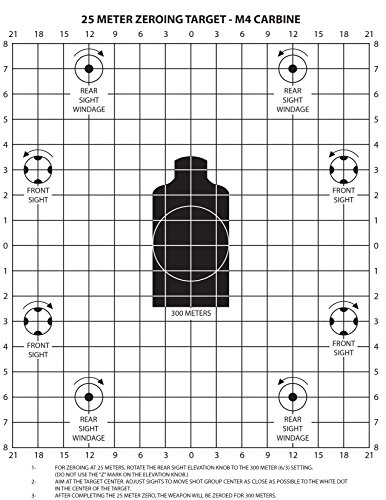
The defining difference is its M4 carbine-specific layout on an EZ Peel notepad. The maker says the target is configured for M4 zeroing and intended for 25-yard sighting, while the product name calls it a 25-meter target. Those distances are not interchangeable: 25 meters is about 27.3 yards, so set the target at the distance required by the procedure you are following. Each pad contains 25 white sheets that peel off for replacement. This is a practical format for an M4 user who wants a tear-off pad; a general red dot target may be a better fit for other firearms.
Bottom line: Pick this for an M4 carbine when its printed procedure and your range distance match.
PlusTactical M16A1 EZ Peel Targets

Unlike a general-purpose sight-in target, this pad is made for the M16A1 25-meter zeroing procedure. The maker identifies M193 55-grain ammunition with a 250-meter zero and M855 62-grain ammunition with a 300-meter zero; those are distinct intended outcomes, not a universal result for other loads. The white EZ Peel notepad contains 25 sheets and measures 11 by 8.5 inches. Choose it when the firearm and ammunition match the procedure. It is less suitable for someone simply seeking a generic 25-yard red dot target or using a different rifle setup.
Bottom line: Choose this when your M16A1 and ammunition match its specified zeroing procedure.
How to Choose a 25 Yard Zeroing Target
Choose a target whose printed aiming references match the sight and zeroing procedure you intend to use. A target can make group location easier to judge, but the firearm, ammunition, sight height and chosen distance determine the resulting zero. Red dot-focused high-visibility paper is useful when the aiming point needs to stand out; a rifle-specific target is more appropriate when following a defined carbine procedure. Confirm the actual firing distance before posting the target: 25 meters equals about 27.3 yards, a difference of roughly 2.3 yards. For an M4 or M16A1, use the applicable manual and ammunition specification rather than assuming every 25-yard target produces the same longer-range zero.
25 Yards Versus 25 Meters
Twenty-five yards and 25 meters are close but not identical ranges, and a zeroing procedure should be followed at its specified distance. Twenty-five meters converts to about 27.3 yards; moving the target to 25 yards changes the geometry of the sight adjustment. Target sheets do not compensate for that difference. A zero also depends on the cartridge and sight height above the bore, so a zero established with one load may not place another load identically. Before firing, measure the range and confirm whether the printed target calls for yards or meters. If the procedure requires 25 meters, place the target at 25 meters rather than estimating from a 25-yard firing line.
What Rifle-Specific Zeroing Targets Mean
Rifle-specific zeroing targets are useful when their procedure matches the rifle and ammunition in use. The M16A1 target here distinguishes M193 55-grain ammunition for a 250-meter zero from M855 62-grain ammunition for a 300-meter zero; those outcomes should not be assumed for a different load. An M4 target likewise signals a carbine-specific procedure, rather than a universal target for every rifle. A red dot sight alone does not make two targets equivalent: the intended distance and ammunition still matter. Use the firearm manual and the target’s own procedure together, and do not transfer one rifle’s adjustment instructions to another firearm without confirming compatibility.
Safe Setup and Common Zeroing Errors
Set up every zeroing target with a suitable backstop and follow the range’s firearm-safety rules. Keep the muzzle pointed downrange, keep the firearm unloaded while installing or adjusting the sight, and use eye and hearing protection on the firing line. A common error is measuring the distance inaccurately or adjusting after a single shot; a group gives a more useful indication of point of impact than one isolated hit. Keep ammunition and sight settings consistent while zeroing, since changing either can change impact. If the target’s printed procedure does not match the firearm or cartridge, stop and verify the correct procedure before making adjustments.
Frequently Asked Questions
How far away should a 25-yard zeroing target be?
Place a 25-yard target 25 yards from the firing position, measured rather than estimated. A 25-meter procedure instead requires about 27.3 yards.
Is 25 meters the same as 25 yards for zeroing?
No. Twenty-five meters is about 27.3 yards, roughly 2.3 yards farther than 25 yards. Use the distance specified by the firearm’s zeroing procedure.
Does a 25-yard zero work with every ammunition type?
No, impact can change with ammunition and firearm setup. Keep the load consistent during zeroing and check the firearm’s procedure for the intended cartridge.
How many shots should I use to check a zero?
Use a group rather than judging the zero from a single shot; three shots are a common minimum for seeing a basic pattern. Follow the firearm manual’s specific procedure if it calls for a different group size.
What safety gear do I need at a shooting range?
Wear eye and hearing protection on the firing line, and keep the muzzle pointed downrange. Use a proper backstop and keep the firearm unloaded during target setup and sight adjustments.