
Frequency Counter CB Radio: 4 Models Compared

The Delta DFC100 is the clearest match for CB radio because its name identifies it as a CB frequency counter; choose another meter if you need broader radio coverage or tone decoding. A frequency counter reads a radio’s transmit frequency, usually from its continuous carrier, rather than changing the radio’s channel.
Confirm whether your setup needs wireless or inline pickup before choosing the Delta, since those approaches connect to a radio differently.
We earn a commission if you buy through links on this page. As an Amazon Associate I earn from qualifying purchases. Products are compared on manufacturer specifications, not hands-on testing.
- Best overall: Delta DFC100 CB Frequency Counter – Its name specifically identifies a CB frequency counter and includes an AC adapter.
- Best for portable range: Surecom SF401 Plus Portable Meter – The 27 MHz–3000 MHz range includes CB frequencies, with TCXO accuracy given for its operating temperature range.
- Best for tone decoding: Surecom SF401 Plus Color-Screen Meter – Its features include CTCSS and DCS decoding alongside 27–3000 MHz coverage.
| Product | Best for | Frequency range | Tone decoding | Power | Shop |
|---|---|---|---|---|---|
| Delta DFC100 CB Frequency Counter | CB-specific use | CB; range not given | — | AC adapter included | Check Price on Amazon |
| Surecom SF401 Plus Portable Meter | Wide-band portability | 27–3000 MHz | CTCSS, DCS | — | Check Price on Amazon |
| Surecom SF401 Plus Color-Screen Meter | Tone decoding | 27–3000 MHz; 27–100 MHz performance not | CTCSS, DCS | Rechargeable lithium-ion battery | Check Price on Amazon |
| Mcbazel Surecom SF-103 | Broad radio range | 2–2800 MHz | — | — | Check Price on Amazon |
CB radio frequency counters
These meters differ in their coverage, decoding features and power arrangements, so match those to the radio signal you need to measure.
Delta DFC100 CB Frequency Counter

The Delta DFC100 is the only option whose name specifically identifies it as a CB frequency counter, making it the most direct fit for a CB-only setup. Its name also describes wireless or inline operation and says an AC adapter is included. US CB radios use 40 channels in the 26.965–27.405 MHz band, so confirm the counter’s pickup method works with your radio and that the adapter suits your setup. The main limitation is that the specifications do not give a measurement range or decoding features, which matters if you need documented coverage beyond CB or tone identification.
Bottom line: Choose this for a CB-specific counter when wireless or inline pickup matches your setup.
Surecom SF401 Plus Portable Meter
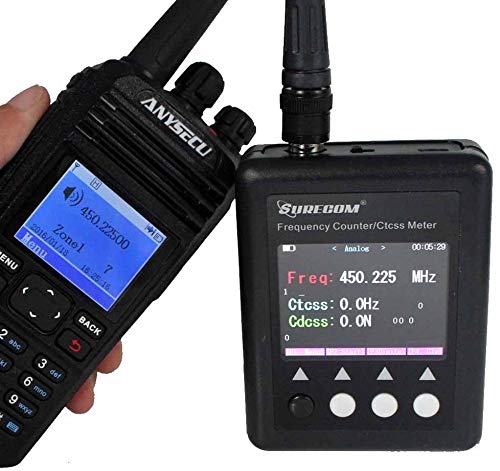
The Surecom SF401 Plus offers a much wider stated range than the CB-specific counter, spanning 27–3000 MHz, and includes a signal-strength indicator and four-button controls. Its features describe measuring a continuous carrier from a two-way radio, so it can suit a buyer who wants one portable meter for CB and other compatible radios. The maker gives ±2 to ±4 ppm accuracy across −45°C to 65°C.
Bottom line: Choose this if broad radio coverage matters and the low-end range suits your CB signal.
Surecom SF401 Plus Color-Screen Meter

The color-screen Surecom SF401 Plus adds a rechargeable lithium-ion battery and CTCSS/DCS decoding to its 27–3000 MHz coverage. Those tone features can help identify settings on compatible analog radios, while frequency measurement is intended for a transmitting radio sending a continuous carrier. The maker cautions that performance from 27–100 MHz is not assured, which includes the CB band; it also says the meter is not for wide-bandwidth signals or devices such as car-remotes. That makes this a less certain CB choice than its wide range may suggest, especially when dependable measurement near 27 MHz is essential.
Bottom line: Choose this when tone decoding and a rechargeable battery matter more than assured CB-band performance.
Mcbazel Surecom SF-103

That range encompasses CB frequencies and may suit a radio enthusiast who wants to measure signals across several bands. The meter has four-button controls and uses a temperature-compensated crystal oscillator; the maker gives no accuracy figure, tone-decoding capability or power source. Buyers who need confirmed CB-band accuracy or CTCSS/DCS readings should weigh those missing capabilities against the broader range.
Bottom line: Choose this for broad continuous-carrier coverage when CB accuracy and tone decoding are not the deciding needs.
How to choose a CB radio frequency counter
Start by checking that the meter can receive a signal in the CB band, not merely that its overall range sounds broad. US CB service uses 40 channels from 26.965 to 27.405 MHz; a device whose low-frequency performance is uncertain may not give dependable readings there. Counters generally measure a transmitting carrier, so a radio must transmit while the meter is positioned for pickup. Wireless pickup is convenient when you cannot connect a counter inline, while an inline method requires a compatible connection. Decide whether you need frequency only or also tone decoding and signal strength. For a CB-only setup, prioritize confirmed 27 MHz performance over a large upper-frequency limit.
What CB frequency counters measure
A frequency counter measures the carrier frequency emitted by a transmitting radio; it does not select channels or modify a radio’s settings. CB channel numbers correspond to specific frequencies, and channels are spaced at 10 kHz intervals across much of the band, with some channel-number gaps in the sequence. A counter may also report signal strength, but that reading is not the same as transmitter output power or antenna performance. Tone decoding is a separate function: CTCSS and DCS help identify signaling tones on compatible radios, but they do not apply to every CB setup. For the clearest reading, measure a steady transmission and keep the radio and counter in the position required by the meter’s pickup method.
Wireless and inline pickup compared
Wireless pickup senses a radio transmission through the air, while inline measurement uses a connection in the radio path. Choose wireless when you want to read a nearby transmitting radio without fitting a connector; choose inline only when the counter and radio use compatible connections and the meter supports that method. Keep transmitter duty limits in mind: CB radio rules limit transmissions to short periods, and unnecessary key-down time can heat radio components. Use brief test transmissions and avoid transmitting into a disconnected or unsuitable antenna. A nearby handheld counter should be positioned as its maker directs; distance and signal strength can affect whether a wireless reading is captured.
| Need | What to prioritize | Why it matters |
|---|---|---|
| CB-only measurement | Assured coverage near 27 MHz | The CB band sits near the low end of many broad-range meters. |
| Several radio bands | Low and high range limits | Both ends must cover the radios you intend to measure. |
| Tone identification | CTCSS or DCS decoding | Frequency measurement alone does not identify these signaling codes. |
Common CB counter measurement mistakes
The most common mistake is assuming that a broad maximum range guarantees reliable readings at its lowest frequencies. A meter may advertise coverage beginning near 27 MHz while cautioning that performance there is not assured, so verify the needed band before relying on it. Another mistake is trying to measure a radio that is receiving rather than transmitting; a counter needs a carrier to count. Wide-bandwidth signals can also exceed a meter’s intended signal type. Finally, do not keep a CB transmitter keyed for a long bench test: use short transmissions and a suitable antenna or test arrangement, because a poor or absent load can damage transmitting equipment.
Frequently Asked Questions
What frequency range does a CB radio use?
US CB radio uses 40 channels from 26.965 to 27.405 MHz. A counter intended for CB should reliably measure signals near 27 MHz, including the channel frequencies in that band.
Does a CB frequency counter need a transmitting radio?
Yes, a counter measures the carrier from a transmitting radio, not a radio that is only receiving. Use a brief transmission and a suitable antenna or test setup.
Can one frequency counter measure CB and ham radios?
A counter can cover both only if its usable frequency range includes the bands involved and its pickup method works with both radios. Check low-frequency performance carefully when CB at about 27 MHz is near the meter’s range limit.
What do CTCSS and DCS decoding features do?
CTCSS and DCS decoding identifies tone or digital code signaling used by compatible radios; it is separate from measuring carrier frequency. These features matter only when the radios being checked use those signaling systems.
How long should I transmit while checking a CB frequency?
Use a brief test transmission rather than holding the transmit key during a long measurement. CB transmissions are subject to short-duration limits, and operating into a disconnected or unsuitable antenna can damage the radio.