
300 Watt Power Inverters Compared by Output and Ports

For a 300 watt power inverter, the BESTEK 300W Pure Sine Wave model is the named-product match, with 300W continuous output, two AC outlets, and PD/QC USB ports. Choose a different model if you need more USB ports or a smaller form factor, since the alternatives vary in charging connections and size.
We earn a commission if you buy through links on this page. As an Amazon Associate I earn from qualifying purchases. Products are compared on manufacturer specifications, not hands-on testing.
- Best overall: BESTEK 300W Pure Sine Wave Inverter – It pairs 300W continuous output and two AC outlets with PD 30W and QC 18W USB charging.
- Best for multiple USB devices: 300W Portable Inverter with 4 USB Ports – It has four USB-A/C charging ports and two AC outlets.
- Best for pure sine wave output: 300W Pure Sine Wave Inverter – It specifies pure sine wave output, two AC outlets, and a metal housing.
| Product | Best for | AC output | USB ports | Dimensions (in.) | Shop |
|---|---|---|---|---|---|
| BESTEK 300W Pure Sine Wave Inverter | USB-C fast charging | 300W continuous | PD 30W, QC 18W | 7 × 5 × 2 | Check Price on Amazon |
| BESTEK 300W Aluminum Inverter | Light travel setup | 300W continuous | 2 USB ports | 4.8 × 3.1 × 1.9 | Check Price on Amazon |
| 300W Portable Inverter with 4 USB Ports | More USB connections | 300W size | 4 USB-A/C ports | 5.43 × 2.75 × 1.4 | Check Price on Amazon |
| 300W Pure Sine Wave Inverter | Protective features | 300W continuous | 1 USB port | 8.39 × 4.96 × 2.17 | Check Price on Amazon |
| BESTEK 300W Car Inverter with PD/QC | Phone fast charging | 300W continuous | USB-C 30W, USB-A 18W | 4.2 × 1.8 × 3.1 | Check Price on Amazon |
300 watt power inverters
Compare the continuous output, outlet setup, USB charging, and physical size before choosing an inverter for your vehicle.
BESTEK 300W Pure Sine Wave Inverter

This BESTEK model combines pure sine wave output with a USB-C PD 30W port and USB-A QC 18W port, alongside two AC outlets. The manufacturer specifies 300W continuous output and 700W peak power, so check the connected devices’ startup demands as well as their running wattage. The input range is 11–17V, and a cigarette-lighter plug is attached to a 24-inch cable. The compact outlet arrangement suits travelers needing AC and quick-charge ports together; buyers with several USB devices may prefer an inverter with more USB connections.
Bottom line: Choose it for pure sine wave output plus PD and QC charging in one vehicle inverter.
BESTEK 300W Aluminum Inverter
The aluminum BESTEK uses a smaller, iPhone-sized form and provides two AC outlets plus two USB ports rated together at 4.8A. The manufacturer gives 300W continuous output and 700W instantaneous power, with an 11–17V input range and a 32-inch cigarette-lighter plug. Its two USB ports may suit a simple phone-and-laptop travel setup, while the other choices include more USB connections or specify a pure sine wave output. As with any car-plug inverter, confirm the vehicle outlet and load can support the devices you plan to run.
Bottom line: Pick this for a compact aluminum body, two AC outlets, and two USB ports.
300W Portable Inverter with 4 USB Ports

Four USB-A/C charging ports set this portable inverter apart from the two-USB alternatives, and the product name also specifies two AC outlets. Its body measures 5.43 × 2.75 × 1.4 inches and weighs 0.56 pound, making it the shallowest option. It is a fit for trips centered on charging several USB devices rather than assuming a particular appliance load.
Bottom line: Choose it when four USB charging ports and a thin body matter most.
300W Pure Sine Wave Inverter

This blue inverter is the only model here whose features explicitly describe multi-protection for overheating, voltage extremes, short circuits, overloads, and overcharging. It specifies 300W continuous output, two AC outlets, one 5V/2A USB port, a metal housing, and built-in cooling fans. The larger 8.39 × 4.96 × 2.17-inch body and 2.3-pound weight matter when storage space is limited. Its single USB port is less suited to charging several small devices at once, but the pure sine wave output and stated protections may appeal to buyers prioritizing those features.
Bottom line: Pick it if pure sine wave output and multiple stated protections are priorities.
BESTEK 300W Car Inverter with PD/QC

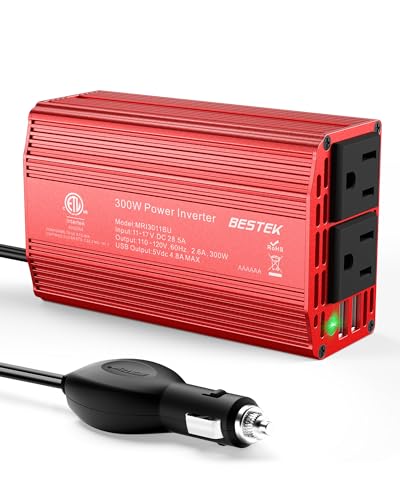
This red BESTEK model adds PD 30W USB-C and QC 18W USB-A charging with two AC outlets, in a 4.2 × 1.8 × 3.1-inch body. The manufacturer specifies 300W continuous output and 700W peak surge power. Its device examples include CPAP ventilators and laptops, but the wattage label alone does not establish compatibility with every model; check the device’s running and startup draw against the inverter’s limits.
Bottom line: Choose it for the compact dimensions and PD/QC charging, after checking device power needs.
How to choose a 300 watt power inverter
Choose by continuous wattage first, then account for startup demand and port needs. A motor or compressor can briefly draw more power when starting than it uses while running, so an inverter’s peak rating is not a substitute for its continuous rating. Add the wattage of devices intended to run at the same time and keep the total below the continuous limit. With an inverter labeled 300W continuous, a combined load above 300W is out of range even if a separate peak figure is higher. USB ports have their own output limits; do not treat USB charging capacity as extra AC wattage. For a device with a motor or compressor, check its nameplate draw before connecting it.
Vehicle outlet and inverter fit
Vehicle compatibility depends on both input voltage and the power available at the outlet. A 300W load at 12V draws at least 25 amps before inverter losses, which is far more than many accessory outlets are designed to supply. That means the full 300W rating may require a direct battery connection, if the inverter supports one; the car-plug models here should not be assumed to deliver their maximum from every vehicle socket. Verify the outlet’s fuse rating and the inverter’s connection instructions before use. Input ranges also differ: some products specify 11–17V, while not every product gives a voltage range.
Pure sine wave and modified output
Pure sine wave describes an AC waveform closer to household utility power, while modified sine wave output is a simpler stepped waveform. Some electronics and motor-driven equipment may run noisier, hotter, or not work properly on a modified waveform, so check the equipment maker’s requirements before connecting it. The input data explicitly calls two models pure sine wave, but does not identify the waveform for the others. For sensitive equipment, select a product explicitly identified as pure sine wave and stay within both its continuous and surge limits. A waveform label does not override the need to confirm the device’s startup wattage.
Safe use and heat management
Keep an inverter’s vents clear and use it on a firm, dry surface; cooling fans need unobstructed airflow to move heat away. High loads and warm vehicle interiors increase heat, so avoid covering the housing or placing it against fabric. Stop using the setup if a plug, socket, or cable becomes unusually hot, or if an overload protection feature trips repeatedly. A 300W inverter is for smaller loads, not high-draw appliances such as kettles or space heaters. Unplug the inverter when the engine is off if the vehicle battery must remain available for starting, since powering devices can discharge it.
Frequently Asked Questions
Can a 300 watt inverter run a laptop?
Usually, if the laptop’s power adapter draw stays below the inverter’s continuous output and its plug matches an AC outlet. Check the adapter label; add other devices running at the same time to the total load.
Can I run a CPAP from a 300W car inverter?
A 300W rating alone cannot establish CPAP compatibility. Check the CPAP’s input wattage, whether it uses a heated humidifier, and whether its maker requires pure sine wave AC; startup and humidifier demand can raise the load.
Will a 300 watt inverter drain my car battery?
Yes, a powered inverter draws energy from the vehicle battery, and a 300W AC load at 12V requires at least 25 amps before conversion losses. Avoid long use with the engine off if you need the battery for starting.
Why does a 300W inverter have a 700W peak rating?
Peak power is a short-duration allowance for startup surges; 300W continuous is the running-load ceiling. Do not plan to operate a device above the continuous rating based on the peak figure.
Can I plug a 300W inverter into any 12V outlet?
No, because many accessory sockets and their fuses cannot provide the current needed for the inverter’s full output. At 300W, a 12V load draws at least 25 amps before losses, so verify the outlet and inverter connection requirements first.