
Bluetooth Earbuds 3000 mAh: Cases and Playtime Compared

For Bluetooth earbuds with a 3000 mAh case, Fawfose Bluetooth Earbuds, 3000 mAh is the clearest match because its case capacity is specified alongside an LED battery display. Choose Wireless Bluetooth Earbuds, Graphene Driver, 3000 mAh if semi-in-ear fit and dual-mic call features matter more; choose another style if you want stated per-charge or total playtime.
A charging case stores energy for recharging the earbuds, so its milliamp-hour capacity is not the same as listening time.
We earn a commission if you buy through links on this page. As an Amazon Associate I earn from qualifying purchases. Products are compared on manufacturer specifications, not hands-on testing.
- Best overall: Fawfose Bluetooth Earbuds, 3000 mAh – Its 3000 mAh case capacity is paired with an LED battery display.
- Best for semi-in-ear fit: Wireless Bluetooth Earbuds, Graphene Driver, 3000 mAh – The product name and features identify a lightweight semi-in-ear design.
- Best for stated playtime: Tribit FlyBuds 3 – The maker claims up to 7 hours per charge and 110 hours with the case.
| Product | Best for | Case capacity | Playtime claim | Call features | Shop |
|---|---|---|---|---|---|
| Fawfose Bluetooth Earbuds, 3000 mAh | Battery display | 3000 mAh | — | CVC 8.0, DSP; single-ear calls | Check Price on Amazon |
| Wireless Bluetooth Earbuds, Graphene Driver, 3000 mAh | Semi-in-ear fit | 3000 mAh | 12 hours | Dual-mic ENC/CVC | Check Price on Amazon |
| Tribit FlyBuds 3 | Long playtime claim | — | 7 hours per charge; 110 hours with case | Built-in mic | Check Price on Amazon |
| MOZOTER S8 Wireless Earbuds | Bluetooth 5.3 | — | 60 hours | — | Check Price on Amazon |
Bluetooth Earbuds With 3000 mAh Cases
Compare the case capacity, stated listening time, and call features before choosing a fit for everyday use.
Fawfose Bluetooth Earbuds, 3000 mAh

The 3000 mAh charging case and LED battery display distinguish this pair from models whose case capacity is not given. The maker says CVC 8.0 and DSP noise-reduction technology help reduce background sound during calls, and either earbud can be used alone. IPX7 appears in the product name, but the features do not explain the rating’s conditions; avoid assuming it permits every kind of water exposure. This is a fit for buyers who want a visible case-battery readout and single-ear call flexibility, but not for anyone choosing by a listening-time figure.
Bottom line: Pick this if a 3000 mAh case and visible battery readout are your priorities.
Wireless Bluetooth Earbuds, Graphene Driver, 3000 mAh

The semi-in-ear design and 12-hour playtime claim set this 3000 mAh-case pair apart from the other exact match. The maker says its graphene diaphragm supports balanced bass and crisp vocals, while dual silicon microphones with ENC/CVC processing are intended to suppress background noise on calls. Buyers who prefer a semi-in-ear shape may favor it; those needing an explicit per-charge figure should verify that point before choosing.
Bottom line: Choose this if semi-in-ear construction and dual-mic call features fit your needs.
Tribit FlyBuds 3
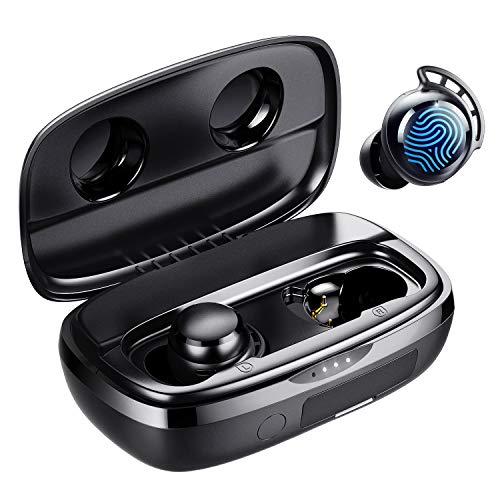
The playtime figures distinguish this pair from the 3000 mAh-case models: the maker claims up to 7 hours of music per charge and up to 110 hours with the charging case. The product name also gives an IPX8 rating and Bluetooth 5.3, while its features describe automatic reconnection after opening the case. It may suit buyers who prioritize the claimed total listening time, but not shoppers who require a case capacity.
Bottom line: Pick this for the maker’s playtime rather than a 3000 mAh case specification.
MOZOTER S8 Wireless Earbuds

Bluetooth 5.3 and a 10 mm speaker distinguish this pair among the models without a case capacity. The maker claims up to 60 hours of playtime, though the maker does not clarify whether that means one charge or total use with case recharges. It also describes automatic connection when the charging-case lid opens after initial pairing and compatibility with iOS and Android devices, computers, laptops, and tablets. It fits buyers comparing connectivity and speaker size, but not those requiring a confirmed 3000 mAh case.
Bottom line: Consider this if Bluetooth 5.3 and the claimed 60-hour playtime matter more than case capacity.
How to compare 3000 mAh earbud cases
A 3000 mAh case capacity describes stored charge, not a guaranteed number of listening hours. Earbud runtime also depends on each earbud’s battery, listening volume, call use, codec, and how many recharges the case can provide. Compare a maker’s per-charge figure separately from a total figure that includes case recharges; do not treat them as interchangeable. If daily use means 2 hours of listening, a claimed 12-hour per-charge runtime represents more than one such session, but actual use can change that. For a buying decision, prioritize a per-charge runtime when you need a predictable listening block, and case capacity when you specifically want a capacity figure to compare.
Earbud fit and listening needs
Fit style affects comfort and how well earbuds stay put, so choose by the shape you already find comfortable rather than by battery capacity alone. In-ear tips create a seal, while semi-in-ear designs sit at the ear opening; neither style fits every ear equally well. For workouts, check the exact water-resistance rating and its permitted exposure before relying on it: an IP rating does not mean every product is suitable for swimming or hot water. If you need awareness of nearby sound, a single-ear mode can be useful, but keep call and playback volume low enough to hear your surroundings. A 3000 mAh case cannot compensate for earbuds that do not fit securely.
Playtime claims and charging cases
Playtime figures are useful only when their basis is clear: per-charge runtime is different from a total that counts case recharges. Volume, calls, and other audio settings can affect actual listening time, so compare products under similar use rather than assuming a case-capacity number predicts hours. A charging case is a portable battery that stores energy and replenishes the earbuds between sessions. Its mAh figure is not a direct conversion to earbud hours because the case and earbuds have separate batteries and energy is lost during charging. Check the USB charging connection and charging instructions before relying on a case as your only charging option.
| Buyer priority | What to compare | Decision rule |
|---|---|---|
| Case capacity | mAh figure | Choose a model with capacity explicitly stated if that number is required. |
| Long listening sessions | Per-charge runtime | Match the per-charge claim to your longest usual session. |
| Calls | Microphone and noise-reduction features | Favor a model that identifies call-focused features if calls are frequent. |
Battery care and safe charging
Lithium-ion batteries age faster when left hot or kept at a full charge for long periods, so store earbuds and their case away from direct sun and hot vehicles. Use the charging cable and power source recommended by the maker, and stop charging if the case becomes unusually hot, swells, or smells odd. Keep charging contacts clean and dry; moisture or debris can interrupt charging or cause damage. A case capacity of 3000 mAh does not mean the case should be opened or its battery serviced by the owner. If a battery is damaged, discontinue use and follow local battery recycling guidance rather than placing it in household trash.
Frequently Asked Questions
Does a 3000 mAh case mean 3000 mAh per earbud?
No; the 3000 mAh figure refers to the charging case, not each earbud. Earbuds have their own batteries, and case capacity does not directly state how many hours they will play.
How many hours should Bluetooth earbuds last per charge?
Per-charge runtime differs by model and use, so compare each maker’s per-charge figure rather than total time including case recharges. Volume and call use can change actual listening time.
Can IPX7 earbuds be used while swimming?
Do not assume an IPX7-marked product is suitable for swimming. Water-resistance ratings have specific test conditions, and buyers should confirm permitted exposure for the exact model before submerging it.
What does a single-earbud call mode do?
Single-earbud use lets you take a call with one earbud while leaving the other ear uncovered. It can help you stay aware of nearby sounds, but it does not replace safe listening practices.
How should I store wireless earbuds in a car?
Keep earbuds and their case out of direct sun and away from a hot vehicle interior. Heat can accelerate lithium-ion battery aging, so store them in a cooler indoor place when not in use.