
Diesel Fuel Storage Additive: 3 STA-BIL Sizes Compared

For most diesel owners storing fuel, STA-BIL Diesel Stabilizer, 32 oz is the straightforward choice because its 32-ounce bottle treats up to 320 gallons. Choose a larger format if you store more fuel or want fewer containers; these products are stabilizers intended for storage, not winter anti-gel additives.
We earn a commission if you buy through links on this page. As an Amazon Associate I earn from qualifying purchases. Products are compared on manufacturer specifications, not hands-on testing.
- Best overall: STA-BIL Diesel Stabilizer, 32 oz – The 32-ounce bottle treats up to 320 gallons and suits modest storage amounts.
- Best for larger volumes: STA-BIL Diesel Stabilizer, 1 gal – The one-gallon jug treats up to 1,280 gallons.
- Best for multipacks: STA-BIL Diesel Stabilizer, 32 oz 4-Pack – The four-pack provides four 32-ounce bottles for separate storage batches.
| Product | Best for | Container size | Treats | Pack | Shop |
|---|---|---|---|---|---|
| STA-BIL Diesel Stabilizer, 32 oz | Smaller fuel stores | 32 oz | 320 gallons | 1 bottle | Check Price on Amazon |
| STA-BIL Diesel Stabilizer, 1 gal | Large fuel volumes | 128 oz | 1,280 gallons | 1 jug | Check Price on Amazon |
| STA-BIL Diesel Stabilizer, 32 oz 4-Pack | Separate fuel batches | 32 oz each | 320 gallons | 4 bottles | Check Price on Amazon |
Diesel fuel storage additive options
Compare the available STA-BIL stabilizer formats by container size, stated treatment capacity and package count.
STA-BIL Diesel Stabilizer, 32 oz
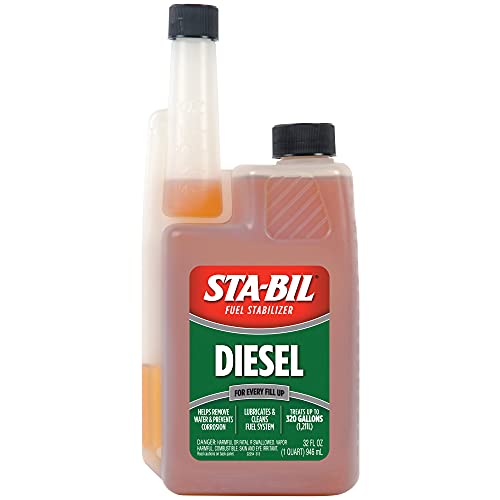
The single 32-ounce bottle is the most compact option among these storage stabilizers, with a treatment capacity of 320 gallons. STA-BIL says the formula helps keep diesel fuel fresh for up to 12 months and helps prevent sludge and water buildup. Its features also describe cleaning and lubricating fuel-system parts, including injectors and pumps. This format suits a seasonal reserve or several smaller batches. If your stored volume exceeds the capacity, choose a format sized for the total fuel instead of assuming one bottle will cover it.
Bottom line: Choose this for a modest reserve or several smaller fuel batches.
STA-BIL Diesel Stabilizer, 1 gal

The gallon jug has the largest single-container treatment capacity here: 128 ounces for up to 1,280 gallons of diesel. STA-BIL says it keeps fuel fresh for up to 12 months, helps prevent sludge and sediment, and cleans and lubricates the fuel system. The larger format fits equipment owners or operations that prepare substantial quantities for storage. It is less convenient if you treat only a small amount at a time, so match the amount used to the fuel volume and the product’s dosing directions rather than estimating.
Bottom line: Pick this when one large container suits the quantity you store.
STA-BIL Diesel Stabilizer, 32 oz 4-Pack

The four-pack supplies four separate 32-ounce bottles, unlike the single-bottle formats. The product name gives a treatment capacity of 320 gallons; use the label directions to determine the dose for each batch rather than assuming the package capacity is four times that figure. STA-BIL says the stabilizer helps keep diesel fresh and describes fuel-system cleaning and lubrication. Separate bottles can be useful when fuel is stored in multiple containers or at different times. The pack is a poor fit if you prefer one large jug or need a different treatment capacity.
Bottom line: Choose the multipack when separate bottles suit your storage setup.
How to choose a diesel fuel storage additive
Choose a stabilizer by the amount of fuel you will treat and how long it will sit. The available STA-BIL formats state capacities of up to 320 gallons for 32 ounces and up to 1,280 gallons for 128 ounces; match the dose to the actual volume using the container’s directions. For stored diesel, keep water and dirt out: use clean, fuel-approved containers with tight closures, and minimize repeated opening. Additive does not replace clean, dry storage. For a small reserve, a single bottle is easier to handle; for several separate batches, individual bottles can simplify keeping them apart. Do not substitute a cold-weather anti-gel product for a storage stabilizer unless its directions also address storage.
Preparing diesel for storage
Clean, dry, sealed storage matters because water and contamination can compromise diesel regardless of additive choice. Use containers approved for diesel, keep them closed, and store them in a cool, ventilated place away from ignition sources; never store fuel near flames, heaters or living areas. Leave enough room for expansion rather than filling a container to the brim, and label each container with its contents and date. Before filling, inspect the container for residue or water and use a clean transfer method. The storage period depends on fuel condition and the environment, so plan to rotate reserves rather than treating a stabilizer as a guarantee of indefinite freshness.
Storage stabilizer versus winter anti-gel additive
A storage stabilizer is selected for fuel kept between uses, while an anti-gel additive is intended to help diesel flow in cold conditions. Cold-weather additives generally work best when mixed before fuel reaches its cloud point, because wax crystals can restrict filters once fuel gets cold. Do not assume that a product marketed for winter use has the same storage purpose or dosing schedule as a stabilizer. Check the product label for its intended use and temperature limits, and use one product only as directed. The stabilizer options compared here are the storage-focused choices; winter protection requires a product specifically formulated and labeled for that job.
Common diesel storage mistakes
Water entry, dirty transfer equipment and poor container closure are avoidable storage problems. Keep fuel containers sealed and protected from rain and condensation, and avoid using a funnel or hose that has held water or another fluid. Do not measure additive by eye: a small dosing error matters more in a small can than in a large tank, so calculate from the treatment rate. Never mix additives casually or exceed their labeled dose, since more concentrate is not automatically more protective. Finally, store diesel only in approved containers and away from heat, sparks and open flames; fuel vapors and spills create fire hazards even when the fuel is intended for later use.
Frequently Asked Questions
How long can diesel fuel be stored with stabilizer?
STA-BIL says these stabilizers keep diesel fuel fresh for up to 12 months. Fuel condition, water exposure and storage environment still matter, so use clean sealed containers and rotate stored fuel.
Should I add diesel stabilizer before storing fuel?
Add the stabilizer when preparing fuel for storage and follow its labeled treatment rate. Measure the fuel volume first, since the 32-ounce format is stated to treat up to 320 gallons.
Can a diesel storage stabilizer prevent fuel gelling?
A storage stabilizer should not be assumed to prevent cold-weather gelling. Diesel anti-gel products address cold flow and generally need to be mixed before fuel reaches its cloud point.
What container should I use for stored diesel fuel?
Use a clean, closed container approved for diesel fuel, kept in a cool, ventilated area away from ignition sources. Leave expansion space and keep water and dirt out during filling.
How much diesel stabilizer should I use?
Dose according to the product’s directions and the volume of fuel being treated. The 32-ounce bottle is stated to treat up to 320 gallons, while the gallon jug is stated to treat up to 1,280 gallons.