
Best 2-Speed Fishing Reels Compared by Capacity

The PENN 16VS Squall suits most anglers who want a versatile 2-speed fishing reel, with 4.5:1 and 2.1:1 gears and capacity for 725 yards of 20-pound mono. Choose a larger-capacity model for heavier line or a dedicated jigging reel for its 30-pound maximum drag and listed line capacity.
Two-speed conventional reels let anglers shift from faster line pickup to a lower gear for added cranking leverage.
We earn a commission if you buy through links on this page. As an Amazon Associate I earn from qualifying purchases. Products are compared on manufacturer specifications, not hands-on testing.
- Best overall: PENN 16VS Squall Lever Drag – The 4.5:1/2.1:1 gear pair and 725-yard 20-pound mono capacity balance pickup and low-gear leverage.
- Best for jigging: Bigchub Slow Pitch 2-Speed Reel – A 30-pound maximum drag and 10-pound line capacity of 300 yards suit the slow-pitch jigging purpose.
- Best for heavy line: PENN 50VSW Squall Lever Drag – It holds 890 yards of 50-pound mono and offers a 1.5:1 low gear.
| Product | Best for | Gear ratio | Mono capacity | Frame material | Shop |
|---|---|---|---|---|---|
| PENN 16VS Squall Lever Drag | Versatile offshore | 4.5:1 / 2.1:1 | 725 yd / 20 lb | Graphite | Check Price on Amazon |
| PENN 30VSW Squall Lever Drag | Heavier mono | 4.2:1 / 1.8:1 | 1,035 yd / 30 lb | Graphite | Check Price on Amazon |
| PENN 50VSW Squall Lever Drag | Heavy mono | 2.9:1 / 1.5:1 | 890 yd / 50 lb | Graphite | Check Price on Amazon |
| Bigchub Slow Pitch 2-Speed Reel | Slow-pitch jigging | 4.5:1 / 2.1:1 | — | CNC-machined aluminum | Check Price on Amazon |
| Okuma Solterra SLX-20IIb | Corrosion-resistant frame | — | 480 yd / 30 lb | Corrosion-resistant frame | Check Price on Amazon |
2-Speed Fishing Reels Compared
Compare gear ratios, mono capacity and frame materials to match a reel to your line and fishing approach.
PENN 16VS Squall Lever Drag
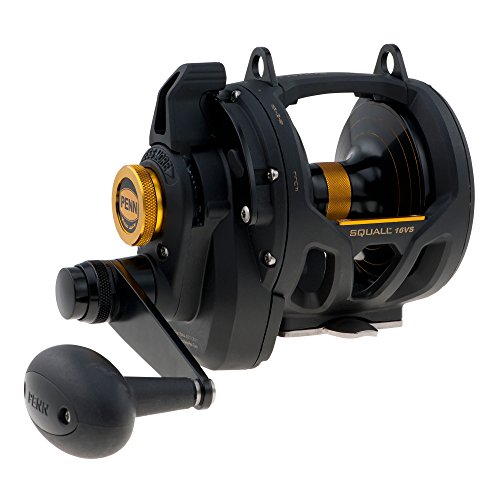
The PENN 16VS Squall has the fastest high gear among these PENN Squall options, paired with a 2.1:1 low gear. Its aluminum spool holds 725 yards of 20-pound mono or 865 yards of 65-pound braid, and the graphite frame and sideplates keep the reel at 2 pounds. PENN says its Quick Shift system changes gears and its Dura-Drag system reduces snags under heavy drag settings. This capacity suits a range of offshore setups, but anglers targeting larger fish with heavier mono may prefer the 30- or 50-size Squall.
Bottom line: Choose this for a 2-pound reel with a quick high gear and midrange line capacity.
PENN 30VSW Squall Lever Drag

The PENN 30VSW Squall steps up line capacity from the 16VS, holding 1,035 yards of 30-pound mono and 1,435 yards of 80-pound braid. Its 4.2:1 high and 1.8:1 low gears trade some pickup speed for a lower pulling gear than the 16VS. The reel uses a graphite frame and sideplates, an aluminum spool, and PENN’s Quick Shift and Dura-Drag systems. It suits heavier-line offshore use; the maker does not give its reel weight, so anglers with a strict weight limit should confirm that before choosing.
Bottom line: Choose this when 30-pound mono capacity matters more than the 16VS’s faster gear pair.
PENN 50VSW Squall Lever Drag

The PENN 50VSW Squall’s 1.5:1 low gear is the lowest among the PENN models here, while its high gear is slower than the 16VS and 30VSW. Its aluminum spool holds 890 yards of 50-pound mono or 1,835 yards of 100-pound braid, making it the heavy-line choice in this comparison. PENN describes the graphite frame and sideplates as lightweight for big-game saltwater fishing and includes Quick Shift 2-speed gearing. That heavier-line capacity comes with less line pickup per handle turn in high gear, so it is a poor match when speed is the priority.
Bottom line: Choose this for heavy mono and the leverage of a 1.5:1 low gear.
Bigchub Slow Pitch 2-Speed Reel

The Bigchub is the only reel in this group explicitly aimed at slow-pitch jigging, and it lists 14 kilograms (30 pounds) of maximum drag. Its dual ratios are 4.5:1 and 2.1:1, and its CNC-machined aluminum construction weighs 20.95 ounces. The maker gives capacity as 300 yards of 10-pound line. That light-line capacity is much lower than the PENN reels’ listed mono capacities, so this is a more focused option for jigging than for high-capacity trolling. The right-hand retrieve also makes it unsuitable for anglers who need a left-hand model.
Bottom line: Choose this for right-hand slow-pitch jigging with a 30-pound maximum drag.
Okuma Solterra SLX-20IIb

The Okuma Solterra SLX-20IIb stands apart with stainless steel main and pinion gears and a corrosion-resistant frame and side plates. Its capacity is 480 yards of 30-pound line, less than the 30VSW Squall’s 1,035 yards at the same line rating. Okuma specifies a Carbonite drag system with Cal’s universal drag grease, two thrust bearings, and a double-dog silent anti-reverse. Gear ratios are not included in the specifications, so anglers choosing specifically by high- and low-gear speed should confirm the ratios before deciding.
Bottom line: Choose this for stainless steel gearing and a corrosion-resistant frame.
How to choose a 2-speed fishing reel
Choose a two-speed reel by matching its line capacity and low gear to the fish and technique. The PENN models here range from 4.5:1 high gear on the 16VS to 2.9:1 on the 50VSW, while their low gears range from 2.1:1 to 1.5:1. A lower ratio turns the spool fewer times per handle turn, generally favoring leverage over line pickup. For a fast-moving fish or quick retrieve, prioritize the higher ratio; for sustained pressure on a heavy fish, prioritize the low gear and enough line capacity. Treat maximum drag and gear ratio as separate factors: a strong drag setting does not itself tell you how much line a spool holds or how much cranking leverage its low gear offers.
Match line capacity to your fishing line
Compare capacity only at the same line rating; spool capacity falls as line diameter increases. For example, the 30VSW holds 1,035 yards of 30-pound mono, while the 50VSW holds 890 yards of 50-pound mono, so those figures do not mean the 50VSW holds more line overall. Braid capacities are also different from mono capacities at the same reel size because braid is thinner. Use the exact line type and pound test you plan to spool when comparing numbers, and leave room for a leader or backing if your setup calls for one. The table below summarizes the mono figures alongside the reels’ listed gear pairs.
| Reel | Mono capacity | Gear ratio |
|---|---|---|
| 16VS Squall | 725 yd / 20 lb | 4.5:1 / 2.1:1 |
| 30VSW Squall | 1,035 yd / 30 lb | 4.2:1 / 1.8:1 |
| 50VSW Squall | 890 yd / 50 lb | 2.9:1 / 1.5:1 |
| Bigchub Slow Pitch | — | 4.5:1 / 2.1:1 |
| Solterra SLX-20IIb | 480 yd / 30 lb | — |
Understand two-speed gear ratios
A two-speed conventional reel has a high gear for faster line pickup and a low gear for slower, more forceful cranking. Ratios such as 4.5:1 and 2.1:1 describe spool turns per handle turn, but spool diameter and line fill also affect how much line each turn retrieves. A 1.5:1 low gear is the lowest among the reels here, while the 4.5:1 high gears are the highest listed. Use a low gear when you need controlled cranking under load, then shift up when retrieving line quickly. Do not compare ratios alone as a measure of maximum drag, capacity, or retrieve distance.
Lever-drag reel use and care
Lever-drag reels adjust drag with a lever, so anglers can move between preset settings rather than repeatedly turning a star drag. Set drag for the line, knot, rod, and target fish; a common starting range is about 20% to 30% of the line’s breaking strength, then adjust for knots and tackle limits. Saltwater reels should be rinsed gently with fresh water after use and dried before storage; avoid forcing water into bearings with a high-pressure stream. Inspect line for abrasion and replace damaged sections before fishing. Follow the reel maker’s service guidance for lubrication and drag maintenance, since drag materials and bearing designs differ among models.
Frequently Asked Questions
What does a 2-speed fishing reel do?
A 2-speed reel lets you switch between a faster high gear and a slower low gear. The lower ratio provides more cranking leverage, while the higher ratio retrieves line faster; actual line pickup also changes with spool diameter and line fill.
How much drag should a fishing reel have?
A common starting point is drag set to about 20% to 30% of the line’s breaking strength. Knots, rod limits, and the reel’s drag system can call for a lower setting, so do not set drag by line rating alone.
How often should I rinse a saltwater reel?
Rinse a saltwater reel gently with fresh water after each outing and dry it before storage. A high-pressure spray can force salt and water into bearings, so use a light flow instead.
Does a lower gear ratio mean more drag?
No; a lower ratio means the spool turns fewer times for each handle turn and generally gives more mechanical leverage. Drag capacity is a separate reel specification.
How much line should I put on a conventional reel?
Use the reel’s capacity for the exact line type and pound test as your guide, and avoid filling past the spool rim. Braid and mono capacities differ because their diameters differ, so match the rating before estimating yardage.