
ZAFRO Portable Air Conditioner: 4 Models Compared

For a larger room or higher cooling demand, the ZAFRO dual-hose inverter model ZAFRO Smart Inverter Dual-Hose 14,000 BTU stands out with 10,000 BTU SACC; the SACC rating is the useful figure for comparing portable AC capacity. Choose another model if you need a smaller unit or want a different balance of features.
Portable air conditioners cool indoor air and send hot air outside through a window exhaust hose, so window fit and ventilation matter as much as the unit’s BTU rating.
We earn a commission if you buy through links on this page. As an Amazon Associate I earn from qualifying purchases. Products are compared on manufacturer specifications, not hands-on testing.
- Best overall: ZAFRO Smart Inverter Dual-Hose 14,000 BTU – Its 10,000 BTU SACC rating is higher than the other models’ 8,000 BTU SACC ratings, and it uses a dual-hose design.
- Best for three modes: ZAFRO 12,000 BTU 3-in-1 Portable AC – It offers cooling, dehumidifying, and fan modes with four fan-speed settings.
- Best for dual-hose cooling: ZAFRO 12,000 BTU Dual-Hose Inverter AC – It combines an 8,000 BTU SACC rating with a dual-hose design.
- Best for smart controls: ZAFRO Smart Portable AC 12,010 BTU – Its feature claims include app control, voice control, and a 24-hour timer.
| Product | Best for | Cooling capacity (SACC) | Hose design | Noise claim | Shop |
|---|---|---|---|---|---|
| ZAFRO Smart Inverter Dual-Hose 14,000 BTU | Higher cooling capacity | 10,000 BTU | Dual hose | 42 dB | Check Price on Amazon |
| ZAFRO 12,000 BTU 3-in-1 Portable AC | Multiple operating modes | 8,000 BTU | — | 47 dB | Check Price on Amazon |
| ZAFRO 12,000 BTU Dual-Hose Inverter AC | Compact dual-hose setup | 8,000 BTU | Dual hose | 43 dB | Check Price on Amazon |
| ZAFRO Smart Portable AC 12,010 BTU | App and voice control | 8,000 BTU | — | — | Check Price on Amazon |
ZAFRO portable air conditioners
Compare these ZAFRO models by SACC capacity, hose setup, and the features that shape day-to-day use.
ZAFRO Smart Inverter Dual-Hose 14,000 BTU
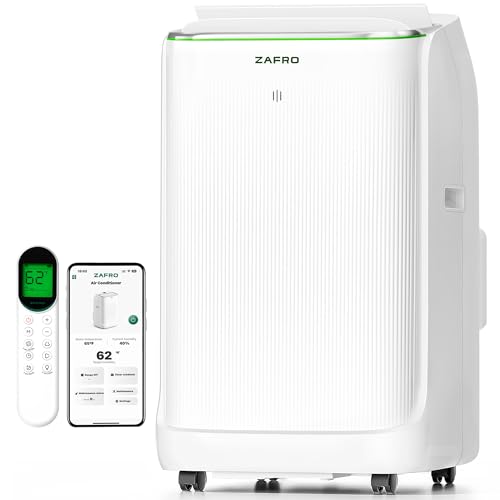
Among these four options, this model has the highest SACC capacity and is the only one with a 10,000 BTU SACC rating. It pairs inverter technology with a dual-hose system, and the maker claims 42 dB operation, app control, drainage-free cooling, and an extra mode that locks the temperature at 61°F. Its 27.2-inch height and 54-pound weight matter when positioning or moving it. The 42 dB claim may appeal to noise-conscious buyers, but the maker does not give a room-size recommendation; confirm that its capacity suits your space before choosing it.
Bottom line: Choose it when you want the highest SACC capacity here and a dual-hose setup.
ZAFRO 12,000 BTU 3-in-1 Portable AC

This model emphasizes operating flexibility: it offers cooling, dehumidifying, and fan modes, plus four fan-speed settings. Its 8,000 BTU SACC rating is lower than the 10,000 BTU option, and the maker claims 47 dB operation. Temperature control spans 61°F to 86°F, while app control, Alexa, Google Home, a remote, and a 24-hour timer add control options. At 23.23 inches tall, it is shorter than the two 27-inch models. The tradeoff is capacity, so buyers with a higher cooling demand should compare the SACC rating before deciding.
Bottom line: Choose it if you value three modes and broad smart-home control options.
ZAFRO 12,000 BTU Dual-Hose Inverter AC

This is the shorter dual-hose choice in the group, standing 27.2 inches tall and weighing 50 pounds. It has an 8,000 BTU SACC rating, inverter design, app and remote control, a 24-hour timer, and drainage-free cooling; the maker claims 43 dB operation. Compared with ZAFRO Smart Inverter Dual-Hose 14,000 BTU, it keeps the dual-hose arrangement but has a lower SACC rating. Compared with ZAFRO 12,000 BTU 3-in-1 Portable AC, its title specifies two hoses. Its capacity may be a limiting factor for rooms with greater cooling needs, so use SACC rather than the larger ASHRAE number when comparing capacity.
Bottom line: Choose it if you want a dual-hose inverter model in the 8,000 BTU SACC class.
ZAFRO Smart Portable AC 12,010 BTU

This model is distinguished by its combination of app and voice control, remote operation, and a 24-hour timer. Its name gives an 8,000 BTU SACC rating, placing it below the 10,000 BTU option in this comparison. Its dimensions are 27.07 inches high, 14.09 inches long, and 16.5 inches wide. Buyers choosing primarily for quiet operation should verify the operating noise before purchase.
Bottom line: Choose it if app and voice controls are more important than a confirmed noise figure.
How to compare portable AC cooling capacity
Use the SACC rating to compare portable air conditioners, because it accounts for heat brought in by the exhaust system; ASHRAE BTU is a separate capacity figure and is usually higher. Here, three models are in the 8,000 BTU SACC class and one is rated at 10,000 BTU SACC. As a rough sizing starting point, 20 BTU per square foot is commonly used for room AC capacity, but sun exposure, ceiling height, occupancy, and heat-producing appliances can change the need. With a room near the upper end of a unit’s suitable area or strong afternoon sun, favor more capacity rather than relying on the headline BTU figure. Verify the room-size recommendation before ordering.
Single-hose and dual-hose portable AC designs
A dual-hose portable AC uses one hose to draw outdoor air for condenser cooling and another to exhaust heated air; a single-hose unit draws some room air and sends it outside. That exhaust can create negative pressure, pulling warm outdoor air through gaps, while dual-hose designs reduce that effect. The ZAFRO models that specify two hoses are ZAFRO Smart Inverter Dual-Hose 14,000 BTU and ZAFRO 12,000 BTU Dual-Hose Inverter AC. A hose count alone does not establish cooling performance: compare SACC ratings and ensure the window kit can seal around the exhaust opening. Keep the hose as short and straight as practical, since bends and extra length can impede airflow and add heat to the room.
Window venting and room setup
Portable ACs need a path to exhaust heat outdoors, so check that the included window kit can fit the opening and that the hose reaches without being crushed. Standard window kits are often adjustable for common sliding or double-hung windows, but unusual windows may need a separate panel solution. Put the unit on a level, stable floor near a grounded outlet; avoid using an extension cord unless the manufacturer explicitly permits it. Close doors to the cooled room and limit gaps around the window panel to reduce warm-air infiltration. Keep air intake and outlet grilles clear, with several inches of open space around them where practical.
Portable AC drainage and upkeep
Portable ACs remove moisture from the air, and many models collect condensate in an internal reservoir or use evaporation to exhaust some moisture with the hot air. Drainage-free cooling claims do not mean every condition is maintenance-free: high humidity can increase condensate, and a drain connection may still be needed. Clean reusable filters about every two weeks during heavy use, or more often in dusty rooms, and let a washed filter dry fully before reinstalling it. Dust buildup restricts airflow and can reduce cooling. Before storage, drain any collected water and keep the unit upright; moving a recently tilted unit can risk compressor damage, so allow settling time as the manufacturer directs.
Frequently Asked Questions
What does SACC mean on a portable air conditioner?
SACC means Seasonally Adjusted Cooling Capacity, expressed in BTU per hour. It adjusts for heat effects from the portable unit’s exhaust setup, so it is more useful than the larger ASHRAE BTU figure when comparing portable AC capacity.
How much cooling capacity does a 300-square-foot room need?
A common starting estimate is about 6,000 BTU per hour for 300 square feet, using 20 BTU per square foot. Strong sun, high ceilings, or several people and heat-producing appliances can raise the required capacity.
Does a dual-hose portable AC cool better?
A dual-hose design generally avoids the room-air exhaust cycle of a single-hose design by drawing outdoor air for condenser cooling. That can reduce negative pressure and warm-air leakage, but compare SACC ratings because hose count alone does not establish capacity.
How often should a portable AC filter be cleaned?
Clean a reusable filter about every two weeks during frequent use. Dusty rooms may call for more frequent cleaning, and the filter should be completely dry before it goes back into the unit.
Can a portable air conditioner use an extension cord?
Use a properly grounded wall outlet and avoid extension cords unless the manufacturer expressly allows one. Portable ACs draw substantial power, and an undersized cord can overheat; keep the cord and outlet dry and undamaged.