
Red and Blue Light for Bike: 5 Options Compared

For a red and blue light for a bike, YUERWOVER Red + Blue Bike Tail Light, 2-Pack is the closest match because it comes as a two-pack with red and blue settings. Choose Dual-Color COB Bike Tail Light for a silicone-strap design and alternating-color mode; the other options are related rear or front-and-rear lights rather than clear dual-color matches.
Red rear lights help make a bicycle visible, but rules for blue lights on public roads vary by location. Check local regulations before using a blue or alternating red-blue mode while riding in traffic.
We earn a commission if you buy through links on this page. As an Amazon Associate I earn from qualifying purchases. Products are compared on manufacturer specifications, not hands-on testing.
- Best overall: YUERWOVER Red + Blue Bike Tail Light, 2-Pack – Two lights offer red and blue settings, plus three additional modes.
- Best for alternating colors: Dual-Color COB Bike Tail Light – Includes steady red, blue, red-blue alternating, and two flashing modes.
- Best for solar charging: Solar + Type-C Smart-Sensing Bike Light – Combines solar charging with Type-C charging and seven modes.
| Product | Best for | Color options | Modes | Charging | Shop |
|---|---|---|---|---|---|
| YUERWOVER Red + Blue Bike Tail Light, 2-Pack | Two-light setup | Red and blue | 5 | USB; 500 mAh | Check Price on Amazon |
| Dual-Color COB Bike Tail Light | Alternating colors | Red and blue | 5 | USB rechargeable | Check Price on Amazon |
| USB Rechargeable Rear Light, Red + Blue + White | White-light option | Red, blue, and white | 5 or 6 | USB rechargeable | Check Price on Amazon |
| Solar + Type-C Smart-Sensing Bike Light | Solar charging | — | 7 | Solar; Type-C | Check Price on Amazon |
| 6-LED Front and Rear Bike Light Set | Front-and-rear set | Red/blue taillight; black set | 5 | USB-C; 6,400 mAh | Check Price on Amazon |
Red and blue bike lights compared
Compare color choices, modes, and charging features to find a light that suits your ride and local rules.
YUERWOVER Red + Blue Bike Tail Light, 2-Pack

YUERWOVER Red + Blue Bike Tail Light, 2-Pack is the only option here that clearly comes as a two-pack with red and blue light settings. Each light measures 3.15 by 0.79 inches and has a COB lamp, a 240-degree viewing angle, and five modes. The maker says the 500 mAh battery takes 1 to 2 hours to charge and runs for 2 to 6 hours. This compact rear light set suits riders who want two lights or a spare. The product name calls it waterproof, but no rating is supplied, so don’t assume it is suitable for heavy rain.
Bottom line: Pick this set if you want two compact lights with red and blue modes.
Dual-Color COB Bike Tail Light
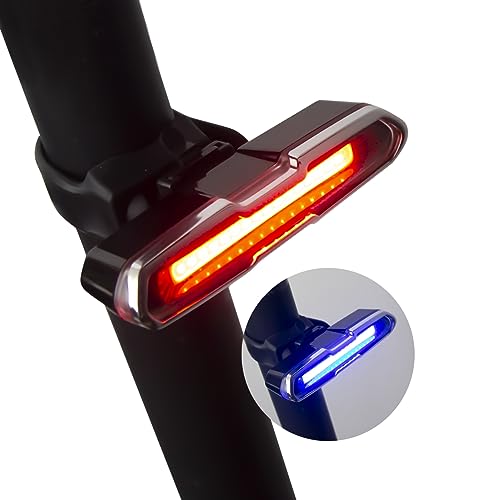
Dual-Color COB Bike Tail Light stands out for its red-blue alternating mode, alongside steady red, steady blue, and two flashing modes. Its COB LED design is described for front or rear use, and its silicone strap can attach to a bike, helmet, or backpack. That makes it a flexible choice for riders who want to move one light between mounting spots.
Bottom line: Choose this if a red-blue alternating mode and movable strap mount matter.
USB Rechargeable Rear Light, Red + Blue + White

USB Rechargeable Rear Light, Red + Blue + White differs from the direct dual-color options by including white along with red and blue. It has a PC shell and a fixing rubber band with an adjustable fit, which may suit riders who want a removable rear light. The maker describes five or six switchable modes, but the exact mode count and color combinations are unclear. Its dimensions are about 3.94 by 1.97 by 1.97 inches. Choose it only if the white-light option is useful and confirm the selected mode behavior before relying on it for a particular ride.
Bottom line: Consider this if you want a rear light that also offers white.
Solar + Type-C Smart-Sensing Bike Light

Solar + Type-C Smart-Sensing Bike Light is a related option rather than a clearly red-and-blue light: its features emphasize solar and Type-C charging, a light sensor, and seven modes. The sensor turns the light on in low light and off during daytime, according to the maker. Its 0.11-pound weight may appeal to riders who want a lightweight, detachable light. The color choices are not clear, so this is not the pick for someone who specifically needs red and blue output. Confirm the light color and mounting fit before choosing it for rear visibility.
Bottom line: Choose this for solar and Type-C charging, not for a confirmed dual-color output.
6-LED Front and Rear Bike Light Set

6-LED Front and Rear Bike Light Set is a front-and-rear lighting set rather than a focused dual-color tail light. Its name identifies a red/blue taillight, while the maker describes a six-LED headlight with five brightness and flash modes. The maker claims a 6,400 mAh battery, up to 5 hours at maximum brightness, and up to 11 hours at low brightness. The body is aluminum alloy and the name claims IPX6 water resistance. The headlight’s brightness may be more than a rider needs for daytime visibility, and the runtime applies to the headlight, not necessarily the taillight.
Bottom line: Pick this if you need a headlight and a red/blue rear light together.
How to choose a red and blue bike light
Choose by color modes, mounting position, and runtime rather than color alone. A rear-facing light is generally red; a front light is generally white, so a red-blue light is best assessed as a visibility signal, not as the only light needed for seeing the road. A steady mode is useful as a baseline, while flashing modes can draw attention; using a second steady rear light can preserve a clear rear-facing point of light. For rides longer than the runtime, carry a charged backup or choose a light whose runtime fits the whole ride. Blue-light rules vary by state and locality, so check local law before using blue on public roads.
Where to mount a bike tail light
Mount a rear light facing backward, with a clear line of sight and no bag, clothing, or seatpost accessory blocking it. A light mounted low near the seatpost can be obscured by a rear rack or pannier; check visibility from behind at rider height after mounting. Flexible silicone straps and rubber bands can fit different tube sizes, but a loose light can rotate or fall off on rough pavement. Secure the mount snugly and verify that the light remains aimed rearward after a short ride. A helmet or backpack mount can move with the rider, so do not assume it replaces a securely mounted rear light.
Red and blue bike light rules and safe use
Red is the conventional color for rear-facing bicycle lights, while blue lights can be restricted because they resemble emergency-vehicle signals. Rules differ across US jurisdictions, and color alone does not establish that a setup is legal. Before riding with blue or alternating red-blue modes on a public road, check the rules where you ride; use red-only mode if you cannot confirm blue is allowed. Keep a rear light aimed level or slightly downward rather than directly into other road users’ eyes. In darkness, a rear light helps others see the bicycle but does not illuminate hazards ahead, so pair it with a suitable forward-facing light.
USB and solar charging for bike lights
USB charging is useful when a light can be topped up between rides, while solar charging can supplement power during daylight but depends on exposure and conditions. A runtime is a planning limit, not a guarantee across every mode; high-output or flashing settings can change how long a light runs. Charge before a night ride and compare the claimed runtime with the entire time you expect to be out. If the route may exceed the runtime, bring a second charged light. Keep charging ports closed and dry before charging, and do not charge a wet light unless its manufacturer permits it.
Frequently Asked Questions
Are blue bike lights legal on public roads?
Blue bicycle lights may be restricted because blue is associated with emergency vehicles, and rules vary by state and locality. Check the rules where you ride before using blue or red-blue alternating modes in traffic.
Should a bicycle rear light be red or blue?
Red is the conventional color for a rear-facing bicycle light; blue is not a universal substitute. If local rules or visibility requirements are unclear, use a red rear light and check local law before adding blue.
How bright should a bike tail light be?
A rear light’s useful brightness depends on ambient light and whether the rider is on a lit street or a dark road. Avoid aiming a bright light directly into approaching road users’ eyes, and use a separate front light to see the road ahead.
How often should I charge a rechargeable bike light?
Charge the light before a ride that could approach its claimed runtime, and leave a margin for high-output settings and delays. For example, the two-pack light’s maker claims 2 to 6 hours, so a longer night ride calls for a charged backup.
Can I use a red and blue bike light in rain?
Rain suitability depends on the light’s water-resistance rating, not its color. One option claims IPX6, while the two-pack is called waterproof without a rating; verify the rating before exposing a light to heavy rain.