
Travel Smart by Conair Adapter Converter Combo Compared

The Travel Smart by Conair Adapter/Converter Combo is the closest match for U.S. appliances abroad because it offers adapter-only and voltage-converter modes for 110/120V devices. Choose a higher-capacity alternative if your appliance’s wattage exceeds the converter’s limit; choose a plug adapter instead when your device already supports the destination voltage.
We earn a commission if you buy through links on this page. As an Amazon Associate I earn from qualifying purchases. Products are compared on manufacturer specifications, not hands-on testing.
- Best overall: Conair Travel Smart Adapter/Converter Combo – Offers adapter-only and converter modes and converts 220/240V to 110/120V.
- Best for high-wattage appliances: Conair 6-Piece Voltage Converter Set – Its high setting supports up to 1,875 watts.
- Best for compact packing: DOACE 350W Converter Adapter Combo – The 350W converter is listed at 1.4 inches high and 0.54 pounds.
| Product | Best for | Voltage conversion | Converter capacity | Charging ports | Shop |
|---|---|---|---|---|---|
| Conair Travel Smart Adapter/Converter Combo | Everyday appliances | 220/240V to 110/120V | — | — | Check Price on Amazon |
| Conair 6-Piece Voltage Converter Set | High-wattage devices | 220V to 110V | Up to 1,875W high setting | — | Check Price on Amazon |
| DOACE 350W Converter Adapter Combo | Compact low-wattage use | 100–240V to 100–120V | 350W | 2 USB-A, 2 USB-C | Check Price on Amazon |
| TREVOLTY 2000W Converter Combo | High-draw appliances | 220–240V to 100–120V | Up to 1,200W converter | 2 USB-A, 2 USB-C | Check Price on Amazon |
| Conair Fast Charge Universal Travel Adapter | Dual-voltage devices | Adapter only | — | 1 USB-C, 4 USB-A | Check Price on Amazon |
Travel Smart Adapter Converter Combos
Compare these options by conversion mode, wattage limits and the devices you plan to use.
Conair Travel Smart Adapter/Converter Combo

The Travel Smart combo is the direct match for travelers carrying U.S. appliances that need 110/120V overseas. It can be used in adapter-only mode or converter mode, and its built-in surge protector is intended to help guard appliances against electrical spikes. Check the appliance’s input voltage and wattage against the converter’s limits before relying on it, especially for heating appliances or other high-draw devices.
Bottom line: Pick this if you want one Conair unit with adapter-only and converter modes.
Conair 6-Piece Voltage Converter Set

The Conair 6-Piece set separates small-device use from higher-wattage appliance use with two converter settings: 0–25 watts on low and 26–1,875 watts on high. Five labeled adapter plugs and a travel pouch make it a more complete set than the single combo unit, and the high setting is the distinguishing factor for appliances such as irons or hair dryers. Its low setting is limited to 25 watts, so it is not the choice for devices that exceed that figure. Confirm the appliance’s wattage before selecting a mode.
Bottom line: Pick this when an appliance’s wattage falls within its high-setting range.
DOACE 350W Converter Adapter Combo

The DOACE stands out for its specified 350-watt capacity and four charging ports in a compact 1.4-inch-high body. Its maker says the converter accepts 100–240V input and supplies 100–120V output, and describes use with devices including CPAP machines and some hair straighteners under 500 watts; the 350W capacity remains the relevant ceiling. It cannot power hair dryers, according to the maker. The 0.54-pound weight suits travelers prioritizing a smaller unit, but the capacity makes it unsuitable for appliances that draw more than 350 watts.
Bottom line: Pick this for a compact converter when your device stays within 350 watts.
TREVOLTY 2000W Converter Combo
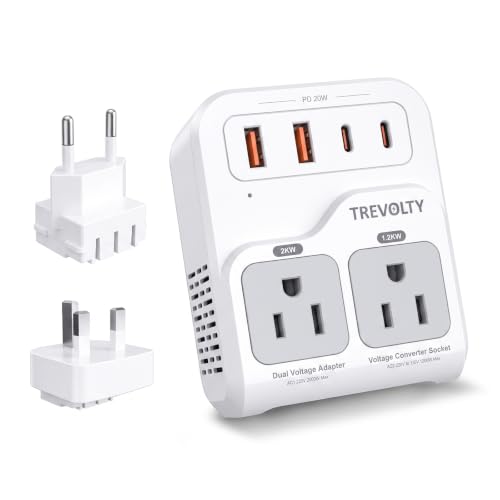
The TREVOLTY distinguishes its conversion and adapter outlets with different limits: its AC2 and AC3 converter outlets support up to 1,200 watts, while AC1 is an adapter outlet rated up to 2,000 watts for wide-voltage devices. The product describes support for appliances such as hair dryers, kettles, rice cookers and irons within the converter limit, and includes two USB-A and two USB-C ports. Touch-screen devices are incompatible, according to the maker. Do not treat the 2,000W adapter rating as the conversion capacity; check which outlet your appliance requires.
Bottom line: Pick this if your appliance needs conversion and draws no more than 1,200 watts.
Conair Fast Charge Universal Travel Adapter

The Conair Fast Charge is an adapter rather than a voltage converter, so it is for dual-voltage devices such as phones, laptops, tablets and cameras. Its maker says it works in more than 150 countries and provides North/South America, EU, UK and Australia pins. A 45-watt USB-C port and four USB-A ports allow charging multiple devices, with up to six devices connected at once. It does not convert 220/240V supply to 110/120V for single-voltage U.S. appliances, so it is the wrong choice for those appliances even though it offers broad plug coverage.
Bottom line: Pick this for dual-voltage electronics that need plug compatibility and USB charging.
How to choose a travel adapter converter combo
Choose by checking the appliance label for input voltage and watts before choosing a converter. A plug adapter changes the outlet shape; a voltage converter changes the electrical voltage, so a plug adapter alone will not make a 110/120V-only appliance suitable for a 220/240V supply. If the label says 100–240V, the device is dual-voltage and generally needs only the correct plug adapter. If it says only 110/120V, compare its wattage with the converter’s output limit. For an appliance above 350 watts, do not choose a 350W converter; select a converter with adequate capacity or leave that appliance at home.
Wattage and appliance fit
Wattage determines whether a converter can handle an appliance, and heating devices often draw more power than small electronics. Compare the appliance’s labeled watts with the converter outlet’s limit, not a separate adapter-only outlet rating. A converter rated for 1,200 watts cannot safely be treated as a 2,000-watt converter just because its adapter outlet carries that figure. For devices labeled in amps rather than watts, multiply volts by amps to estimate watts; for example, 120 volts × 5 amps equals 600 watts. Leave headroom rather than choosing a converter exactly at the appliance’s draw, particularly for devices with motors or heating elements.
Adapter versus converter types
Travel adapters, converters and combo units solve different problems: adapters change plug geometry, converters change voltage, and combo units may provide both functions. The quick guide below helps match the tool to the device label.
| Device label or need | Choose |
|---|---|
| 100–240V input | Plug adapter for destination |
| 110/120V only on 220/240V supply | Voltage converter within watt limit |
| Both kinds of device | Combo, with mode matched to each device |
Do not assume a USB port or surge protector also converts voltage at an AC socket. Confirm the outlet mode for each appliance before connecting it, and keep high-wattage appliances off adapter-only outlets.
Using converters safely overseas
Use a converter only when the appliance’s voltage and wattage match the converter’s input and output limits. Unplug an appliance before switching converter modes, and avoid connecting one converter to another or using a power strip to multiply its rated load. High-wattage appliances can overload a travel converter, so a hair dryer or iron needs particular scrutiny; choose a travel appliance designed for the destination voltage when its draw exceeds the converter’s rating. A surge protector helps with voltage spikes but does not increase a converter’s wattage capacity. Keep converters dry, uncovered and away from bedding or other heat-trapping materials during operation.
Frequently Asked Questions
Does a plug adapter convert voltage for U.S. devices?
No, a plug adapter changes plug shape but does not change voltage. Check the device label: a 100–240V input device is dual-voltage, while a 110/120V-only device needs an appropriate converter on a 220/240V supply.
How do I check whether a converter has enough wattage?
Compare the appliance’s wattage with the converter outlet’s rated limit and do not exceed it. If the appliance label gives amps instead, multiply volts by amps; a 120V, 5A device uses 600 watts.
Can I use a travel converter with a hair dryer?
Only if the converter supports the dryer’s wattage and the dryer is compatible with the converter’s output. Hair dryers are high-draw appliances, so check the label and compare its watts with the converter’s limit before connecting it.
What does dual voltage mean on a charger?
A dual-voltage charger accepts more than one supply voltage, commonly indicated by a range such as 100–240V on its input label. Such a charger typically needs a plug adapter for outlet shape, not a separate voltage converter.
Can I connect several devices to one travel converter?
Only if their combined load stays within the converter’s rated capacity and the outlets support the devices. Add the devices’ wattage together before connecting them; USB port counts do not raise the converter’s AC wattage limit.