
White Shoe Paint for Soles: 5 Options Compared

For white shoe paint for soles, Eagle Sneaker Whitener 2-Pack is the clearest match because its maker names rubber and includes built-in sponge applicators. Choose another option if you need a leather-specific paint or a more controlled marker tip; several products also cover uppers, not just soles.
We earn a commission if you buy through links on this page. As an Amazon Associate I earn from qualifying purchases. Products are compared on manufacturer specifications, not hands-on testing.
- Best overall: Eagle Sneaker Whitener 2-Pack – The maker names rubber among the compatible materials, and the 2-pack has built-in sponge applicators.
- Best for broad sole coverage: Wilkins Sneaker Whitener 2.53 fl oz – Its maker says the whitener works on foam and rubber and has a wide sponge applicator.
- Best for small touch-ups: White Shoe Polish Paint Pen, 2-Pack – The maker describes a precision tip for scuffs, scratches, edges and hard-to-reach areas.
| Product | Best for | Named sole materials | Application | Size | Shop |
|---|---|---|---|---|---|
| Eagle Sneaker Whitener 2-Pack | Rubber sole refresh | Rubber, foam | Built-in sponge tips | 2.5 oz | Check Price on Amazon |
| Wilkins Sneaker Whitener 2.53 fl oz | Broad sole coverage | Foam, rubber | Wide sponge applicator | 2.53 fl oz | Check Price on Amazon |
| Angelus Acrylic Leather Paint, White | Smooth leather work | Smooth leather | Paint bottle | 1 fl oz | Check Price on Amazon |
| Max White Shoe Polish, 75 ml | Multi-surface touch-ups | Leather, textiles | — | 75 ml | Check Price on Amazon |
| White Shoe Polish Paint Pen, 2-Pack | Precise edge touch-ups | Leather, rubber midsoles | Precision tip | 2-pack | Check Price on Amazon |
White Shoe Paint for Soles Compared
The key differences are the sole materials each maker names and how the paint or whitener is applied.
Eagle Sneaker Whitener 2-Pack
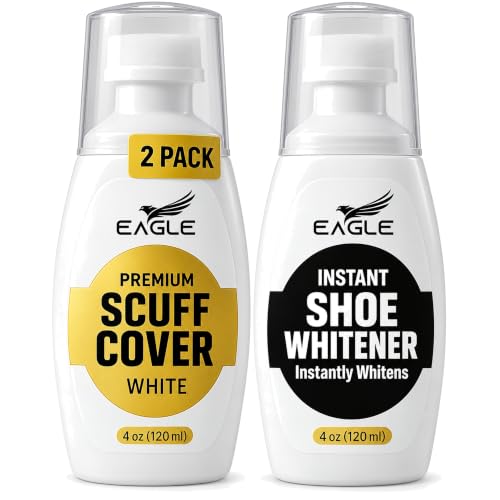
Eagle Sneaker Whitener 2-Pack is the only option here that combines explicit rubber compatibility with two separate formulas: one for general brightening and one for deeper scuff cover. The pair uses built-in sponge tips, and the maker says it covers leather, canvas, mesh, foam and rubber. That breadth suits buyers refreshing both midsoles and uppers. The trade-off is less precision than a pen-style applicator for tiny marks; the product is better suited to broader coverage than pinpoint corrections.
Bottom line: Choose this if you want rubber named as compatible and prefer sponge application.
Wilkins Sneaker Whitener 2.53 fl oz

Wilkins Sneaker Whitener 2.53 fl oz stands out for its wide, soft sponge applicator, which the maker says covers a large area quickly. Its named materials include canvas, leather, foam and rubber, making it a match for buyers treating both a sole section and the shoe upper. The maker also claims it covers yellowing and scuffs. The bottle requires shaking and pressing its sponge against a hard surface to start the flow, so buyers seeking a ready-to-use fine-point tool may prefer a marker instead.
Bottom line: Pick this for larger foam or rubber areas where a broad sponge is useful.
Angelus Acrylic Leather Paint, White

Angelus Acrylic Leather Paint, White differs from the sole-focused whiteners because its maker specifies smooth leather goods rather than rubber or foam. The 1 fl oz bottle contains a water-based acrylic paint, and the maker says the finish remains flexible and resists cracking, scratching and peeling. That makes it a closer fit for leather uppers or leather projects than for an unidentified sole compound. Buyers specifically treating a rubber outsole should select an option that names rubber compatibility instead.
Bottom line: Choose this for smooth leather, not an unspecified rubber sole.
Max White Shoe Polish, 75 ml

Max White Shoe Polish, 75 ml is positioned as a multi-surface white shoe polish, with the maker naming leather and textile products such as fabric shoes. Its 75 ml size gives it a larger stated volume than the 1 fl oz leather paint, but its surface range does not identify rubber or foam. It may suit someone refreshing textile uppers or leather accessories alongside footwear. For sole work, the missing material match matters: choose a whitener whose maker explicitly names the sole material you need to cover.
Bottom line: Pick this for leather or textile work rather than rubber soles.
White Shoe Polish Paint Pen, 2-Pack

White Shoe Polish Paint Pen, 2-Pack is the precision-focused option: its maker describes a controlled-flow tip for small scuffs, edges and hard-to-reach spots, and names rubber midsoles as a target. The matte-white finish is intended to blend with common white sneakers, leather uppers and rubber midsoles. This format fits localized corrections better than repainting a broad area.
Bottom line: Choose this for narrow midsole edges or small marks needing controlled application.
How to choose white paint for shoe soles
Choose by sole material first: rubber compatibility is the key deciding condition for rubber midsoles and outsoles. Product labels commonly separate leather paint from sole whitener because smooth leather and rubber have different surface behavior; a flexible leather paint is not automatically suitable for rubber. For broad yellowing, a sponge applicator covers more area, while a marker tip gives better control on narrow edges. Clean dirt and residue off the shoe before applying any coating, then work in thin layers rather than trying to hide a dark mark with one heavy coat. Allow each layer to dry before adding another, and test a small hidden area first because finish and adhesion can vary by sole compound.
Rubber, foam and leather sole compatibility
Rubber, foam and leather are distinct surfaces, so match the product’s named materials rather than assuming all white shoe paints work across them. Foam midsoles can have textured or porous surfaces that take coating differently from smooth rubber; leather coatings are formulated around a different substrate. The clearest decision rule is to choose a product explicitly naming the sole material, especially when working on rubber. This comparison table separates the named surface range from the applicator style so you can narrow the options before considering volume.
| Surface need | Look for | Application fit |
|---|---|---|
| Rubber midsole | Rubber named as compatible | Sponge for broad areas; tip for edges |
| Foam section | Foam named as compatible | Apply carefully on textured areas |
| Leather shoe | Leather paint or polish | Check whether smooth leather is specified |
Paint pen versus sponge applicator
A paint pen or precision tip is best for small scuffs, narrow borders and spots near seams, while a sponge head is more practical for larger, continuous areas. Neither format guarantees a particular finish: coverage depends on the shoe’s texture, the existing coating and how much pigment the surface absorbs. Work around the outsole edge with masking tape if you need a crisp boundary, and keep the shoe level while the coating dries to reduce smearing. Avoid applying a thick layer into tread grooves, where paint can pool and wear unevenly. For a full sole refresh, check the applicator instructions and make a small test patch before coating the visible area.
Preparing and applying sole whitener
Preparation determines whether a coating can bond: remove loose dirt and old residue, then let the surface dry fully before applying paint. Many shoe coatings are built up in thin coats, with drying time between layers; temperature, humidity and the sole’s texture affect the wait. Use ventilation and avoid skin or eye contact, even when a product is water-based, and keep coatings away from children and pets while wet. A white finish can look different against an aged upper, so compare the test patch in daylight before covering the full sole. Do not paint over damaged, crumbling foam as if a cosmetic coating were a structural repair.
Frequently Asked Questions
Can I use leather paint on rubber shoe soles?
Only use leather paint on rubber when its maker names rubber as compatible. Smooth leather and rubber have different surface properties, so a small test patch is prudent even when compatibility is stated.
How do I cover yellowing on white soles?
Use a whitener that names the sole’s material, then apply thin coats over a clean, dry surface. Textured foam and rubber can absorb or show coating differently, so test a discreet area first.
Are sponge applicators better than paint pens?
Sponge applicators cover broader areas, while precision tips suit small scuffs and narrow edges. For extensive sole coverage, prioritize surface compatibility and broad application over point accuracy.
How many coats should shoe sole paint need?
Apply thin layers and let each dry before adding another; the number depends on the underlying color and surface texture. A heavy first coat can pool in tread grooves and dry unevenly.
Can shoe whitener fix peeling or crumbling soles?
No cosmetic whitener should be treated as a structural repair for peeling or crumbling soles. Coatings are for surface appearance, and a failing sole needs assessment rather than paint.