
Best Reading Magnifiers for Seniors: 4 Options Compared

Rechargeable 5X Page Magnifier suits most readers because its 5X rectangular lens covers a 4.5-by-7.09-inch area, reducing how often you need to reposition it across a page. Choose a higher-power handheld lens for tiny labels or fine details, but expect to move it more often because stronger magnification narrows the view.
A handheld magnifier enlarges only the area directly under its lens, so the best choice depends on print size, lighting and how much of a page you want to see at once.
We earn a commission if you buy through links on this page. As an Amazon Associate I earn from qualifying purchases. Products are compared on manufacturer specifications, not hands-on testing.
- Best overall: Rechargeable 5X Page Magnifier – The 5X lens has a 4.5-by-7.09-inch viewing area and a rechargeable light.
- Best for adjustable lighting: JMH 18-LED Magnifier – Its 18 LEDs offer cold, warm and mixed light modes.
- Best for tiny print: Nazano 10X Glass Magnifier – The 10X glass lens and 12 LEDs target fine details and dim settings.
- Best for multiple locations: 12-Pack 10X Magnifiers – The set includes 12 handheld 10X magnifiers with 60 mm lenses.
| Product | Best for | Magnification | Lens size | Lighting | Shop |
|---|---|---|---|---|---|
| Rechargeable 5X Page Magnifier | Full-page reading | 5X | 114.3 × 180.1 mm | Built-in light; rechargeable | Check Price on Amazon |
| JMH 18-LED Magnifier | Light control | — | 105.8 × 204.9 mm | 18 LEDs; 3 modes; 3 AAA | Check Price on Amazon |
| Nazano 10X Glass Magnifier | Fine print | 10X | — | 12 LEDs | Check Price on Amazon |
| 12-Pack 10X Magnifiers | Shared use | 10X | 60 mm | No light mentioned | Check Price on Amazon |
Reading Magnifiers for Seniors
Match lens power and viewing area to the print you read most, then consider whether built-in light or multiple units will help.
Rechargeable 5X Page Magnifier

Rechargeable 5X Page Magnifier stands out for its wide rectangular viewing area, which suits lines and blocks of book or newspaper text better than a small round lens. The 5X magnifier measures 114.3 by 180.1 mm and weighs 3.8 ounces, with a built-in light and USB recharging. Its lightweight handle may be easier to hold for extended reading than a heavier glass lens. The broad area still requires you to keep the lens close to the page and move it as you read; readers who need very high power for tiny labels may prefer a 10X option.
Bottom line: Choose this for reading larger areas of text with a rechargeable light.
JMH 18-LED Magnifier
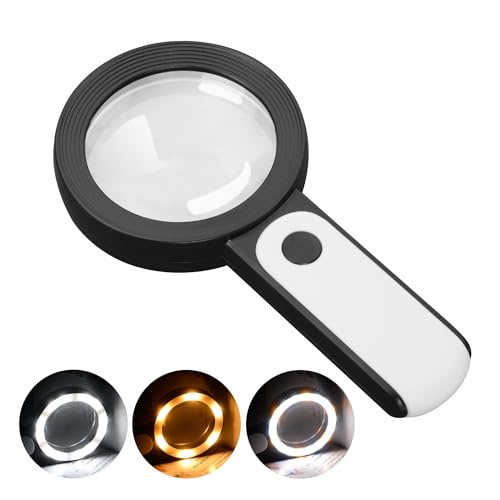
JMH 18-LED Magnifier separates itself with three light settings: cold, warm and mixed, provided by 18 LEDs. Its handheld body is about 105.8 by 204.9 mm, and it runs on three AAA batteries that are not included. That makes it a fit for readers who want to change the light color for different surroundings without choosing a rechargeable design. The magnification strength is not provided, so it is harder to match to a particular print size; confirm the power suits your reading before choosing it.
Bottom line: Choose this if switching among three LED light modes matters most.
Nazano 10X Glass Magnifier

Nazano 10X Glass Magnifier is the high-power choice here, with a double-layer optical glass lens rated at 10X and 12 built-in LEDs. That combination is aimed at reading very small print, such as labels or prescriptions, and examining close-up details. Ten-power magnification usually shows a smaller area at once than lower-power lenses, so it is less convenient for following a full page of text.
Bottom line: Choose this for fine print and close-up details rather than whole pages.
12-Pack 10X Magnifiers

12-Pack 10X Magnifiers differs from the single-unit options by supplying 12 handheld magnifiers, split between orange and green, each with 10X magnification and a 60 mm lens. The shatterproof glass lens and nonslip rubber handle are useful distinctions for shared settings or keeping a magnifier in several places. At 10X, these small lenses are better suited to labels and close details than scanning full pages, since the visible area is limited. Built-in lighting is not part of the feature set, so consider whether a separate reading light will be needed.
Bottom line: Choose this when several people or locations need their own small magnifier.
How to choose a reading magnifier
Start with the size of the print and the amount of text you want in view: higher power enlarges smaller details but narrows the visible area. Handheld magnifiers commonly range from about 2X to 10X; lower powers are generally easier for scanning lines, while 10X is more useful for tiny print or close details. A practical rule is to choose a broad lens at 5X or below for paragraphs, and reserve 10X for labels or brief passages. Check whether the lens shape gives enough width to follow a line without frequent repositioning. Built-in lighting can help in dim rooms, but it does not replace positioning the lens close to the page and keeping the text evenly lit.
Magnification and viewing area
A stronger handheld magnifier generally shows less of the page at once and requires closer positioning than a lower-power lens. Magnification labels are not a direct promise of a particular reading distance; lens design and the reader’s vision affect the useful working distance. This table maps common reading needs to a practical starting point, not a prescription.
| Reading need | Starting point | Trade-off |
|---|---|---|
| Paragraphs and book pages | Broad lens, about 2X–5X | Less enlargement than high power |
| Small labels or short print | About 5X–10X | Smaller view; more repositioning |
| Fine close-up details | About 10X | Limited area for continuous reading |
Lighted and unlit magnifiers
Even illumination reduces shadows across print, while adjustable light color can help readers choose a comfortable setting for a particular room. A built-in light is most useful when the page is dim or the lens casts a shadow; it does not increase the lens’s optical power. Battery-powered lights need replacement cells, while rechargeable designs need access to charging. For long reading sessions, aim a separate lamp at the page as well and avoid glare reflecting off glossy paper. If sensitivity to bright light is an issue, use the lowest comfortable setting and keep the light source angled away from the eyes.
Using a handheld magnifier comfortably
Hold the magnifier close to the page and adjust its distance from your eyes until the text comes into focus; moving the lens farther away can make the image blur. Keep the page flat and move the magnifier steadily along a line rather than repeatedly lifting it, especially with higher power. A wide rectangular lens can cover more text in one pass, while a compact round lens is easier to direct at a single word or label. For medication labels, confirm the wording under good light rather than relying on a quick glance. A sudden change in vision warrants prompt professional care, since a magnifier does not determine why vision changed.
Frequently Asked Questions
What magnification is best for reading books?
A broad lens around 2X to 5X is a practical starting point for book paragraphs because it keeps more text visible than a 10X lens. Choose the lowest power that makes the print readable, since stronger magnification often means more repositioning.
Is a 10X magnifier good for reading whole pages?
Usually not; a 10X handheld lens shows a relatively small area at a time, so it is better for labels, short text or close details. For whole-page reading, a larger lens at lower power is generally easier to move across lines.
Do lighted magnifiers work without room light?
Many built-in LED models can illuminate a page in dim conditions, but room light can still improve overall contrast and reduce shadows. Position the light so it falls evenly on the page and does not shine directly into your eyes.
How close should I hold a magnifying glass?
Keep the lens close to the page, then adjust its distance from your eyes until the print appears sharp. The comfortable working distance changes with lens design and vision, so move gradually rather than assuming stronger magnification lets you hold the lens farther away.
Can a magnifier replace an eye examination?
Sudden vision changes need prompt professional attention, and persistent difficulty reading merits an eye examination.