
Best Ruger 10/22 Picatinny Rails Compared by Fit

The Leapers UTG PRO is the best Ruger 10/22 Picatinny rail for most owners because its 4.67-inch, 11-slot design adds scope or dot placement while retaining a see-through view of the front bead sight.
Choose an extended rail instead if you need more forward optic placement; a 20 MOA mount is a distinct choice for a scope setup that needs that angle.
We earn a commission if you buy through links on this page. As an Amazon Associate I earn from qualifying purchases. Products are compared on manufacturer specifications, not hands-on testing.
- Best overall: Leapers UTG PRO 10/22 Rail – Its 4.67-inch, 11-slot rail has a see-through design for retaining use of the front bead sight.
| Product | Best for | Distinctive feature | Shop |
|---|---|---|---|
| Leapers UTG PRO 10/22 Rail | Bead sight clearance | See-through design | Check Price on Amazon |
| Bengor 10/22 11-Slot Rail | Lightweight accessory rail | T6-6061 aluminum | Check Price on Amazon |
| 11-Slot Red Dot Picatinny Rail | Lightweight red dot setup | Retains OEM sights | Check Price on Amazon |
Ruger 10/22 Picatinny Rails
Compare these mounts by length, slot count and sight or optic setup before choosing.
Leapers UTG PRO 10/22 Rail
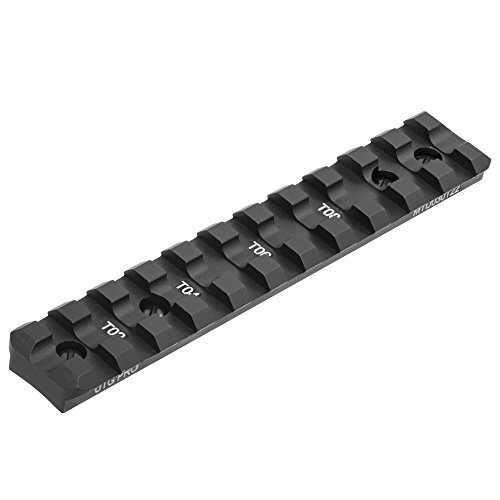
The Leapers UTG PRO is the only mount here with a see-through design called out for using the front bead sight. Its 4.67-inch aircraft-grade aluminum rail has 11 Picatinny slots, and its contoured bottom is made to fit the Ruger 10/22 pre-drilled and tapped receiver. The low-profile layout suits owners who want to place an optic while preserving a view of the front sight. Maker specifications describe a matte black hard-anodized finish and U.S. manufacture. Its 11 slots provide less fore-aft placement than a 13-slot extended rail, so buyers who need extra forward reach should compare the longer option.
Bottom line: Choose this if keeping use of the front bead sight matters alongside optic placement.
Bengor 10/22 11-Slot Rail
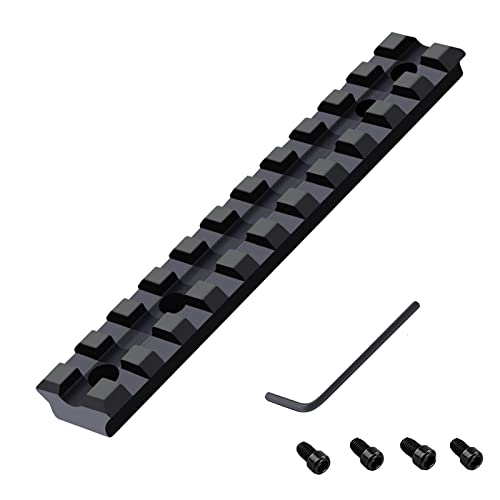
The Bengor mount pairs an 11-slot layout with a curved profile and U-shaped groove, features that set its design apart from the see-through Leapers rail. Its maker identifies T6-6061 aluminum, a matte black anodized finish and customized hex socket screws for factory mounting holes. It is intended for standard 21 mm Picatinny accessories, including optics and lights. The mount suits buyers who want an accessory rail with hex hardware and do not need an extended 13-slot layout. The length is not available in the specifications, so compare the mount’s footprint with the receiver and optic position you need before choosing it.
Bottom line: Pick this for its curved, grooved design and hex-screw attachment.
11-Slot Red Dot Picatinny Rail

Its specifications specify CNC-machined 6061-T6 aluminum, a matte black anodized finish, factory-hole hex screws and an included Allen wrench. The rail is intended for standard 21 mm Picatinny accessories, including red dots and scopes. It suits an owner seeking a lightweight red-dot mount while keeping the original sights available.
Bottom line: Choose this for a lightweight rail that retains OEM sights.
How to choose a Ruger 10/22 Picatinny rail
Choose by receiver fit first, then by optic position and sight clearance. Ruger 10/22 rails in this set use factory pre-drilled and tapped holes; mounts attach at those points rather than clamping around the barrel. A rail with more slots gives more positions along its length, but does not guarantee that every optic can sit at the desired eye relief. For a simple decision rule, choose the 5.5-inch rail if you need more forward adjustment than a 4.5-inch standard rail can provide. A see-through rail is the specific choice when retaining the front bead sight’s view matters.
| Need | Rail feature to prioritize |
|---|---|
| Use front bead sight | See-through design |
| More forward optic placement | Extended 13-slot rail |
| Angled scope base | 20 MOA mount |
Rail slots, length and optic placement
Rail length and slot count determine how much room an optic has to move, not the optic’s eye relief by themselves. Picatinny slots are crosswise attachment points; a longer rail can provide additional fore-aft positions when the optic and rings allow them. The Leapers mount is 4.67 inches with 11 slots. Before choosing, measure the optic’s ring or clamp footprint and the position needed for a clear sight picture; selecting by slot count alone can leave the optic too far forward or rearward.
When a 20 MOA rail makes sense
It is not a general upgrade for every red dot or short-range scope setup. The other rails emphasize standard positioning, sight clearance or added rail length rather than a specified angle. Choose based on the scope’s adjustment range and intended use, not on the angle alone.
Mounting and sight alignment
Use the receiver’s factory mounting holes and the mount’s hardware; damaged, mismatched screws can compromise alignment or strip receiver threads. Keep the rail centered and seat it evenly before tightening, using the mount maker’s torque guidance rather than guessing. Check that the optic’s clamp engages the rail slots fully and that the sight picture remains clear after mounting. A see-through channel can preserve a view of a front bead, but it does not guarantee that an optic and iron sights will share the same point of aim. Confirm alignment at a safe range, with the firearm unloaded during installation and handling pointed in a safe direction.
Frequently Asked Questions
Will a Ruger 10/22 Picatinny rail fit every 10/22?
These mounts are intended for Ruger 10/22 factory mounting holes, but fit depends on the receiver and mount pattern matching. Confirm the rifle has the pre-drilled and tapped holes before selecting a rail.
Does a see-through rail keep iron sights usable?
A see-through channel leaves a viewing path for the front bead sight, as on the Leapers rail. It does not ensure a mounted optic and iron sights are aligned to the same point of aim.
Can a red dot mount on a Picatinny rail?
A red dot with a Picatinny-compatible clamp can attach to a standard Picatinny rail. Check the optic’s interface before mounting; a rail slot count does not establish compatibility with every optic footprint.