
Dry Flex Resin Wood Repair: 4 Compounds Compared

For most decayed-wood repairs, Repair Care Dry Flex 4 is the better starting point because it suits cracks and gaps and can be painted after four hours. Choose Repair Care Dry Flex 16 A+B for large timber repairs or splicing; its 16-hour paint window and required dosing gun make it a different fit.
Dry Flex is an elastic repair compound intended to accommodate natural wood movement. The two PC-Woody options are alternatives, not Dry Flex products, and use two-part epoxy paste instead.
We earn a commission if you buy through links on this page. As an Amazon Associate I earn from qualifying purchases. Products are compared on manufacturer specifications, not hands-on testing.
- Best overall: Repair Care Dry Flex 4 – Designed for cracks and gaps, with same-day sanding and painting after four hours.
- Best for large timber: Repair Care Dry Flex 16 A+B – Intended for large repairs and splicing, with a 3:1 ratio applied using the specified dosing gun.
- Best for epoxy filling: PC Products PC-Woody 12 oz – Two-part paste fills missing or rotted wood and tolerates indoor or outdoor use.
| Product | Best for | Repair type | Paint time | Application | Shop |
|---|---|---|---|---|---|
| Repair Care Dry Flex 4 | Cracks and gaps | Cracks and gaps | 4 hours | Standard caulk gun | Check Price on Amazon |
| Repair Care Dry Flex 16 A+B | Large timber splices | Large repairs and splicing | 16 hours | EASYQ dosing gun, 3:1 | Check Price on Amazon |
| PC-Products PC-Woody and PC-Petrifier Kit | Rotted wood restoration | Harden rotted wood, then fill | — | Hardener, then two-part paste | Check Price on Amazon |
| PC Products PC-Woody 12 oz | Two-part epoxy filling | Replace missing or rotted wood | — | Equal-volume mix | Check Price on Amazon |
Dry Flex resin wood repair compounds and alternatives
Compare the repair scale, finish timing and application method before matching a compound to the damaged area.
Repair Care Dry Flex 4

For smaller cracks and gaps, this elastic compound is the most direct match among these options. The maker says it suits interior and exterior use on wood, masonry, plaster, concrete and metal, and can be sanded and painted the same day; paint is possible after four hours. It can be applied with a standard caulk gun and shaped without slumping, sagging or shrinking, according to the maker.
Choose it when the repair needs to accommodate natural movement. The four-hour paint time is a minimum, so a tight schedule should allow for actual site conditions and the product instructions.
Bottom line: Pick this for cracks and gaps when a four-hour paint window suits the job.
Repair Care Dry Flex 16 A+B

For large timber repairs and splicing, this Dry Flex option is built for a different scale than Repair Care Dry Flex 4. The maker says it forms an elastic, permanent repair for decayed or damaged material and is suitable for interior and exterior work. Painting is possible after 16 hours.
Application requires the Repair Care EASYQ High Performance Double Dosing Gun to deliver the 3:1 ratio. That equipment requirement matters for anyone planning a one-off repair without the specified gun. The product text also mentions masonry, plaster, concrete and metal, so its use is not limited to timber.
Bottom line: Choose this for large timber repairs or splicing if you have the required dosing gun.
PC-Products PC-Woody and PC-Petrifier Kit
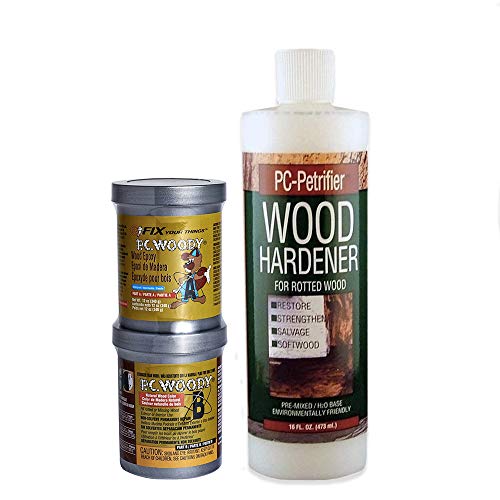
This kit pairs a liquid wood hardener with a separate two-part epoxy paste, rather than using a Dry Flex elastic compound. The maker says PC-Petrifier penetrates rotted wood to harden and strengthen it, after which PC-Woody fills missing or damaged areas such as window sills, frames, beams, columns and trim.
PC-Woody can be painted, stained and machined after it fully cures. The staged approach suits repairs where weakened wood needs hardening before filling. It is less direct for someone specifically seeking a single elastic compound for cracks or a large splice.
Bottom line: Pick this when a rotted area needs hardening before the missing wood is filled.
PC Products PC-Woody 12 oz
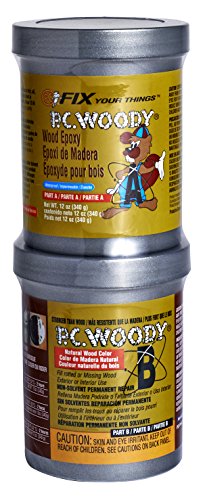
This two-part tan epoxy paste fills missing or rotted wood, making it a straightforward alternative to an elastic Dry Flex compound. The maker says it resists dry rot, UV light, fresh water and salt water, and can be used indoors or outdoors. Its application temperature range is 35°F to 115°F, with a service temperature range of -20°F to 200°F.
Part A and Part B must be mixed in equal volumes on a flat surface with a stiff putty knife; the maker warns not to mix it with gloves. The mixing step makes it less convenient than a standard-caulk-gun compound.
Bottom line: Choose this for a two-part epoxy fill when its temperature ranges suit the work.
How to choose a wood repair compound
Match the compound to the repair scale and application setup first. Dry Flex 4 targets cracks and gaps, while Dry Flex 16 is intended for large timber repairs and splicing; PC-Woody is a two-part paste for replacing missing or rotted wood. A caulk gun is enough for Dry Flex 4, but Dry Flex 16 requires the specified EASYQ gun to apply its 3:1 ratio. PC-Woody instead needs equal-volume mixing with a stiff putty knife. Use this guide to narrow the type before checking cure and paint timing.
| Need | Type to consider | Key condition |
|---|---|---|
| Cracks and gaps | Elastic repair compound | Standard caulk gun |
| Large timber splice | Dry Flex 16 | EASYQ dosing gun, 3:1 |
| Fill missing or rotted wood | PC-Woody epoxy paste | Equal-volume mixing |
Where the repair depends on exact proportions, do not substitute an improvised mixing method or dispensing tool.
Dry Flex paint timing and application
Dry Flex 4 has a four-hour paint window, while Dry Flex 16 has a 16-hour paint window. Those are useful planning figures, but they do not make the products interchangeable: Dry Flex 4 is aimed at gaps and cracks, while Dry Flex 16 is intended for larger repairs and splicing. Both are described by the maker as elastic and suitable for interior and exterior applications.
For a repair that must be shaped, the maker says these compounds have molding qualities and will not slump, sag or shrink. Confirm the repair is ready for finishing under the product’s instructions rather than treating the paint time as a guarantee for every site condition.
Mixing two-part epoxy wood paste
Two-part epoxy paste requires its components to be combined at the specified ratio before it can fill a repair. PC-Woody calls for equal volumes of Parts A and B mixed on a flat surface with a stiff putty knife. Its maker specifically warns not to attempt mixing with gloves, so plan the work surface and follow the product’s handling directions.
Temperature also matters: PC-Woody’s application range is 35°F to 115°F, while its service range is -20°F to 200°F. Those refer to different stages, so do not use the service range as an application target. With the kit, the hardener is used first on rotted wood and the paste follows to replace the damaged area.
Wood repair mistakes to avoid
The common mistake is choosing by finish time alone instead of matching the compound to the repair and its required equipment. Dry Flex 16 needs a dedicated dosing gun and 3:1 ratio; a standard caulk gun is the option for Dry Flex 4. PC-Woody needs an equal-volume mix, not either Dry Flex dispensing setup.
Another mistake is treating paste and elastic compound as the same repair type. Dry Flex is intended to accommodate natural movement, while PC-Woody is a paste used to replace missing or rotted wood. Keep application and service temperatures distinct, and do not start a PC-Woody job outside its 35°F to 115°F application range.
Frequently Asked Questions
How long before Dry Flex 4 can be painted?
The maker says Dry Flex 4 can be painted after four hours and sanded and painted the same day. Allow for the job conditions and follow the compound’s directions before finishing.
What gun does Dry Flex 16 require?
Dry Flex 16 must be used with the Repair Care EASYQ High Performance Double Dosing Gun to obtain its 3:1 ratio. A standard caulk gun is not the specified application setup for this product.
What is the PC-Woody mixing ratio?
PC-Woody Parts A and B are mixed in equal volumes on a flat surface with a stiff putty knife. Its maker warns not to attempt mixing with gloves.
What temperature range suits PC-Woody application?
PC-Woody’s application temperature range is 35°F to 115°F. Its separate service temperature range is -20°F to 200°F, which applies after application rather than during mixing and placement.
Can wood repair compound be used on masonry?
The maker says both Dry Flex 4 and Dry Flex 16 can also be used on masonry, plaster, concrete and metal. Check the intended repair and product directions before applying a compound to a nonwood surface.