
Camco Self-Leveling Sealant: Types Compared by Fit

For a horizontal RV roof, choose Dicor 501LSW-1 Self-Leveling Lap Sealant: its self-leveling formula is made for horizontal surfaces and works with EPDM, TPO, and PVC membranes. The named Camco product is a non-leveling trim sealant, so choose it for slanted edges, vents, or windows instead of a roof field that needs to level.
We earn a commission if you buy through links on this page. As an Amazon Associate I earn from qualifying purchases. Products are compared on manufacturer specifications, not hands-on testing.
- Best overall: Dicor 501LSW-1 Self-Leveling Lap Sealant – Self-leveling application and stated compatibility with EPDM, TPO, and PVC membranes make it the closest fit for roof work.
- Best for multi-pack supply: PAULINN Self-Leveling Lap Sealant, 4-Pack – Four tubes are included, with self-leveling application for flat RV roof surfaces.
| Product | Best for | Application | Pack size | Shop |
|---|---|---|---|---|
| Dicor 501LSW-1 Self-Leveling Lap Sealant | Horizontal RV roofs | Self-leveling; horizontal | 10.3 oz | Check Price on Amazon |
| PAULINN Self-Leveling Lap Sealant, 4-Pack | Four-tube repairs | Self-leveling; flat surfaces | 4-pack | Check Price on Amazon |
| BEBOBLY Self-Leveling RV Roof Sealant, 4-Pack | Flexible roof seams | Self-leveling; horizontal | 4-pack | Check Price on Amazon |
Camco Self-Leveling Sealant Alternatives
These options differ in whether they level on horizontal surfaces or hold shape on slanted trim.
Dicor 501LSW-1 Self-Leveling Lap Sealant

For a horizontal RV roof needing a self-leveling lap sealant, this option has the clearest membrane compatibility: EPDM, TPO, and PVC. It also adheres to aluminum, mortar, wood, vinyl, galvanized metal, fiberglass, and concrete, so it suits repairs that cross roof materials. The 10.3-ounce white tube is intended for maintenance and repair, with a sun-ray stabilized formula that the maker says avoids spoiling and discoloration.
This is a single tube, not a multi-pack, and its self-leveling behavior makes it a poor choice for sloped trim where sealant must stay in place.
Bottom line: Choose this for a horizontal roof seam when membrane compatibility matters.
PAULINN Self-Leveling Lap Sealant, 4-Pack
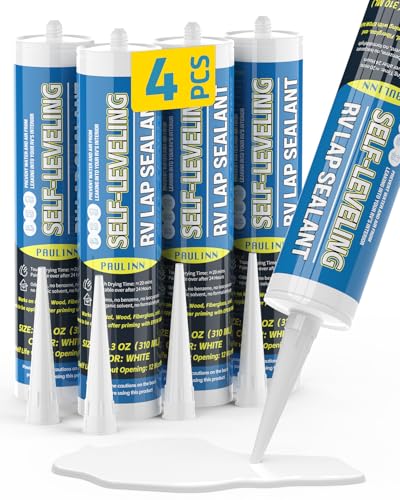
Four tubes distinguish this option from the single-tube alternative, making it suited to roof repairs that need more material on hand. PAULINN describes the formula as self-leveling for flat RV surfaces and suitable for a standard glass caulk gun. The maker says it can be applied in dry or wet conditions from 40°F to 104°F, and that it sets within 30 minutes before full cure.
The product is a less precise match when the repair requires verified membrane compatibility: the specifications do not identify compatible roof materials. Confirm compatibility with your roof membrane before applying it.
Bottom line: Choose this when a four-tube pack and flat-surface application fit the repair.
BEBOBLY Self-Leveling RV Roof Sealant, 4-Pack

BEBOBLY’s maker gives a specific flexibility figure—over 300% elongation—setting it apart for buyers prioritizing a flexible seal at a roof gap. The four-pack is designed for RV roofs, and its self-leveling formula is intended for horizontal applications; the maker says it levels within 30 seconds. It is positioned for camper, trailer, and motorhome roof repair.
Verify the roof material before use.
Bottom line: Choose this for horizontal roof gaps when the flexibility figure is the deciding factor.
Choosing sealant by roof surface
Horizontal roof seams call for self-leveling lap sealant, while angled edges and fixtures call for a non-sag formula. Self-leveling material flows outward after application; non-sag sealant resists gravity and holds a bead shape. A practical rule is to use a self-leveling formula only on a nearly horizontal surface where a spreading bead will stay within the repair area. For sloped roof edges, vent pipes, and window trim, use non-sag sealant to reduce run-off. Match the formula to the membrane: RV roofs commonly use EPDM or TPO, while PVC and fiberglass also occur. Check the roof material and existing sealant type before layering a new product, since compatibility—not just color—determines adhesion.
Matching an RV roof membrane
EPDM and TPO are common flexible RV roofing membranes, and sealant compatibility is material-specific. The product comparison identifies one formula as compatible with EPDM, TPO, and PVC; Camco’s trim formula is stated to bond with EPDM and TPO as well as fiberglass, wood, aluminum, steel, and masonry. Those claims should not be treated as universal across every sealant. Before sealing, remove loose or failed material and clean the surface using the membrane maker’s approved method; solvent choices can damage some roofing. Do not assume a sealant made for a roof membrane is suitable for every roof coating or old bead. If the roof material is unknown, identify it before applying a new sealant.
Applying lap sealant without a mess
Lap sealant is commonly dispensed from a caulk gun around roof penetrations, seams, and trim. Plan the bead so a self-leveling product cannot flow into a drain, onto a sidewall, or beyond the repair zone; use masking only if the sealant maker permits it. Apply to a clean, dry surface unless the specific formula permits wet application, since moisture can interfere with adhesion. The PAULINN maker gives a 40°F to 104°F application range and says wet application is allowed; do not transfer that range to other formulas. Avoid bridging dirt, loose caulk, or standing water, which can leave a weak bond. Use eye and skin protection and keep uncured sealant away from contact.
Sealant maintenance and leak checks
Inspect RV roof seams and penetrations at least twice a year and after severe weather or roof work; early cracking or separation is easier to address than water damage inside a wall. Look closely around vents, skylights, antennas, and edge trim, where cuts through a roof membrane create vulnerable points. A new surface bead does not fix a loose fitting or a wet, damaged roof substrate. Find the leak path and remove failed material before resealing rather than covering a gap with a thicker layer. Stop using the RV if water is reaching electrical equipment or interior wiring, and have the affected area assessed before restoring power. Keep a record of the sealant type used so later maintenance can preserve material compatibility.
Frequently Asked Questions
Can self-leveling sealant go on a sloped RV roof?
Self-leveling sealant is intended for horizontal surfaces because it flows to flatten the bead. On a sloped edge or vertical fixture, use a non-sag formula; even a slight pitch can let a flowing bead migrate outside the seam.
How often should RV roof seams be inspected?
Inspect roof seams at least twice a year and after severe storms or roof repairs. Pay particular attention to penetrations such as vents and skylights, where a small break can admit water.
Can I apply new RV sealant over old sealant?
A new bead should not cover loose, cracked, or dirty old material. Remove failed sealant and clean the bonding surface using the roof membrane maker’s approved method, because unsuitable cleaners can damage flexible roofing.
What temperature is suitable for applying RV sealant?
Application temperatures are formula-specific rather than universal. One option here gives a 40°F to 104°F range, so check the chosen product’s permitted range instead of applying that figure to every sealant.