
Kevlar Sleeves for Biting: 5 Options Compared

For Kevlar sleeves that address biting, BSV Kevlar Arm Sleeves, 18-Inch is the closest match because its maker describes it as bite resistant and it is 18 inches long. Choose Triple-Layer Kevlar Sleeves, ANSI A5 if you want a triple-layer Kevlar option with an ANSI A5 cut rating; choose another style if your priority is a short, washable arm guard rather than Kevlar.
Protective sleeves are barriers for the forearm, not a guarantee against punctures or other injuries. Match the coverage and fit to the task, and use appropriate animal-handling controls.
We earn a commission if you buy through links on this page. As an Amazon Associate I earn from qualifying purchases. Products are compared on manufacturer specifications, not hands-on testing.
- Best overall: BSV Kevlar Arm Sleeves, 18-Inch – The maker identifies bite resistance, and the sleeve is 18 inches long.
- Best for rated cut protection: Triple-Layer Kevlar Sleeves, ANSI A5 – It combines triple-layer Kevlar construction with an ANSI A5 cut rating.
- Best for multiple pairs: Five-Pair HPPE Arm Guards, 21 cm – The package includes five pairs in five colors, with an unstretched length of about 8.27 inches.
| Product | Best for | Material | Length or fit | Package | Shop |
|---|---|---|---|---|---|
| BSV Kevlar Arm Sleeves, 18-Inch | Longer arm coverage | 100% Kevlar | 18 in. | 1 pair | Check Price on Amazon |
| Triple-Layer Kevlar Sleeves, ANSI A5 | Cut-rated Kevlar | 100% Kevlar | Stretches up to 9 in. | Sleeves; count not given | Check Price on Amazon |
| Five-Pair HPPE Arm Guards, 21 cm | Several washable pairs | HPPE, nylon, spandex | 8.27 in. unstretched | 5 pairs | Check Price on Amazon |
| G & F 58123-6 Kevlar Sleeves, 18-Inch | Six sleeve pack | 100% Kevlar | 18 in. | 6 sleeves | Check Price on Amazon |
| OriStout HPPE Farmers Sleeves | Adjustable thumb-hole fit | HPPE | One size; long | 1 pair | Check Price on Amazon |
Kevlar Sleeves for Biting and Related Arm Protection
Compare the fiber, coverage and package format before choosing a sleeve for bite-related work.
BSV Kevlar Arm Sleeves, 18-Inch

At 18 inches, these sleeves offer the longest coverage among the options with a specified length. The fabric is 100% Kevlar, and the finger opening accommodates glove use. The maker describes the sleeves as bite, cut, scratch, stab and heat resistant. This pair suits workers who want a longer sleeve with an opening to help coordinate with gloves. The limitation is that the maker provides no bite-test measure, so do not treat the bite-resistant claim as proof against puncture or crushing injuries.
Bottom line: Choose this pair when 18-inch coverage and a finger opening suit your work.
Triple-Layer Kevlar Sleeves, ANSI A5

The distinguishing feature here is an ANSI A5 cut rating paired with triple-layer Kevlar construction. The maker also gives an abrasion rating of 4 and says the sleeves stretch up to 9 inches; that stretch figure is not a fixed sleeve length. The design is aimed at work ranging from gardening to welding and pet grooming, with a half-finger style. This option suits buyers prioritizing a named cut rating. Its limitation for bite-related work is that the maker provides no bite-resistance rating or test result.
Bottom line: Choose this style when its cut rating and flexible fit matter more than a bite rating.
Five-Pair HPPE Arm Guards, 21 cm
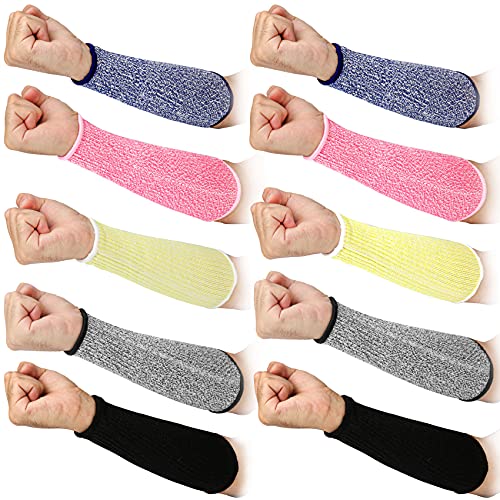
This set stands out for quantity: five pairs in five colors, with an unstretched length of about 8.27 inches. The sleeves use HPPE, nylon and spandex, and the maker claims Level 5 cut resistance, breathability, elasticity and washability. That shorter, elastic guard may suit a buyer who wants several pairs for rotating use. It is not a Kevlar sleeve, and a cut-resistance level does not by itself describe resistance to animal bites or punctures. Check that the short unstretched coverage is enough for the area you need protected.
Bottom line: Choose this set for multiple short HPPE guards, not when Kevlar is required.
G & F 58123-6 Kevlar Sleeves, 18-Inch

Unlike the single-pair styles, this product is sold as six sleeves, each 18 inches long, with a thumb slot. The maker identifies DuPont Kevlar fiber and double-ply construction, and says the sleeve will not melt, ignite or conduct electricity. It is a practical fit when a multi-sleeve supply and compatibility with cut-resistant gloves are the deciding factors. The maker’s claims focus on cuts, burns, heat and electrical resistance rather than biting, so this should not be selected as a bite-protection product based on its Kevlar content alone.
Bottom line: Choose this pack for six long Kevlar sleeves with thumb slots, not for a bite claim.
OriStout HPPE Farmers Sleeves

The adjustable hook-and-loop closure sets this pair apart from pull-on sleeves, while thumb holes help hold the fabric in place. The product uses HPPE rather than Kevlar and is intended for tasks including gardening, welding, kitchen work, pet grooming and arm protection for biting. The maker claims protection from cuts, scratches, heat and flames. This style may suit someone who wants adjustable positioning and a long, one-size fit. The fields give no sleeve length or bite-test measure; verify the coverage needed for your task before relying on it as a barrier.
Bottom line: Choose this pair when adjustable closure matters and Kevlar is not essential.
How to choose sleeves for bite-related work
Choose by coverage, fit and the specific hazard claim, not by fiber name alone. A bite can involve puncture and crushing forces, while a cut rating addresses a different hazard; a cut level should not be read as a bite rating. Compare whether the maker explicitly claims bite resistance, whether the sleeve stays in place during movement, and whether gloves can overlap or work with its opening. For tasks involving animals, use sleeves as one layer of protection alongside handling practices that reduce the chance of a bite. No sleeve claim here establishes protection from every animal, bite force or injury type.
How much forearm coverage do you need
Coverage is a fit decision: an 18-inch sleeve reaches farther than a sleeve measuring about 8.27 inches unstretched, but arm length and stretch affect where either one ends. Measure from the point on the hand or wrist where the sleeve should begin to the upper-arm point that needs coverage. If the needed distance exceeds the sleeve’s length, choose a longer measured option rather than assuming stretch will add dependable coverage. The 9-inch figure for Triple-Layer Kevlar Sleeves, ANSI A5 describes how far the fabric stretches, not the sleeve’s length. Check that the top edge remains in place and that glove overlap does not expose skin during the work motion.
Kevlar, HPPE and cut ratings are different factors
Fiber, construction and hazard rating describe separate attributes. Kevlar is the fiber in BSV Kevlar Arm Sleeves, 18-Inch, Triple-Layer Kevlar Sleeves, ANSI A5 and G & F 58123-6 Kevlar Sleeves, 18-Inch, while Five-Pair HPPE Arm Guards, 21 cm and OriStout HPPE Farmers Sleeves use HPPE blends; the product claims do not make those fibers interchangeable for every hazard. Triple-Layer Kevlar Sleeves, ANSI A5 supplies an ANSI A5 cut rating, and Five-Pair HPPE Arm Guards, 21 cm claims Level 5 cutting resistance, but neither figure should be treated as a bite rating. Double-ply construction is specified for G & F 58123-6 Kevlar Sleeves, 18-Inch, while Triple-Layer Kevlar Sleeves, ANSI A5 describes three layers. This comparison helps distinguish the construction and cut claims; it cannot establish performance in a bite scenario without a relevant bite test.
| Need | Relevant choice | Trade-off |
|---|---|---|
| Explicit maker bite claim with long coverage | BSV Kevlar Arm Sleeves, 18-Inch | Claim has no bite-test figure |
| Named cut rating with Kevlar | Triple-Layer Kevlar Sleeves, ANSI A5 | No stated bite rating |
| Multiple short pairs | Five-Pair HPPE Arm Guards, 21 cm | Not Kevlar |
| Six long sleeves with thumb slots | G & F 58123-6 Kevlar Sleeves, 18-Inch | No stated bite claim |
Fit and use limits for protective sleeves
A sleeve should cover the intended area without sliding, bunching or restricting the hand and elbow. Try the fit with the gloves and work movements you plan to use; a finger or thumb opening can change the amount of skin left exposed. If the task involves a person or animal capable of biting, do not rely on fabric alone: keep distance where possible and use appropriate restraints or handling procedures. Stop using a sleeve that is torn, has a pulled seam or no longer stays in place, because gaps and damaged areas reduce the barrier coverage. Confirm the needed coverage before choosing an option without a precise sleeve length.
Frequently Asked Questions
Does Kevlar make a sleeve bite proof?
No; Kevlar fiber alone does not establish bite-proof protection. Bite injuries can include puncture and crushing forces, so look for a claim specific to the intended hazard and do not treat a cut rating as equivalent.
Is ANSI A5 a bite-resistance rating?
No, ANSI A5 is a cut-resistance designation, not a bite rating. The A5 claim for Triple-Layer Kevlar Sleeves, ANSI A5 does not establish how the sleeve performs against punctures or crushing.
How should a protective sleeve overlap gloves?
Aim for continuous coverage at the wrist while moving through the task’s full range of motion. Try the actual glove and sleeve combination, since finger and thumb openings can leave different areas exposed.
Can cut-resistant sleeves prevent animal bites?
A cut-resistant claim does not guarantee prevention of an animal bite. Bite risk depends on the animal and circumstances, so use handling controls and do not rely on a cut level as a bite-test result.
How do I choose sleeve length for my arm?
Measure from the wrist or hand position where coverage should start to the upper-arm point that needs protection. Select a sleeve whose length reaches that distance; an unstretched 8.27-inch sleeve and an 18-inch sleeve provide substantially different coverage.