
16 Band V7 Radar Detector Options Compared by Features

The KF Premium Car Radar 16 Band V7 is the closest match for drivers who want the named detector type plus GPS speed and location awareness. Choose another option if you need a better-described display or camera-alert features, or if you prefer a different detector model.
We earn a commission if you buy through links on this page. As an Amazon Associate I earn from qualifying purchases. Products are compared on manufacturer specifications, not hands-on testing.
- Best overall: KF Premium Car Radar 16 Band V7 – Matches the 16-band V7 search and includes GPS speed and location awareness with voice alerts.
- Best for range claims: V7 Car 16 Band GPS Detector – Claims detection of stable or mobile radar monitors 250–2,500 meters ahead.
- Best for camera alerts: Full-Band 360° Car Radar Detector – Includes built-in GPS, mute memory, and red-light and speed-camera alerts.
| Product | Best for | Band support | GPS | Laser detection | Shop |
|---|---|---|---|---|---|
| KF Premium Car Radar 16 Band V7 | GPS awareness | 16 bands | Yes | 360° | Check Price on Amazon |
| V7 Car 16 Band GPS Detector | Long-range claims | 16 bands | Yes | 360° | Check Price on Amazon |
| Full-Band 360° Car Radar Detector | City driving modes | X/K/Ka/Ku plus others | — | 360° | Check Price on Amazon |
| Uniden R3 | Camera alerts | — | Yes | Yes | Check Price on Amazon |
16 Band V7 Radar Detectors and Alternatives
Compare the closest V7 matches with related detectors by signal support, GPS features and laser detection.
KF Premium Car Radar 16 Band V7

The KF Premium Car Radar 16 Band V7 pairs 16-band radar detection with GPS speed and location awareness. The maker says GPS helps make alerts relevant to location and reduce false alerts; the detector also has voice alerts and 360-degree laser detection. It suits drivers looking for the V7 type with location features. The voice-alert behavior is not established here, so buyers who need particular spoken warnings should confirm that capability before choosing it.
Bottom line: Choose this if GPS awareness matters alongside the 16-band V7 format.
V7 Car 16 Band GPS Detector
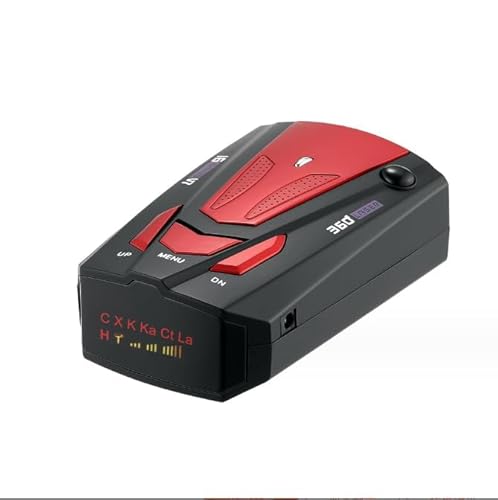
The V7 Car 16 Band stands apart with a maker claim of detecting stable or mobile radar monitors 250–2,500 meters ahead, plus super-heterodyne circuitry. It also has pop-mode detection, voice alerts, relative-speed auto-mute, and 360-degree laser detection. Its red finish and 5.5 × 3.5 × 2.5-inch dimensions may matter for dashboard placement. Detection range is a maker claim, not a guarantee; radar type, terrain, and installation can affect whether a warning arrives in time.
Bottom line: Choose this if you want the range claim and a red unit.
Full-Band 360° Car Radar Detector

The Full-Band 360° detector differs from the V7 models by naming X, K, Ka, and Ku signal support and adding city and highway modes. It also has DSP noise reduction, voice alerts, and memory function; the maker says processing helps reduce interference such as automatic door sensors. At 4.5 × 3.5 × 1.5 inches, it has the lowest height among these units. The 16-band count is not established for this model, so it is a related alternative rather than a direct V7 match.
Bottom line: Choose this if city/highway modes and named signal bands matter more than the V7 label.
Uniden R3

The Uniden R3 stands apart for route-based alerts: built-in GPS can remember and mute common false alerts, and it includes red-light and speed-camera alerts. It also has voice alerts, a multicolor OLED display, and database and firmware updates. Its 4.5-inch length and 1.25-inch height offer a size reference for placement. A 16-band count is not established for this model, so choose it for GPS and camera functions rather than a V7 specification.
Bottom line: Choose this if GPS mute memory and camera alerts are your priority.
How radar detector bands differ
Radar bands identify radio-frequency ranges, not a promise that a detector will catch every enforcement device. Common police radar bands include X near 10.525 GHz, K near 24.15 GHz and Ka across roughly 33.4–36 GHz; detector coverage and regional enforcement practices differ. A product claiming 16 bands may count other signals or subdivisions, so compare the named frequencies when that information is available. More band labels do not by themselves establish better range or earlier alerts. For a practical choice, prioritize named radar support and usable filtering over a high band count alone.
Laser is different: lidar uses a narrow infrared beam rather than the broad radar signal patterns many detectors can encounter ahead of time. A 360-degree laser sensor means the device can sense laser from multiple directions; it does not guarantee advance notice before a vehicle is measured. Treat every warning as a prompt to drive within posted limits, not as a substitute for attention.
Choose a detector by the alerts you need
Choose by the feature that changes your daily drive: named band support for radar alerts, GPS for location-aware functions, or camera database alerts for fixed red-light and speed-camera locations. GPS can also support location memory, but those are distinct functions; a GPS mention alone does not establish camera alerts or false-alert muting. The V7 options emphasize 16-band detection, while the Uniden R3 specifically names camera alerts and mute memory.
Use this decision rule: if you need red-light or speed-camera warnings, select a model whose features explicitly name both rather than assuming GPS includes them. If you mainly drive in town, look for explicit city mode or false-alert filtering; automatic doors and vehicle electronics can trigger unwanted alerts. A detector’s alert capability does not change speed limits or make high-speed driving safe.
| Need | Feature to prioritize | Why it matters |
|---|---|---|
| Radar warnings | Named signal bands | Shows which signal families are supported |
| Route-based camera alerts | GPS and camera database | Location capability alone is not a camera alert |
| Fewer repeat alerts | GPS mute memory | Can remember common false-alert locations |
Mounting and legal limits for radar detectors
Mounting position affects both visibility and sensor exposure: keep a detector with a forward-facing radar antenna unobstructed by metalized glass, wipers or bulky objects. A clear windshield area with a view through the glass is generally preferable, but windshield-mounting rules vary by state, so check the law where the vehicle is registered and driven. Never place equipment where it blocks the driver’s view or interferes with airbags.
Radar detector legality is not uniform across the United States. Virginia and Washington, D.C., prohibit radar detector use in most private vehicles, and federal law restricts use in commercial motor vehicles. Rules can also differ by vehicle type and location, so verify local requirements before installing or operating a detector. Detector-detector immunity claims do not make use lawful where detectors are prohibited.
What laser detection can and cannot do
Laser detection is not equivalent to long-range radar warning because lidar targets a small area and can measure speed quickly. A sensor may alert only after a beam reaches the vehicle, potentially after the speed reading has been taken. A 360-degree claim describes directional sensing, not guaranteed warning distance or protection.
Use laser and radar alerts as situational cues, not permission to speed or rely on the device to prevent a citation. Keep attention on traffic and posted signs; do not adjust a detector while moving. If a warning appears, respond calmly and lawfully rather than making sudden maneuvers. A detector’s GPS functions may reduce repeat nuisance alerts, but they cannot establish that a road is free of enforcement.
Frequently Asked Questions
Do radar detectors work against laser speed guns?
A detector with laser sensing can alert when it receives a lidar beam, but lidar’s narrow beam may reach a vehicle only when its speed is being measured. A 360-degree sensor describes coverage direction, not guaranteed advance warning.
What does 16-band mean on a radar detector?
A 16-band label counts signal ranges or subdivisions that a device claims to detect; it does not automatically mean 16 police-radar frequencies. Common radar families include X near 10.525 GHz, K near 24.15 GHz and Ka around 33.4–36 GHz.
Does GPS on a radar detector include camera alerts?
No, GPS by itself does not establish that a detector has a red-light or speed-camera database. Look for camera alerts to be explicitly named as a feature, as they are on the Uniden R3.
Are radar detectors legal in every US state?
No, restrictions vary by location and vehicle: Virginia and Washington, D.C., prohibit use in most private vehicles, while federal rules prohibit them in commercial motor vehicles. Verify the applicable rules before installation or use.
Where should I mount a radar detector?
Use a position with an unobstructed view through the windshield and keep the device clear of the driver’s sightline and airbag zones. State windshield-mounting restrictions vary, so check the rules where the vehicle is driven.