
Zovenchi Ultrasonic Animal Repellent: Alternatives Compared

The Zovenchi ultrasonic animal repellent is not among these options, so the closest match for most yards is Solar Motion-Sensor Repellent, 2-Pack, a solar outdoor repellent that pairs motion detection with ultrasonic sound and flashing lights. Choose ASPECTEK Yard Sentinel, 2-Pack instead if you need a plug-in unit with adjustable sound and a coverage area, or select by pack size if you need more than one device.
We earn a commission if you buy through links on this page. As an Amazon Associate I earn from qualifying purchases. Products are compared on manufacturer specifications, not hands-on testing.
- Best overall: Solar Motion-Sensor Repellent, 2-Pack – Combines a PIR motion sensor, ultrasonic sound, LED strobe lights and a two-device pack.
- Best for stated coverage: ASPECTEK Yard Sentinel, 2-Pack – Uses an AC adapter and extension cord, with coverage listed up to 5,000 square feet.
- Best for adjustable modes: Solar Repellent with Five Modes – Offers five operating modes, including an audible alarm with strobe lights.
| Product | Best for | Power / connection | Modes or frequency | Pack size | Shop |
|---|---|---|---|---|---|
| Solar Motion-Sensor Repellent, 2-Pack | Two-point yard coverage | Solar | Ultrasonic + strobe | 2 devices | Check Price on Amazon |
| Solar Repellent with Five Modes | Mode selection | Solar | 5 modes | 1 device | Check Price on Amazon |
| Solar Motion-Sensor Repellent, 2-Pack, 150° | Wide-angle detection | Solar | Ultrasonic + strobe | 2 devices | Check Price on Amazon |
| ASPECTEK Yard Sentinel, 2-Pack | Plug-in coverage | AC adapter + extension cord | 15–18 kHz; 3 modes | 2 devices | Check Price on Amazon |
Ultrasonic animal repellents
Compare these outdoor animal deterrents by power source, operating options and quantity in the pack.
Solar Motion-Sensor Repellent, 2-Pack
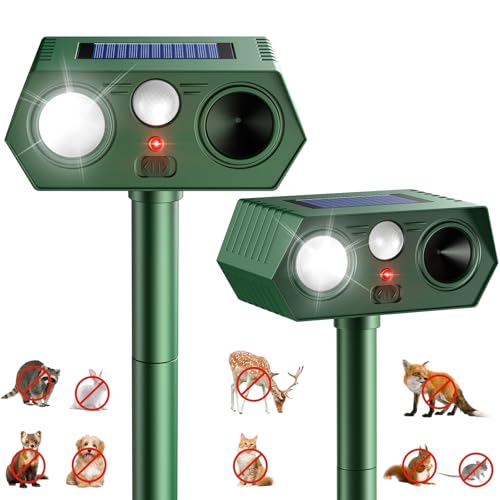
This solar two-pack is the only option here that pairs a PIR motion sensor with a two-device quantity. The sensor activates ultrasonic sound and bright LED strobe lights when it detects movement, and the target animals include deer, squirrels, cats, dogs, snakes, moles, gophers, chipmunks, skunks, raccoons and rabbits. It suits buyers who want to place deterrents at separate approaches to a yard. The dimensions are each 1 inch, so confirm the physical size before choosing if placement space is tight.
Bottom line: Choose this if you want two solar motion-triggered units for separate yard areas.
Solar Repellent with Five Modes

Five selectable modes distinguish this solar repellent from the simpler motion-triggered options. Modes 1, 2, 3 and 5 emit different ultrasonic frequencies, while Mode 4 combines an audible alarm and strobe lights; the manufacturer recommends trying settings consistently for 10 to 15 days. It is a fit for buyers who want to adjust the response to animals visiting their yard. The maker says it is IP65 waterproof, but gives no detection range, so it may be less useful when you need a known trigger distance.
Bottom line: Pick this if you want five settings and can allow time to compare them.
Solar Motion-Sensor Repellent, 2-Pack, 150°
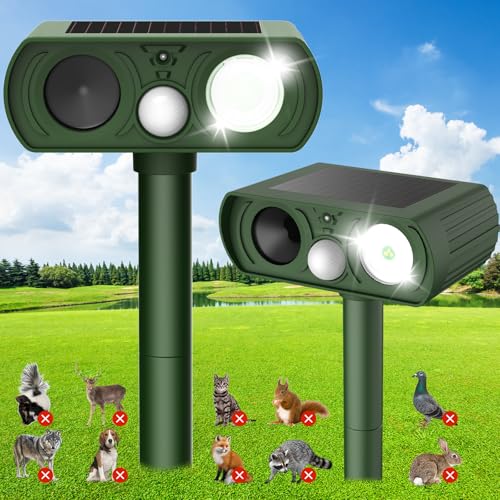
A 150-degree infrared detection angle and 25-to-30-foot detection range set this solar two-pack apart. Motion triggers ultrasonic sound and flashing LED strobe lights, with deer, cats, dogs, squirrels, rabbits and raccoons among the target animals. Those measurements can help when deciding whether a unit can face a particular approach to the yard. The maker does not identify operating modes, so this is less suitable for buyers who need selectable settings or an audible-alarm option.
Bottom line: Choose this if its 25-to-30-foot detection range fits your yard approach.
ASPECTEK Yard Sentinel, 2-Pack

The ASPECTEK Yard Sentinel is the only plug-in choice here, and its coverage is up to 5,000 square feet. It includes an AC adapter and extension cord, three operating modes for day, night or continuous use, and a frequency dial; the ultrasonic signal remains fixed at 15 to 18 kHz while the audible harassment can be turned off. This suits locations with a dependable outlet where solar charging is not preferred. A power connection is required, so it is a poor fit for distant areas without access to electricity.
Bottom line: Pick this for an outlet-served area where its coverage and modes suit.
How to choose an ultrasonic animal repellent
Start with the power source and the size of the area you need to cover. A plug-in model can be a practical fit near an outlet; solar units avoid a cord but depend on sunlight for charging. Motion-triggered devices activate only when movement is detected, while selectable modes give you more ways to adjust the response. A range or coverage figure helps with placement, but detection distance and coverage area describe different things: range is a sensor’s reach, while coverage estimates the area served.
For a yard with multiple entry points, consider whether one unit can face each approach; a two-pack may simplify that layout. If the product gives no detection range, avoid assuming it will cover a particular distance. Ultrasonic sound may not pass effectively through solid barriers, so place a unit with a clear path toward the area you want to monitor.
Where to place motion-sensor deterrents
Place a motion-sensor repellent facing the approach animals use, with a clear line of sight to that path. A sensor’s detection range can guide placement, but obstacles such as dense shrubs, walls and fences can block detection or sound. A 25-to-30-foot trigger distance is useful only when the approach is unobstructed and the unit faces it.
For larger yards, position devices at separate access points rather than expecting one sensor to cover every side. Keep solar panels exposed to direct sunlight when possible, and avoid aiming strobe lights into neighboring windows or high-traffic areas. Outdoor placement also calls for securing the unit so wind or incidental contact does not change its orientation.
Ultrasonic, alarm and light settings compared
Ultrasonic-only modes produce high-frequency sound, while alarm and strobe combinations add audible and visual signals. Animals may respond differently to frequencies and sensory cues, so a setting that works in one yard may not suit another. Select the least disruptive option that serves the location, and be mindful that audible alarms can bother people and nearby pets.
Use this comparison to match the device style to the yard’s constraints rather than treating coverage, detection and sound frequency as interchangeable measurements.
| Need | Consider | Key constraint |
|---|---|---|
| No outdoor outlet | Solar unit | Panel needs light to recharge |
| Known sensor reach | Model with a detection range | Obstructions can limit sensing |
| Adjustable response | Multiple operating modes | Try settings consistently |
| Remote area with outlet | Plug-in model | Requires cord access |
What to know about ultrasonic deterrent limits
Ultrasonic devices are not a guaranteed barrier: sound can be obstructed, and animals can become less responsive to a repeated stimulus. Changing placement or settings may help address a specific approach, but avoid relying on a repellent alone to protect pets, gardens or people from wildlife. Secure food waste, close gaps under sheds and use physical barriers where access must be controlled.
Use audible alarms and flashing lights thoughtfully around neighbors, children and pets. Keep the device’s intended target area in view and follow local rules for wildlife management; some species may be protected, and trapping or relocation requirements vary by location. Treat electronic deterrents as one part of a broader yard-management plan.
Frequently Asked Questions
Do ultrasonic animal repellents work through walls?
Ultrasonic sound generally does not pass well through solid walls, so place the unit with an unobstructed path toward the area you want to deter animals from. A clear line of sight also helps motion sensors detect an approaching animal.
How long should I try one setting?
Allow about 10 to 15 days of consistent use before judging a mode, as recommended for one of these devices. Keep placement and other yard conditions steady during that period so you can tell whether the setting is helping.
Can I use a solar repellent in shade?
A solar device needs sunlight on its panel to recharge, so deep shade can reduce charging. Place the panel in a sunnier location when possible, while keeping the sensor pointed toward the animal approach.
How far apart should two deterrents be placed?
There is no universal spacing because sensor range and yard obstacles differ by device and layout. Use the detection range as an upper guide, then position units to face separate approaches with clear paths.