
Best Hand Held Welder: 4 Portable Models Compared

Protmex 110V Portable Welder is the best hand held welder for most home projects because its 20–120A output and stated 3/32- to 1/8-inch rod fit cover common stick-electrode sizes.
Choose 110V Handheld MMA Welder instead if having a welding mask and ground clamp in the package matters; for repeated or heavier welding, compare a conventional stick welder’s duty cycle and electrode compatibility before buying.
We earn a commission if you buy through links on this page. As an Amazon Associate I earn from qualifying purchases. Products are compared on manufacturer specifications, not hands-on testing.
- Best overall: Protmex 110V Portable Welder – It combines a 20–120A range with compatibility for 3/32- and 1/8-inch rods.
- Best for included gear: 110V Handheld MMA Welder – Its package includes a ground clamp, welding mask and five rods.
- Best for 3/32-inch rods: Saker 110V Handheld Welder – It specifies 3/32-inch rods and includes 20 rods.
| Product | Best for | Rod size | Included gear | Shop |
|---|---|---|---|---|
| Protmex 110V Portable Welder | Mixed rod sizes | 3/32–1/8 in. | 20 rods | Check Price on Amazon |
| Saker 110V Handheld Welder | 3/32-inch rods | 3/32 in. | 20 rods | Check Price on Amazon |
| 110V Handheld MMA Welder | Included protection gear | — | Mask, clamp, 5 rods | Check Price on Amazon |
| 110V Handheld Arc Welder | 1/8-inch rod option | 3/32–1/8 in. | — | Check Price on Amazon |
Hand held welders compared
Match each compact stick welder’s output and electrode fit to the work you plan to do.
Protmex 110V Portable Welder

Protmex 110V Portable Welder is the only option here with a fit for both 3/32- and 1/8-inch rods, making it the most flexible match for common stick-electrode sizes. The 110V unit has a five-position current control covering 20–120A and weighs about 2.2 lb. Protmex says its IGBT inverter and automatic current compensation help maintain arc stability when voltage fluctuates. That claim does not replace checking the electrode package for its recommended amperage. Pick this model when you want rod-size flexibility; buyers who need a specified duty cycle or included protective equipment should verify those before choosing.
Bottom line: Choose this for flexibility across 3/32- and 1/8-inch rods.
Saker 110V Handheld Welder
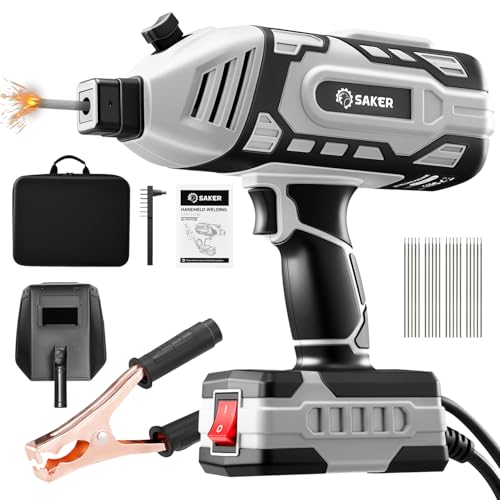
Saker 110V Handheld Welder is specifically presented for 3/32-inch rods, and the package includes 20 rods. Its 110V supply and five-setting control span 20–120A, matching the output range of other compact options here while keeping its electrode fit narrower than Protmex 110V Portable Welder and 110V Handheld Arc Welder. Saker says its IGBT inverter supports arc stability and easier arc starting. Use the electrode maker’s amperage guidance rather than treating the five settings as a substitute for it. This is a straightforward choice for work planned around 3/32-inch electrodes; choose another model if 1/8-inch compatibility is a requirement.
Bottom line: Pick this when your planned work uses 3/32-inch rods.
110V Handheld MMA Welder

110V Handheld MMA Welder stands apart by including a welding mask and ground clamp alongside five rods, so it comes with more of the basic welding gear than the other packages. It is a 110V manual metal arc (MMA, or stick) machine with five current settings across 20–120A and a compact body measuring about 9.84 × 3.94 × 9.84 inches. Its front chuck holds the electrode, with a handle button and top adjustment knob. The rod diameter is not given, so confirm that it suits your chosen electrodes before ordering. Choose this package if the included mask and clamp are useful, while still ensuring the mask’s shade is appropriate for the amperage.
Bottom line: Choose this if the included mask and clamp suit your setup.
110V Handheld Arc Welder

The machine is described as a 110V handheld arc welder with an IGBT inverter; the maker also claims hot-start and anti-stick functions. Those features may help with starting or rod sticking, but they do not establish how long the machine can weld continuously. Choose it if the rod range fits your jobs and you already have suitable safety equipment. Buyers planning sustained welds should confirm duty cycle and electrode-specific amperage before purchase.
Bottom line: Pick this if its rod range fits and you have protective gear.
How to choose a hand held welder
Choose by electrode diameter and the amperage range printed on that electrode package, not by a broad maximum-amp figure alone. As a typical guide, 3/32-inch stick electrodes run about 40–100A, while 1/8-inch rods often run about 75–130A; the electrode classification and workpiece affect the correct setting. A 20–120A machine can cover much of those ranges, but may not reach the upper end for every 1/8-inch rod. These compact tools are manual stick welders: the rod itself is both electrode and filler metal, and a separate ground clamp completes the circuit. If a job needs long continuous welds, compare duty cycle, a specification for how long a welder can operate within a 10-minute period, before choosing.
Rod size and fit for handheld stick welders
Rod diameter determines both the holder fit and the current needed, so confirm the machine accepts the electrode size you intend to use. A 3/32-inch rod is a common choice for lighter repair work; 1/8-inch rods generally call for more amperage and a machine capable of sustaining the needed output. Do not force a rod into a chuck or use a current setting beyond the electrode maker’s range. The 110V input on these models also means the available supply matters: a long or undersized extension cord can cause voltage drop, so use a cord rated for the welder’s input current and keep it as short as practical. Use this quick guide as a starting point, then match the rod package:
| Electrode diameter | Typical current range | Fit decision |
|---|---|---|
| 3/32 in. | About 40–100A | Confirm chuck fit and electrode range |
| 1/8 in. | About 75–130A | Confirm welder reaches rod’s needed setting |
Safety gear for handheld welding
Use a welding helmet with the correct filter shade, welding gloves, flame-resistant clothing and eye protection; an included mask is not automatically suitable for every current or process. Stick welding produces ultraviolet radiation, hot spatter and fumes, so keep exposed skin covered, remove combustible material from the work area and provide ventilation without directing a strong draft across the arc. Secure the work and attach the ground clamp to clean metal close to the weld. Never weld a sealed container or a container that held flammable material. A handheld gun-style body does not make the process safer to hold casually: keep the electrode end away from skin and conductive surfaces, and disconnect power before changing or inspecting the electrode holder.
Common mistakes with portable stick welders
Setting current by guesswork is a common cause of sticking, excessive spatter or burn-through; begin within the electrode maker’s amperage range and adjust for joint position and metal thickness. Thin sheet needs less heat and faster travel than thick plate, so a machine’s maximum output does not establish that it suits delicate work. Another mistake is assuming a short product name or package photo guarantees a complete setup: confirm the rod diameter, duty cycle and necessary safety equipment for your actual job. For occasional tack welds and small repairs, a compact 20–120A model may be sufficient if its electrode fit matches. For sustained fabrication, thicker stock or repeated long seams, compare conventional welders with documented duty cycles and output suited to the required electrode.
Frequently Asked Questions
Can a 110V handheld welder use 1/8-inch rods?
Some can, provided the chuck accepts that diameter and the welder reaches the electrode’s recommended current. A typical 1/8-inch stick rod may call for about 75–130A, so a 120A maximum will not cover every rod’s full range.
What amperage should I use for a 3/32-inch rod?
A typical 3/32-inch stick electrode runs about 40–100A, but its classification and the workpiece determine the right setting. Start within the range printed on the electrode package and adjust for the joint and material thickness.
Is a handheld stick welder suitable for thin sheet metal?
It can be used for some sheet-metal repairs, but thin metal is easier to burn through because stick welding concentrates heat in the joint. Use a small electrode and low current within its recommended range; under 1/8-inch material, a process designed for thinner stock may be easier to control.
What does a stick welder duty cycle mean?
Duty cycle is the operating time allowed in a 10-minute period at an output before the machine needs to cool. For example, a 20% duty cycle means two minutes welding and eight minutes cooling at that specific output; the allowable time can change at lower amperage.
Do I need a welding helmet with a handheld welder?
Yes, arc welding requires suitable eye and face protection, gloves and clothing that covers exposed skin. Choose a helmet filter shade appropriate for the process and amperage; a bundled mask should not be assumed to fit every welding condition.