
Blu-Tack for Walls: 3 Reusable Putty Options Compared

For general wall use, BOSTIK Blu Tack 1.6 oz is the straightforward choice because it is the original reusable putty in a 1.6-ounce pack; Feosky Adhesive Putty 120 Squares suits buyers who prefer pre-cut squares, while Blu-Tack Reusable Adhesive 75g gives 75 grams of pliable strips.
Blu-Tack is a moldable adhesive putty for temporarily holding lightweight items, but painted walls can discolor or lift, so test a discreet spot before mounting anything valuable.
We earn a commission if you buy through links on this page. As an Amazon Associate I earn from qualifying purchases. Products are compared on manufacturer specifications, not hands-on testing.
- Best overall: BOSTIK Blu Tack 1.6 oz – A 1.6-ounce pack of reusable putty for flexible portions and general wall tasks.
- Best for pre-cut pieces: Feosky Adhesive Putty 120 Squares – Includes 120 pre-cut 0.4-inch squares for portioned applications.
- Best for strip format: Blu-Tack Reusable Adhesive 75g – A 75-gram pack supplied as pliable adhesive strips.
| Product | Best for | Pack amount (oz) | Format | Color | Shop |
|---|---|---|---|---|---|
| BOSTIK Blu Tack 1.6 oz | Flexible portions | 1.6 oz | Moldable putty | Blue | Check Price on Amazon |
| Blu-Tack Reusable Adhesive 75g | Strip applications | 2.65 oz | Strips | Light blue | Check Price on Amazon |
| Feosky Adhesive Putty 120 Squares | Pre-cut squares | 120 pieces | 0.4 × 0.4 in squares | Blue | Check Price on Amazon |
Blu-Tack for walls
Compare the pack amount and format to choose a putty that suits the size and shape of your mounting task.
BOSTIK Blu Tack 1.6 oz

BOSTIK Blu Tack 1.6 oz is the flexible option for wall tasks that call for custom-sized pieces rather than a fixed number of squares. The 1.6-ounce pack contains blue reusable putty, and the maker says it can hold lightweight objects on walls, glass, and metal. That adaptability suits notes, signs, and temporary decorations. The limitation is that the maker gives no specific load rating, so reserve it for light items and avoid relying on it for framed or valuable objects.
Bottom line: Choose this if you want to shape portions for different lightweight items.
Blu-Tack Reusable Adhesive 75g
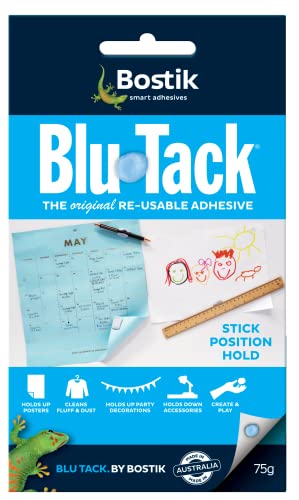
Blu-Tack Reusable Adhesive 75g stands out for its strip format: the blue-only pack has four strips, each approximately 0.75 inch wide by 8 inches long. Its 75-gram amount can be divided and shaped for poster corners or other small contact points, and the maker also describes uses beyond mounting, such as keeping pictures straight. Strip dimensions make portion planning easier, but this option is not pre-cut into small squares; buyers wanting ready-sized pieces may prefer a different format.
Bottom line: Pick this when long strips are more useful than pre-cut portions.
Feosky Adhesive Putty 120 Squares

Feosky Adhesive Putty 120 Squares differs from the strip-style options by arriving as 120 pre-cut squares, each 0.4 by 0.4 inch. That makes it convenient when a display needs repeated, similarly sized portions for posters, photos, or crafts. The maker says the putty is removable and reusable and advises softening a piece by rubbing it before application.
Bottom line: Choose this for repeated applications where pre-cut pieces save preparation.
How to choose wall putty for posters
Choose by the amount and shape of putty each mounting point needs, not by color alone. A moldable tack lets you pinch off a custom portion, while pre-cut 0.4-inch squares give repeatable portions for small, light prints. For a poster, use several attachment points near the corners rather than one large lump; larger or heavier pieces need a mounting method rated for their load. Painted finishes need extra care: oils from putty or paint weakness can leave marks or pull paint away. Test a small amount in a hidden spot and check it after removal before putting up a full display.
Wall surfaces and safe removal
Use tack only on a clean, dry surface, and press gently rather than rubbing it across the wall. Smooth, sealed surfaces generally give putty better contact than dusty, textured, or freshly painted walls; wait until paint has fully cured before applying any adhesive. To remove putty, roll or dab it against itself instead of pulling straight outward, which can stress fragile paint or paper. Never assume “removable” means risk-free on every finish: delicate wallpaper, chalky paint, and old plaster are especially poor places to experiment. A discreet test is the practical decision rule before mounting anything important.
Putty, strips, and pre-cut squares compared
Choose continuous putty when portion size needs to change, strips when a long narrow shape is convenient, and squares when repeated portions matter most. Format changes setup time and flexibility, but it does not establish how much weight an adhesive can safely support. The products here provide no comparable load rating, so avoid using them to secure breakable, heavy, or hazardous objects over people or pets.
| Need | Useful format | Why it fits |
|---|---|---|
| Change portion size | Moldable putty | Pinch off the amount needed |
| Cover a narrow contact area | Strip | Long shape suits a linear hold |
| Repeat small attachment points | Pre-cut squares | Portions are consistent |
Common wall putty mistakes
The most common mistake is treating a reusable tack as a rated wall anchor. Adhesive putty is intended for light, temporary holding; paper, paint condition, temperature, and contact area all change how reliably it grips. Avoid mounting glass, heavy frames, or anything that could injure someone if it falls. Another mistake is applying too much putty to compensate for a rough surface: larger blobs may be harder to remove and can leave oily marks. Keep the attachment small, use multiple points for a light poster, and switch to hardware designed for the item’s weight when the wall finish or consequence of a fall matters.
Frequently Asked Questions
Can Blu-Tack damage painted walls?
Yes, putty can leave an oily mark or pull away weak paint, particularly on a fragile or poorly cured finish. Test a small hidden area first and avoid delicate wallpaper.
How much weight can wall putty hold?
Use wall putty only for lightweight items because no comparable load rating is provided for these options. Do not use it for glass, heavy frames, or objects that could injure someone if they fall.
How do you remove putty from a wall?
Roll or dab the putty against itself instead of pulling it straight away from the wall. On paint or wallpaper, stop if the finish starts lifting and test removal on a hidden patch first.
Should a wall be clean before applying poster putty?
Yes, use a clean, dry surface so dust and moisture do not interfere with contact. Rough or dusty walls may grip less reliably than smooth, sealed finishes.
Can reusable putty hold posters on wallpaper?
It may adhere to some vinyl-coated wallpaper, but delicate or aged wallpaper can mark or lift during removal. Test an inconspicuous patch, and use another mounting method if the wallpaper is valuable.