
Oxyflow Breathing Trainer: 5 Models Compared

The Oxyflow Portable Adjustable Trainer for Oral and Muscular Exercise suits most people seeking a single adjustable trainer, because it is explicitly made for daily fitness training and has adjustable resistance. Choose the two-pack if you want a pair for sports training, or a different model if you want a respiratory-focused or relaxation-oriented tool rather than Oxyflow.
Breathing trainers add resistance to airflow during breathing practice; they exercise breathing muscles, not the lungs themselves.
We earn a commission if you buy through links on this page. As an Amazon Associate I earn from qualifying purchases. Products are compared on manufacturer specifications, not hands-on testing.
- Best overall: Oxyflow Portable Adjustable Trainer – The Oxyflow single trainer has adjustable resistance and is presented for daily fitness training.
- Best for a two-pack: Oxyflow Adjustable Trainer 2-Pack – The set contains two trainers with rotating adjustable-resistance valves.
- Best for breathwork: Breathing Control Trainer – Its adjustable airflow resistance is framed around deep, slow breathing practice.
| Product | Best for | Pack size | Resistance | Material | Shop |
|---|---|---|---|---|---|
| Oxyflow Portable Adjustable Trainer | Daily fitness | 1 trainer | Adjustable valve | — | Check Price on Amazon |
| Oxyflow Adjustable Trainer 2-Pack | Sports practice | 2 trainers | Rotating valve | Silicone | Check Price on Amazon |
| OxyBio Oxy Respiratory Trainer | Breath muscle work | 1 trainer | Fully adjustable | Silicone, stainless steel | Check Price on Amazon |
| Portable Lung Capacity & Ab Trainer | Core-focused exercise | 1 trainer | Adjustable flow valve | Silicone | Check Price on Amazon |
| Breathing Control Trainer | Calm breathwork | 1 trainer | Adjustable airflow | Silicone | Check Price on Amazon |
Oxyflow breathing trainers and alternatives
Compare the intended routine, resistance controls and materials before choosing a trainer.
Oxyflow Portable Adjustable Trainer

For a single Oxyflow device aimed at daily fitness, this model combines a portable format with adjustable resistance. Its features describe a valve system for oral and muscular exercise, plus an easy-to-clean design. The compact format may suit someone who wants a trainer to carry between home and workouts. Its focus includes broad muscle and posture benefits, but the product facts do not establish measurable outcomes; choose it for the adjustable breathing practice, not as a treatment for pain or other health concerns.
Bottom line: Pick this if you want one adjustable Oxyflow trainer for daily fitness practice.
Oxyflow Adjustable Trainer 2-Pack

The two-piece format separates this Oxyflow option from the single trainer, making it the practical choice when you want a pair. Each trainer has a rotating valve for adjustable resistance, and the maker describes flexible silicone construction and easy cleaning. Its use spans running, cycling, swimming and other sports, so it fits someone who wants resistance practice alongside varied activities. A pack of two does not establish separate resistance settings or different sizes, so do not assume the trainers are tailored to different users or training stages.
Bottom line: Choose this when a pair of adjustable trainers better suits your routine.
OxyBio Oxy Respiratory Trainer
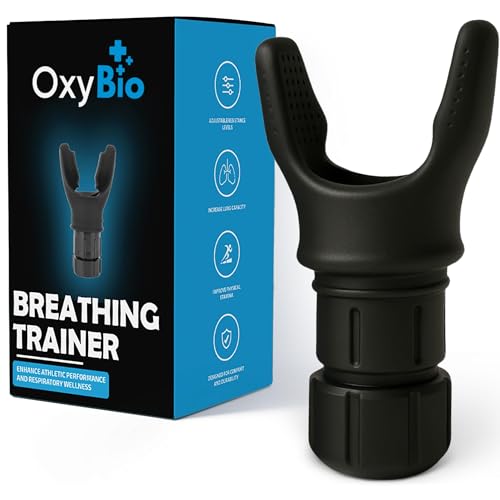
Unlike the Oxyflow options, this OxyBio trainer is explicitly described for inhalation and exhalation muscle exercise. It has adjustable resistance, a silicone body and a corrosion-proof stainless-steel valve, in a portable black design. That combination may suit someone prioritizing a full-cycle breathing exercise and a metal valve. The features do not give a calibrated resistance range or a measurement scale, so anyone needing a specific training load should verify that the adjustment can match their intended program.
Bottom line: Pick this for a respiratory-focused trainer with an adjustable valve.
Portable Lung Capacity & Ab Trainer

This option stands apart by being presented as an abdominal and core exercise trainer as well as a breathing exerciser. The product facts give dimensions of 3.9 by 3.9 by 2.32 inches and a weight of 0.06, alongside a flow-control valve and silicone construction. Those measurements help assess whether its shape will fit a compact storage space. Its claims about rapid lung-capacity gains and particular recovery uses are not established by the specifications, so avoid relying on those outcomes when deciding whether the design suits your practice.
Bottom line: Consider this if a core-oriented breathing tool is your intended use.
Breathing Control Trainer

Rather than emphasizing athletic or muscular training, this compact trainer is framed for controlled, deep and slow breathing. It uses adjustable airflow resistance, has a silicone design and is described as portable for home or outdoor routines. That focus makes it a different fit from the Oxyflow trainers marketed for fitness or sports.
Bottom line: Choose this when controlled breathwork is more important than a sports-training focus.
How to choose a breathing trainer
Choose by the kind of resistance control and practice you need, not by claims about lung capacity. A rotary or flow valve can change how freely air passes, but an adjustable setting is not automatically a calibrated pressure measurement. Threshold trainers, by contrast, use a pressure threshold that must be overcome to draw air in; some models train inhalation and exhalation separately. If your program calls for a specific pressure load, look for a value in cm H₂O and an adjustment range before ordering. For general practice, start with a resistance that lets you keep a steady breathing rhythm rather than straining. Stop if you feel light-headed, and seek medical advice before using resistance training if you have a respiratory or cardiovascular condition.
How breathing resistance trainers work
Breathing resistance trainers make airflow harder by narrowing or regulating the air path, which increases the work of breathing muscles. They do not increase lung size, and a sensation of harder breathing is not proof of a larger lung capacity. Flow-resistance devices can feel different as breathing speed changes, while threshold devices target a pressure that must be reached before air moves. For a measurable program, compare the pressure range and whether the device supports inhalation, exhalation or both. Mouthpiece fit and a comfortable seal also matter: air leaking around the mouth can make the exercise less consistent. Avoid treating the highest setting as the goal; a controlled breath is more useful than a strained one.
Cleaning and safe use for breathing trainers
Clean a mouth-contact trainer after each session and let all parts dry fully before storing it; moisture left inside a closed device can encourage microbial growth. Follow the maker’s material-specific cleaning directions, because silicone and metal parts may tolerate different methods than any removable valve components. Do not share a mouthpiece unless it has been cleaned and sanitized appropriately. Begin seated with low resistance, since breathing against resistance can cause light-headedness when effort becomes excessive. Stop the session if dizziness, chest discomfort or unusual shortness of breath occurs. People with asthma, COPD, heart conditions or recent surgery should get clinician guidance before adding resistance exercise, rather than using a trainer to replace prescribed care.
Common breathing trainer selection mistakes
A common mistake is treating every adjustable valve as a precise training gauge. Many simple flow-resistance tools offer no pressure scale, so a dial position may not translate into a repeatable load. Another mistake is choosing a device based only on a claimed lung-capacity result; breathing exercises work the respiratory muscles and cannot promise a particular change in lung volume. Match the device to the actual routine: full-cycle exercise, sports practice or calm breathwork are distinct emphases. If more than one person will use a device, account for hygienic cleaning and separate mouth-contact components. And if a health condition is part of the reason for training, ask a clinician what resistance and frequency are appropriate before starting.
Frequently Asked Questions
Do breathing trainers increase lung capacity?
Breathing trainers primarily add work for breathing muscles; they do not make the lungs larger. A specific change in lung capacity cannot be assumed from an adjustable valve alone.
What is the difference between flow and threshold resistance?
Flow resistance depends on air moving through a restricted path, while a threshold device opens airflow after a target pressure is overcome. A calibrated pressure range in cm H₂O is more useful for tracking a specific training load than a valve position alone.
How often should I clean a breathing trainer?
Clean the mouth-contact parts after each use and dry them fully before storage. For a shared device, clean and sanitize the mouthpiece appropriately between users.
Can I use a breathing trainer with asthma?
Ask a clinician before using resistance breathing exercise if you have asthma or another heart or lung condition. Stop if a session causes unusual shortness of breath, chest discomfort or dizziness.
Should I start with the highest resistance setting?
No; begin at low resistance and use a level that allows smooth, controlled breaths without straining. Reduce resistance or stop if breathing becomes uncomfortable or you feel light-headed.