
Best Pump for Dirty Water: 5 Models Compared

SHANGDA 1.7 HP Manual Sump Pump suits most dirty-water jobs because it handles solids up to 1-1/4 inches, more than the other pumps with a solids limit. Choose AQUASTRONG 1 HP 4,500 GPH Pump, FOTING 1 HP 4,600 GPH Manual Pump, Flowbase 1 HP 5,000 GPH Sump Pump or PANRANO 1.6 HP Automatic Sump Pump instead when leaving only about 1/5 inch of water matters more than passing larger debris; these pumps are submersible water-transfer pumps for flooded areas, ponds and pools.
We earn a commission if you buy through links on this page. As an Amazon Associate I earn from qualifying purchases. Products are compared on manufacturer specifications, not hands-on testing.
- Best overall: SHANGDA 1.7 HP Manual Sump Pump – Its solids capacity reaches 1-1/4 inches, the largest of the group.
- Best for automatic cycling: PANRANO 1.6 HP Automatic Sump Pump – The float switch turns the pump on at 4 inches and off below 2 inches.
- Best for hose flexibility: Flowbase 1 HP 5,000 GPH Sump Pump – Its adapters fit 3/4-, 1- and 1-1/4-inch hose connections.
| Product | Best for | Flow at 5 ft | Solids capacity | Residual water | Shop |
|---|---|---|---|---|---|
| SHANGDA 1.7 HP Manual Sump Pump | Larger debris | 7,500 GPH | 1-1/4 in | 2 in | Check Price on Amazon |
| PANRANO 1.6 HP Automatic Sump Pump | Automatic drainage | 7,000 GPH | 1/5 in | 2 in | Check Price on Amazon |
| Flowbase 1 HP 5,000 GPH Sump Pump | Flexible connections | 5,000 GPH | — | 1/5 in | Check Price on Amazon |
| FOTING 1 HP 4,600 GPH Manual Pump | Routine water transfer | 4,600 GPH | 1/5 in | 1/5 in | Check Price on Amazon |
| AQUASTRONG 1 HP 4,500 GPH Pump | Shallow drainage | 4,500 GPH | 1/5 in | 1/5 in | Check Price on Amazon |
Best Pumps for Dirty Water
Compare the flow, debris limits and drainage depth against the water and solids you need to move.
SHANGDA 1.7 HP Manual Sump Pump

For dirty water with larger debris, this pump’s 1-1/4-inch solids capacity sets it apart from the other models here. The stainless steel casing and higher base plate are designed for repeated drainage tasks, and the pump moves up to 7,500 GPH at 5 feet and lifts water up to 30 feet, according to the maker. Its manual operation suits a job where someone can control when it runs. The tradeoff is that it leaves about 2 inches of water behind, so it is a poor fit when you need a near-dry surface.
Bottom line: Pick it for dirty water with larger solids when a 2-inch residual level is acceptable.
PANRANO 1.6 HP Automatic Sump Pump

Unlike the manual pumps, this model has a float switch for automatic cycling: the maker says it starts at 4 inches of water and stops below 2 inches. Its 7,000 GPH flow at 5 feet makes it suited to a pool, pond or basement job where unattended cycling is useful. The screen blocks debris larger than 1/5 inch when slid down. That smaller debris limit matters in muddy water with larger solids, and the pump’s on/off thresholds mean it is not the choice for removing only a shallow film of water.
Bottom line: Choose it when automatic cycling matters more than handling larger debris.
Flowbase 1 HP 5,000 GPH Sump Pump
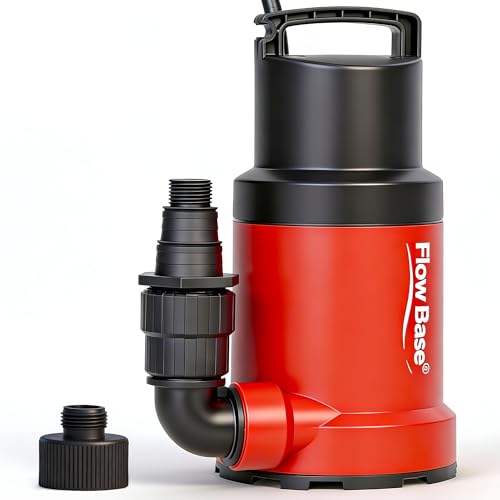
Flowbase emphasizes hose flexibility: its multi-size adapter accommodates 1- and 1-1/4-inch connections, and it also includes a 3/4-inch garden-hose adapter. The maker says its 1 HP pump moves up to 5,000 GPH and lifts water up to 30 feet; a mesh bag filters sediment and solids during transfer. It draws water down to 1/5 inch, useful for shallow pools and basement floors. The features give no maximum solid size, so this is a less certain choice when the water contains chunky debris; confirm the debris size is suitable before use.
Bottom line: Pick it when hose connection options and shallow-water removal are priorities.
FOTING 1 HP 4,600 GPH Manual Pump
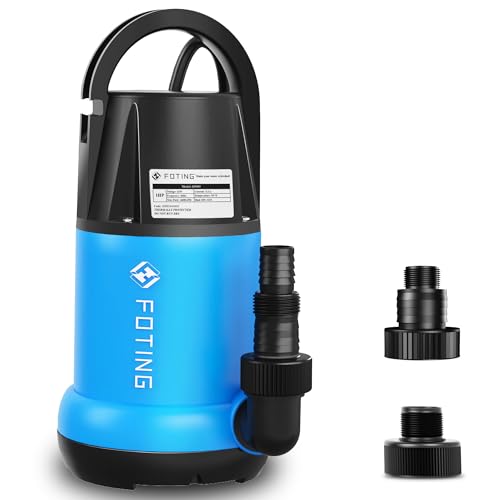
FOTING combines a removable bottom with a 1/5-inch solids limit, making cleaning access its distinguishing feature among the manual pumps. The thermoplastic housing resists corrosion, and the maker says the 1 HP unit moves up to 4,600 GPH at 5 feet, lifts water up to 31 feet and removes water to 1/5 inch. Its 10-foot cord and rounded handle support portable use. Its flow is lower than the other models with a GPH figure, so a large, fast-filling area may call for a higher-capacity option.
Bottom line: Choose it for portable transfer when removable-bottom cleaning access is useful.
AQUASTRONG 1 HP 4,500 GPH Pump

AQUASTRONG is a compact manual option for water that needs to be drawn close to the surface: its bottom-suction design leaves about 1/5 inch behind and handles solids up to 1/5 inch. The maker says its 1 HP motor moves up to 4,500 GPH at 5 feet and lifts water up to 30 feet. A 1-1/4-inch discharge and included adapters support several hose sizes. Its flow is the lowest of the group with a GPH figure, and the small solids limit makes it less suitable for water carrying larger debris.
Bottom line: Pick it for shallow drainage when debris is limited to small solids.
How to Choose a Dirty-Water Pump
Choose by solids size first, then by flow at the lift height you actually need. Pump flow falls as discharge height and hose resistance rise, so a maximum GPH figure at 5 feet does not tell you the rate at a taller lift. Compare the debris limit with the largest solid in the water; a screen or strainer can clog when leaves, fabric or stringy debris collect against it. For a flooded area with solids over 1/5 inch, the 1-1/4-inch capacity of SHANGDA 1.7 HP Manual Sump Pump is the clearer fit. For water that must be drawn nearly to the floor, prefer a pump with a 1/5-inch residual level over one that leaves 2 inches.
Keep the pump stable and do not let it run dry; water cools many submersible pump motors. Use a ground-fault circuit interrupter (GFCI) on a wet-area circuit, keep plugs and connections dry, and avoid standing water while handling electrical connections.
Dirty-Water Pump Capacity and Solids
Match the pump’s solids limit to the debris, not just to the word “dirty.” A 1/5-inch limit is about 0.2 inch, while 1-1/4 inches is more than six times wider; stringy debris can still obstruct an intake even when it is thin. The pumps in this group list flows from 4,500 to 7,500 GPH at 5 feet, but those figures are not interchangeable with flow at a higher lift. Discharge hose diameter and length also affect resistance: narrow, long hose can reduce the amount moved. Use a wider, shorter discharge route when the setup permits, and keep the intake clear of sediment buildup.
The table separates the two decisions that matter most for dirty water: debris clearance and how much water remains.
| Need | Relevant pump trait | Choice |
|---|---|---|
| Pass larger solids | 1-1/4-inch solids capacity | SHANGDA 1.7 HP Manual Sump Pump |
| Automatic cycling | Float starts at 4 inches, stops below 2 inches | PANRANO 1.6 HP Automatic Sump Pump |
| Leave a shallow residual layer | Removes water to 1/5 inch | AQUASTRONG 1 HP 4,500 GPH Pump, FOTING 1 HP 4,600 GPH Manual Pump or Flowbase 1 HP 5,000 GPH Sump Pump |
Dirty-Water Pump Setup and Electrical Safety
Set up a submersible pump with a clear intake and a discharge path that cannot kink or shift. A small change in lift or hose routing can slow drainage, so route the hose as directly as practical and secure it where it discharges. Keep the power connection above the wet area, use a GFCI-protected outlet, and do not touch a plug or switch while standing in water. Never lift or lower a powered pump by its cord; use its handle. A pump should not run dry because the surrounding water helps cool the motor. For an automatic float model, leave enough room for the float to rise and fall without catching on a wall, hose or debris.
Dirty-water pumps are not a substitute for sewage or wastewater equipment unless the pump is specifically rated for that use. Remove power before clearing an intake or cleaning a removable base, and do not reach into standing water around a live pump.
Common Dirty-Water Pump Mistakes
The most common sizing mistake is choosing by horsepower or peak GPH alone. A pump with a high advertised flow can still be wrong if its solids limit is too small or if the water level must drop below its residual depth. A second mistake is assuming an automatic switch means unattended operation is safe; floats can snag or become obstructed, so the pump still needs periodic checks. Keep leaves and cloth away from the intake and stop the pump before removing debris. For a basement or window well, verify that discharge water will drain away from the foundation rather than returning to the flooded area.
Before ordering for a permanent or critical installation, confirm the required discharge fitting and the pump’s allowable duty cycle; those can determine whether it fits your setup.
Frequently Asked Questions
How large of debris can a dirty-water pump handle?
The capacities here range from 1/5 inch to 1-1/4 inches. Choose a pump whose limit exceeds the largest solid you expect, and clear stringy material from the intake because it can wrap or clog.
Can a submersible pump run without water?
No; do not run a submersible pump dry, because surrounding water helps cool its motor. Stop it once the water falls below the pump’s usable intake level.
Does a higher GPH rating always drain faster?
No; GPH falls as lift height, hose length and hose resistance increase. Compare pumps at the same lift and use a direct, appropriately sized discharge hose.
Is a GFCI needed for a water pump?
Use a GFCI-protected outlet for a pump used around wet areas. Keep electrical connections dry and never handle a plug while standing in water.
How do I stop a pump intake from clogging?
Keep leaves, cloth and stringy debris away from the intake and inspect the screen during pumping. Disconnect power before clearing a blockage or cleaning a removable base.