
Small Dog Clippers for Face and Paws: 5 Picks

oneisall 0.8-Inch LED Paw Trimmer suits most people because its 0.8-inch rounded blade trims a little more width per pass and its LED helps illuminate hidden areas. Choose Upgrade 0.7-Inch Dual-Speed Trimmer instead if you want two speed settings, or oneisall Small Paw Trimmer if its two-hour runtime matters more.
Small-area clippers use narrow blades for detail work around paws, ears and the face; they are not a substitute for a full-size coat clipper.
We earn a commission if you buy through links on this page. As an Amazon Associate I earn from qualifying purchases. Products are compared on manufacturer specifications, not hands-on testing.
- Best overall: oneisall 0.8-Inch LED Paw Trimmer – Its 0.8-inch rounded blade covers more width per pass, and the built-in LED illuminates hard-to-see areas.
- Best for speed control: Upgrade 0.7-Inch Dual-Speed Trimmer – Two speeds—5,000 and 6,000 RPM—let you select between the settings.
- Best for longer sessions: oneisall Small Paw Trimmer – The maker says a full charge supports about two hours of use.
| Product | Best for | Blade width | Noise claim | Notable feature | Shop |
|---|---|---|---|---|---|
| oneisall 0.8-Inch LED Paw Trimmer | Wider detail passes | 0.8 in | 35 dB | LED light | Check Price on Amazon |
| Upgrade 0.7-Inch Dual-Speed Trimmer | Two-speed trimming | 0.7 in | Under 35 dB | Two speeds | Check Price on Amazon |
| Mcbazel Micro Precision Trimmer | Ceramic blade detail | 0.7 in | Under 50 dB | LED light | Check Price on Amazon |
| oneisall Small Paw Trimmer | Longer sessions | — | — | About 2 hr runtime | Check Price on Amazon |
| Pet Precision Trimmer with Travel Lock | Travel-safe storage | 0.7 in | — | Display and lock | Check Price on Amazon |
Small Dog Clippers for Face and Paws
Compare blade width and handling features to match a detail trimmer to your grooming routine.
oneisall 0.8-Inch LED Paw Trimmer

The 0.8-inch blade is wider than the 0.7-inch blades in several other picks, so it can cover more area in each pass. The rounded blade and LED are intended for close work around paws, ears and the face, where visibility and careful control matter. The maker says it runs at 35 dB and cuts 40% more hair per pass; those are manufacturer claims, not a guarantee for every coat. Pick this trimmer for small-area grooming when you want the wider blade. Its blade is still narrow, so it is not meant to replace a full-coat clipper.
Bottom line: Choose this if a wider detail blade and built-in light are your priorities.
Upgrade 0.7-Inch Dual-Speed Trimmer

The two-speed control distinguishes this trimmer from the single-speed options: its settings are 5,000 and 6,000 RPM. The 0.7-inch ceramic blade has rounded edges, and the built-in LED is intended to improve visibility around paw pads, toes and ears. The maker says operating noise is under 35 dB and describes the trimmer as IP68 waterproof. Choose it if you want to adjust speed for detail work and value a water-resistance rating. The blade is narrower than oneisall 0.8-Inch LED Paw Trimmer’s 0.8-inch blade, which may mean more passes over a given area.
Bottom line: Pick this if you want two speed settings and a 0.7-inch blade.
Mcbazel Micro Precision Trimmer
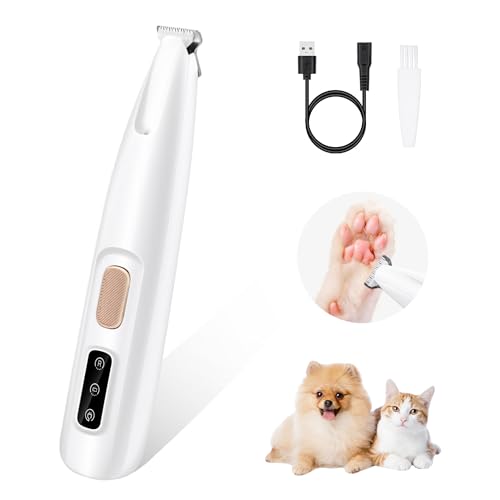
The dual-blade construction pairs a ceramic moving blade with a stainless steel fixed blade, setting this apart from the other compact options. Its 0.7-inch narrow blade and LED are intended for precise work around paws, ears and the face. The maker says it runs under 50 dB. Choose it if the ceramic-and-steel blade combination is your main preference for detail trimming. The noise ceiling is higher than the 35 dB claims for oneisall 0.8-Inch LED Paw Trimmer and Upgrade 0.7-Inch Dual-Speed Trimmer, so owners prioritizing the lowest claimed noise may prefer one of those alternatives.
Bottom line: Choose this for a ceramic moving blade and illuminated detail work.
oneisall Small Paw Trimmer

The battery runtime is its clearest distinction: the maker says this rechargeable trimmer runs for about two hours after a two-hour charge. Its small blade is intended for paws and other small areas, including ears and the face, and the USB charging setup avoids replaceable batteries. Choose it when cordless grooming time matters more than a published blade width or noise figure. The maker does not establish a blade measurement, so compare its physical blade with your target area before choosing if width is decisive.
Bottom line: Pick this when a two-hour cordless runtime is useful.
Pet Precision Trimmer with Travel Lock

The display and travel lock distinguish this precision trimmer, which also has a 0.7-inch ceramic blade with rounded edges. Those controls and the compact form suit detail grooming and packed storage. Choose it if you want a travel lock to reduce accidental activation in a bag. The features do not give the two speed values or a noise figure, so buyers who need those comparisons should favor a model with explicit figures.
Bottom line: Choose this for a travel lock and a compact 0.7-inch blade.
How to choose small dog clippers for face and paws
Start with blade width: these picks range from 0.7 to 0.8 inch, making them detail tools rather than full-coat clippers. A wider blade covers more area per pass, while a narrower blade can be easier to position in tight spaces; choose 0.7 inch when working around small paw pads, and consider 0.8 inch for slightly broader areas. Look next at visibility and handling: an LED can help illuminate shaded creases, and speed controls let you choose among the settings offered. Noise figures are maker claims and are not directly comparable unless measured under the same conditions. Keep the blade flat and move slowly; stop if the dog pulls away or you cannot see the skin clearly.
Blade width and safe trimming around paws
A 0.7- to 0.8-inch blade is a useful scale for detail work, but the right width depends on the space and coat. Paw-pad fur grows in narrow creases, so use short, controlled passes and do not force the blade between pads. For the face, trim only hair you can clearly see and keep the cutting edge away from the eyes, nostrils and ear canal. If a mat resists the blade or pulls the skin, stop rather than tugging or cutting blindly. A blade that feels warm should be allowed to cool before continuing; check it against the inside of your wrist periodically. Use a full-size clipper for broad body areas instead of trying to cover them with a narrow detail blade.
Choosing noise, light and speed features
Noise claims in these options range from under 35 dB to under 50 dB, but the figures come from manufacturers and do not prove how a particular dog will react. Let a noise-sensitive dog hear the switched-off tool first, then introduce the running clipper at a distance and pause if the dog becomes distressed. LED lighting helps reveal shaded areas between toes, but it does not replace good positioning and a steady view of the skin. Two-speed controls offer more choice during a trim; they do not make rushed handling safe. A practical rule: if you cannot keep the skin visible and the dog still, stop and return to the area later or ask a professional groomer.
Small trimmer types at a glance
Match the feature to the grooming task rather than treating every small trimmer as interchangeable. A 0.7-inch blade favors tighter positioning, while a 0.8-inch blade can cover a little more width per pass. Lighting matters most in shaded creases, and a travel lock matters when the tool is stored with other items. Use this need-to-feature guide to narrow the choice; it does not replace checking the blade position against the area you intend to trim.
| Need | Feature to prioritize | Why it matters |
|---|---|---|
| Tight spaces | 0.7-inch blade | Narrower blade for detailed positioning |
| Broader detail areas | 0.8-inch blade | Covers slightly more width per pass |
| Shaded creases | Built-in LED | Helps illuminate the trimming area |
| Changing trim tasks | Two speeds | Offers selectable motor settings |
Frequently Asked Questions
Can small dog clippers trim around the eyes?
Small-area clippers can be used for visible facial hair, but keep the blade away from the eyes and move only where you can see the skin clearly. If the dog moves or the hair blocks your view, stop rather than trimming blindly.
Should paw hair be clipped between the pads?
Trim only hair that extends beyond the paw pads and remains easy to see. Use short passes and stop if the blade catches, the dog pulls away, or the skin is hard to distinguish from the coat.
How often should I clean a dog clipper blade?
Brush loose hair from the blade after each grooming session so debris does not build up between the teeth. Follow the clipper maker’s care directions for lubrication and cleaning, since water resistance and blade construction differ.
Can a small paw trimmer cut a matted coat?
A narrow detail trimmer is intended for small areas, not for forcing through a mat. If a mat resists or pulls the skin, stop; pulling can make a close trim difficult to control.
How can I help a dog tolerate clipper noise?
Introduce the switched-off clipper first, then briefly run it at a distance while the dog remains calm. Pause if the dog shows distress; a manufacturer’s decibel claim does not predict an individual dog’s response.