
Best Magnifying Light for Needlework: 4 Options Compared

30X/10X Gooseneck Magnifier is the best magnifying light for needlework here because it pairs a 10X main lens with five color modes and stepless dimming. Choose a floor lamp instead if you want a floor-standing setup, or a rectangular lens if a wider view is more useful.
We earn a commission if you buy through links on this page. As an Amazon Associate I earn from qualifying purchases. Products are compared on manufacturer specifications, not hands-on testing.
- Best overall: 30X/10X Gooseneck Magnifier – Combines a 10X main lens, 30X spot lens, five color modes and stepless dimming.
- Best for floor use: 6-Inch Floor Magnifier – Uses a floor stand and a 6-inch viewing window with 10X and 30X lenses.
- Best for rectangular view: 12X/30X Rectangular Glass Magnifier – Has a rectangular real-glass main lens with 12X magnification.
| Product | Best for | Magnification | Format | Lighting | Shop |
|---|---|---|---|---|---|
| 30X/10X Gooseneck Magnifier | Adjustable desk use | 10X main, 30X spot | Desk stand, flexible neck | 5 color modes, stepless dimming | Check Price on Amazon |
| Krstlv 10X Gooseneck Magnifier | Single-power lens | 10X | Desk stand, 12.6-inch arm | 5 color modes, stepless dimming | Check Price on Amazon |
| 6-Inch Floor Magnifier | Floor-standing setup | 10X and 30X | Floor stand, 6-inch window | 72 LEDs, 3 color modes, 4 brightness levels | Check Price on Amazon |
| 12X/30X Rectangular Glass Magnifier | Rectangular viewing area | 12X main, 30X spot | Desk stand, flexible neck | 5 color modes, stepless dimming | Check Price on Amazon |
Magnifying Lights for Needlework
Compare lens options, stand styles and lighting controls against your stitching setup and working distance.
30X/10X Gooseneck Magnifier

30X/10X Gooseneck Magnifier stands out for pairing a 10X main lens with a 30X spot lens and flexible gooseneck. Its maker says the optical-grade HD lens is intended for close work including needlework, cross stitch and sewing. Five color modes and stepless dimming let you adjust illumination while stitching, and the included base makes this a desk setup. The spot lens is suited to small details, but its higher magnification may require bringing the work closer and can narrow the area visible at once.
Bottom line: Choose this if you want adjustable desk lighting and a separate high-magnification spot lens.
Krstlv 10X Gooseneck Magnifier

Krstlv 10X Gooseneck Magnifier offers a single 10X magnification level and a 12.6-inch flexible arm, unlike options with a separate spot lens or floor stand. The maker says its lamp has on-head mechanical controls, which can be convenient when your hands are occupied with fabric and thread. The product is presented for sewing and other close work. A single lens keeps the setup straightforward, but stitchers who want stronger magnification for tiny details will need a different option.
Bottom line: Pick this if a flexible desk arm and one magnification level fit your routine.
6-Inch Floor Magnifier

6-Inch Floor Magnifier is the floor-standing choice, with a 6-inch viewing window and flexible gooseneck rather than a desk base. Its maker specifies dual 10X and 30X lenses, 72 LEDs, three color modes and four brightness levels. A wider window can help keep more of a stitching area in view, while the floor format suits a chair-side setup where a desk lamp would take workspace.
Bottom line: Choose this if you need a floor lamp and a wider viewing window.
12X/30X Rectangular Glass Magnifier
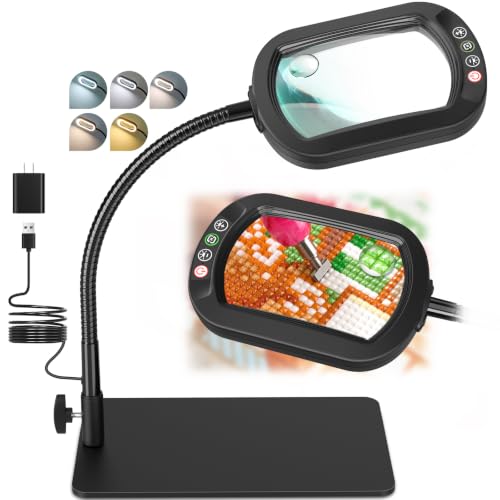
12X/30X Rectangular Glass Magnifier differs with a rectangular real-glass main lens rated at 12X and a 30X spot lens. Its maker says the rectangular shape provides a wider viewing area with reduced edge distortion compared with round lenses; it is also described for sewing and crafts. Five color modes and stepless dimming provide lighting adjustments for different work areas. The product’s dimensions and stand format are not clear, so confirm the size and how it mounts before choosing it for a particular table.
Bottom line: Pick this if you prefer a rectangular main lens and real glass.
How to Choose a Needlework Magnifying Light
Choose by working distance and viewable area before choosing the largest magnification number. Stronger magnification generally means a shorter focal distance and a smaller field of view, so a high-power spot lens can help with a single stitch detail but may be awkward for following a full pattern. For ordinary stitching, a broad main lens is often more useful than a tiny high-power spot. Keep the lens far enough from the fabric to hold a comfortable posture, then adjust the lamp so the needle and thread remain visible without casting a hand shadow. A stable arm also matters: reposition the lamp rather than pulling fabric toward the lens.
Magnification and Working Distance for Stitching
Lens power and working distance are linked: increasing magnification typically brings the usable focus closer and reduces the area visible at once. Magnifier lenses are sometimes labeled in diopters; a 3-diopter lens is about 1.75X by the common relaxed-eye convention, and a 5-diopter lens is about 2.25X. Product magnification labels may use different conventions, so compare the usable focus distance and view area as well as the number. A practical rule is to test whether you can keep your needle, thread and nearby stitches in focus together; if only a tiny point stays clear, use the lower-power main lens for the stitching and reserve a spot lens for inspection.
Desk Lamps and Floor Magnifiers Compared
Desk magnifiers attach the viewing area to a table-side base, while floor models place the base beside a chair and can free desk surface. A flexible arm helps move the lens over the hoop or fabric, but the lamp should remain stable when repositioned. Use this choice guide to match the setup to the space:
| Need | Better format | Reason |
|---|---|---|
| Clear desk-side setup | Desk stand | Base rests on the work surface |
| More free table area | Floor stand | Base sits beside the chair |
| Inspecting tiny stitches | Main lens plus spot lens | Switch between broad work and detail |
Check table or floor clearance and arm reach before settling on a format. A lens that cannot be positioned above the work comfortably will not help, regardless of its magnification rating.
Lighting and Safe Needlework Use
Adjustable brightness and color modes can help tune the view to fabric color, thread contrast and room lighting. Position the light so your stitching hand does not block the beam; right-handed stitchers can start with the lamp on the left, and left-handed stitchers can reverse that placement. LED lamps run cooler than incandescent bulbs, but avoid touching electrical components with wet hands and keep cords clear of the needle and scissors. Magnification does not replace adequate ambient lighting: combine the lamp with general room light to avoid an overly bright work spot against a dark background. Take regular visual breaks during prolonged close work.
Frequently Asked Questions
What magnification is useful for hand embroidery?
A lower-power lens is generally more practical for seeing several stitches at once, while stronger magnification suits inspecting a single detail. Higher power usually requires a shorter working distance and narrows the visible area.
Does a higher-power magnifier show more fabric?
No; higher magnification usually shows a smaller field of view. Choose a broad main lens for following a pattern area and reserve a high-power spot lens for close inspection.
Where should I position a needlework lamp?
Place the lamp opposite your dominant hand so the hand is less likely to block the beam. Adjust the lens over the fabric without pulling your neck toward the work.
Are desk and floor magnifying lamps interchangeable?
They provide different setups: desk models use a tabletop base, while floor models place the base beside a chair. Measure the available space and confirm the arm can position the lens over your usual stitching area.
How can I avoid eye strain while stitching?
Use enough room light alongside the task lamp and adjust brightness to keep the fabric clearly visible without glare. Take breaks during extended close work, since magnification does not remove the need to rest your eyes.