
Best Easy Out Tool for Pipe: 3 Sets Compared

The Thinkpro six-piece set suits most pipe repairs because it includes extractors for six nominal sizes from 1/8 inch to 1 inch. Choose a different set if you need drill-compatible hex shanks or only need to remove a broken screw.
A pipe easy out grips the inside of a broken threaded pipe so it can be turned out of its fitting.
We earn a commission if you buy through links on this page. As an Amazon Associate I earn from qualifying purchases. Products are compared on manufacturer specifications, not hands-on testing.
- Best overall: Thinkpro 6-Piece Pipe Extractor Set – Six extractors cover nominal pipe sizes from 1/8 inch through 1 inch.
- Best for drill use: Broken Pipe Extractor Set, 3 Sizes – Its hex shank is made to fit power drills and impact drivers.
- Best for marked sizes: 6-Piece Pipe Extractor Set – The product features say extractor sizes are laser-etched for identification.
| Product | Best for | Nominal size range | Included sizes | Shop |
|---|---|---|---|---|
| Thinkpro 6-Piece Pipe Extractor Set | Broad size coverage | 1/8–1 in | 1/8, 1/4, 3/8, 1/2, 3/4, 1 in | Check Price on Amazon |
| Broken Pipe Extractor Set, 3 Sizes | Drill-compatible drive | 1/2–1 in | 1/2, 3/4, 1 in | Check Price on Amazon |
| 6-Piece Pipe Extractor Set | Size identification | 1/8–1 in | 1/8, 1/4, 3/8, 1/2, 3/4, 1 in | Check Price on Amazon |
Easy Out Tools for Pipe
Compare the size coverage and drive style to match the broken pipe and the access you have.
Thinkpro 6-Piece Pipe Extractor Set

The Thinkpro set covers six nominal pipe sizes, from 1/8 inch to 1 inch, giving it the broadest explicitly enumerated size range here. The pieces are made from heat-treated steel, and the product features say their teeth grip the pipe’s inner wall. This suits repairs where the broken nipple size is known and falls within that range. Its key limitation is the lack of a drive style, which matters if you need to plan around a drill or a particular hand tool. NPT size is nominal, not the pipe’s measured outside diameter.
Bottom line: Choose this set when you want explicitly stated coverage from 1/8-inch through 1-inch pipe.
Broken Pipe Extractor Set, 3 Sizes

The hex shank is the distinguishing feature of this three-size extractor set: its product features say it fits power drills and impact drivers. The specified sizes are 1/2, 3/4 and 1 inch, and the set is described as using gripping teeth for damaged or rusted threaded fittings. This suits a repair in that size range when drill compatibility is a priority. The tradeoff is narrower coverage than a set that includes 1/8-, 1/4- and 3/8-inch sizes, so identify the pipe size before choosing it. Use controlled torque; a drill can apply force quickly.
Bottom line: Pick it when the pipe is 1/2, 3/4 or 1 inch and a hex-shank drive suits your setup.
6-Piece Pipe Extractor Set
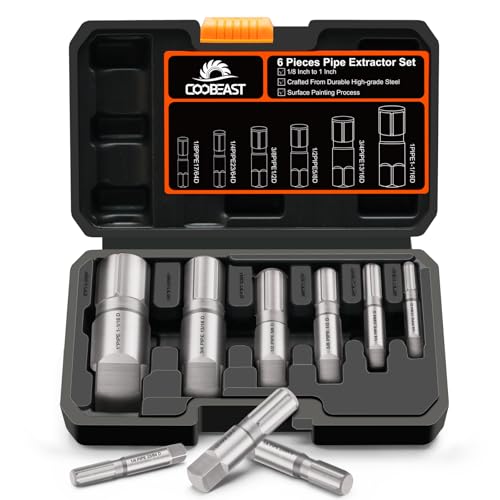
Laser-etched size markings are the notable feature of this six-piece pipe extractor set, which covers nominal sizes from 1/8 inch to 1 inch. The marked sizes can help distinguish pieces before a repair, and the product features describe hardened steel intended for torque and hammer strikes. This is a fit for home or industrial pipe repairs when clear size identification matters. The features also contain an inconsistent piece count, so confirm the set contents before ordering. Its size coverage matches the Thinkpro set, so the markings—not a wider range—are the meaningful difference.
Bottom line: Choose it if clearly marked extractor sizes matter more than a drive style.
How to choose an easy out tool for pipe
Choose by the broken pipe’s nominal size first, then by the drive method you can control in the available space. NPT sizes are nominal: a 1/2-inch pipe does not measure 1/2 inch across its outside diameter. NPT threads taper at 1 inch in 16 along the thread, so the extractor must bite the inner wall without forcing the remaining pipe deeper into the fitting. Match the extractor’s labeled size to the pipe rather than selecting by a quick outside-diameter measurement. For a 1/2-, 3/4- or 1-inch repair with drill access, a hex shank may be useful; for smaller sizes, choose a set that explicitly includes them.
Pipe size and NPT fit
Nominal size is the selection rule for common NPT pipe, not the pipe’s outside diameter. Common NPT fittings use tapered threads, while straight-thread connections rely on different sealing arrangements; do not assume an internal pipe extractor is appropriate for every threaded connection. The six-piece sets here enumerate sizes from 1/8 inch to 1 inch, and the three-piece set covers 1/2, 3/4 and 1 inch. Check the remaining pipe’s size marking or the matching fitting before selecting a tool. If the broken pipe is outside the extractor’s sizes, do not force a near-size tool into it; the wrong fit can damage the fitting or make removal harder.
Using a pipe extractor safely
Shut off the water supply and relieve pressure before working on a plumbing line; trapped water can spill when the broken section comes free. Clear access to the pipe opening, seat the correctly sized extractor inside the broken section, and turn in the direction that backs the threaded piece out—typically counterclockwise for right-hand pipe threads. Apply steady, controlled force rather than a sudden high-torque burst, especially with a drill or impact driver. Stop if the extractor slips or the fitting begins to deform. Pipe material and how tightly the broken section is stuck affect removal, so a damaged fitting may need replacement rather than repeated force.
Pipe extractor sets compared by repair need
Match the set to the size and access requirement rather than counting pieces alone. The table uses the explicitly stated sizes and drive details for each fit product.
| Repair need | Choose by | Why it matters |
|---|---|---|
| Small or mixed pipe sizes | Set with 1/8–1 in range | Includes sizes down to 1/8 inch |
| Drill-compatible setup | Hex-shank set | Specified for drill and impact-driver fit |
| Quick size identification | Laser-marked sizes | Markings help identify the correct extractor |
Regardless of set, identify the nominal size and thread type before applying torque. For tight spaces, access and the ability to keep the tool aligned matter as much as the extractor count.
Frequently Asked Questions
How do you size an easy out for a pipe?
Match the extractor label to the pipe’s nominal size, not its measured outside diameter. The sets cover either 1/8 through 1 inch or 1/2, 3/4 and 1 inch.
Which way do you turn a pipe extractor?
Turn it counterclockwise to back out a broken section with typical right-hand pipe threads. Keep the tool aligned and use controlled force so the extractor does not slip or damage the fitting.
Can a pipe extractor work with a power drill?
A hex-shank design is specified for power drills and impact drivers. Use controlled torque because a powered tool can apply force faster than a hand tool.
Do you need to shut off water before removing a broken pipe?
Yes, shut off the supply and relieve pressure before removing a broken plumbing section. Even a small amount of trapped water can spill when the pipe comes free.
Are nominal pipe size and outside diameter the same?
No; nominal pipe size is a designation, not the outside-diameter measurement. Select an extractor from the pipe’s size marking or matching fitting rather than measuring the exterior alone.