
Tennis Ball on a String: 4 Solo Trainers Compared

For a ready-to-use tennis ball on a string trainer, Teloon Solo Tennis Trainer includes a base you can fill with water or sand, plus two balls and a mesh bag.
We earn a commission if you buy through links on this page. As an Amazon Associate I earn from qualifying purchases. Products are compared on manufacturer specifications, not hands-on testing.
- Best overall: Teloon Solo Tennis Trainer – Includes a refillable base, two string balls and a mesh bag.
- Best for no-fill setup: TENIX Stainless-Steel Base Trainer – Uses a weighted stainless-steel base that needs no water.
- Best for longer cord reach: Senston String Trainer 2-Pack – Its 3.8-meter nylon rope stretches up to 7.5 meters.
| Product | Best for | Ball count | Base type | Shop |
|---|---|---|---|---|
| Teloon Solo Tennis Trainer | Complete starter set | 2 | Fillable water-or-sand | Check Price on Amazon |
| TENIX Stainless-Steel Base Trainer | No-fill base | 1 implied | Weighted stainless steel | Check Price on Amazon |
| Senston String Trainer 2-Pack | Extended cord reach | 2 | Not included | Check Price on Amazon |
| MOVEMATE Tennis-Trainer Set | Wilson ball set | 1 implied | Fillable container | Check Price on Amazon |
Tennis ball on a string trainers
Compare each setup by whether it includes a base, how many balls it supplies and the cord information provided.
Teloon Solo Tennis Trainer
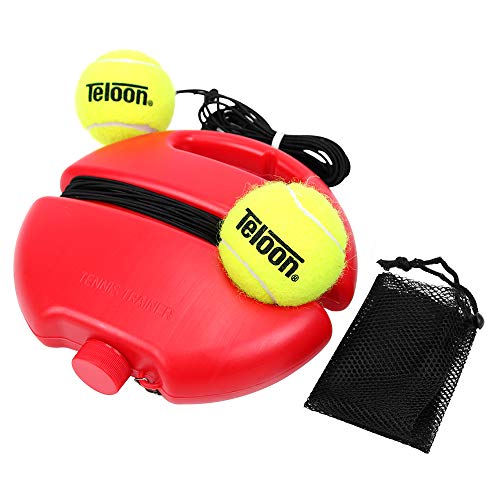
Teloon Solo Tennis Trainer is the most complete standalone setup here: the kit pairs two balls with a base, an anti-tangle hook and a mesh carry bag. The base can be filled with water or sand, and its bottom has anti-skid material to help hold position during practice. The maker says the balls have a thicker core and wool felt, and that the elastic cord is wear-resistant. This option suits beginners or families who want the base included. Its 21 cm by 21 cm base footprint calls for a flat practice spot with room for the swing.
Bottom line: Choose this if you want a fillable base and two balls in one kit.
TENIX Stainless-Steel Base Trainer

TENIX Stainless-Steel Base Trainer differs from the refillable bases by using a weighted stainless-steel shell, solid metal core and grip system instead of water or sand. It is presented for practice on a lawn, driveway or court, with no wall or backboard required. The maker says the ball returns after each hit, making this set suitable for someone who wants a compact solo-practice arrangement without filling a reservoir.
Bottom line: Pick this if you want a weighted base without filling it.
Senston String Trainer 2-Pack

Senston String Trainer 2-Pack stands out for its measured cord reach: each stretch nylon rope is 3.8 meters long and can extend to 7.5 meters. The set contains two training balls and is described as lightweight and portable for one-person practice. This is a sensible option for players who already have a trainer base or another suitable anchor point and want a defined cord length. It does not include a base, so it is not a complete setup on its own; plan the anchor and clear swing area before practice.
Bottom line: Choose this when cord reach is a priority and you have an anchor.
MOVEMATE Tennis-Trainer Set

MOVEMATE Tennis-Trainer Set uses a Wilson tennis ball modified by MOVEMATE, with a rubber cord incorporated directly into the ball surface. Its container can be filled with water, and a transport bag and exercise videos are included. This setup suits players who want a ready-to-carry set and prefer the Wilson-branded ball described in the product name. Unlike a weighted no-fill base, this container needs filling before use. The dimensions are about 7.1 inches square at the base and 3.5 inches high, so allow room for both the container and your stroke.
Bottom line: Pick this for the modified Wilson ball and fillable container.
How to choose a solo tennis trainer
Choose first between a ball-and-cord replacement and a complete trainer with an anchor base. A base that fills with water or sand is convenient to transport empty but needs filling and access to a level practice area; a weighted base avoids that step but is heavier to carry. Cord reach determines how far a rebound ball can travel, so leave enough space for the full extension plus your swing. For example, a cord that reaches 7.5 meters needs a clear practice area extending several meters from its anchor, not just a clear stance. If you already have a base, prioritize compatibility and replacement ball count; otherwise select a kit explicitly including a base.
Base types and setup needs
Fillable bases gain stability from the water or sand inside, while weighted bases use built-in mass and grip. Set either type on a flat, non-slippery surface and keep it outside the path of your feet; a base that shifts can change the cord’s return line. The comparison below maps common setup needs to a base choice.
| Setup need | Base choice | Trade-off |
|---|---|---|
| Empty carry between sessions | Fillable water-or-sand base | Must fill before use |
| No filling step | Built-in weighted base | Weight is carried every time |
| Already own an anchor | Ball-and-cord pack | Compatibility matters |
Space, cord reach and safe practice
Allow more clear area than the cord’s relaxed length because elastic cords stretch during a hit. A rope that extends to 7.5 meters can send the ball through a much wider path than a short tether, so keep people, pets, windows and breakable objects outside that arc. Wear tennis shoes with traction, avoid swinging toward bystanders, and stop if a cord or attachment shows fraying or damage. Begin with controlled strokes rather than full-power hits; the ball’s return can be unpredictable when the base slides or the cord twists. Outdoor practice also needs a surface where the base can sit firmly without obstructing footwork.
Frequently Asked Questions
How much space does a tennis ball on a string need?
Leave a clear area around the anchor at least as long as the cord’s maximum extension, plus room for your stance and swing. A cord reaching 7.5 meters needs a wide, unobstructed practice zone; keep other people and breakables outside the ball’s path.
Can a tennis trainer base use sand instead of water?
Some fillable trainer bases accept either water or sand, as does the Teloon set. Sand is less likely to slosh, while water is easier to pour out before carrying the base.
How do you stop a string tennis ball from tangling?
Keep the cord straight before each session and avoid letting the ball spin around the base between hits. A trainer with an anti-tangle feature can help, but inspect the cord for twists before swinging.
When should a tennis trainer ball be replaced?
Replace a ball or cord when the felt tears, the attachment loosens, or the cord frays or loses elasticity. Training balls are consumables, and a damaged cord can change the rebound or break during a swing.