
Cheap HVLP Spray Gun: 4 Nozzle Kits Compared

For a versatile automotive HVLP spray gun, ENDOZER HVLP Set, 1.4–2.0 mm is the clearest pick because it includes 1.4, 1.7 and 2.0 mm nozzles, a 600 ml cup and adjustable fluid, fan and airflow controls. Choose a different kit if you need a 1.3 mm nozzle, a 2.5 mm option or a specified air regulator.
“Cheap” can’t be established from these specifications alone, so compare the nozzle range, cup and compressor match rather than assuming a low price means a suitable gun.
We earn a commission if you buy through links on this page. As an Amazon Associate I earn from qualifying purchases. Products are compared on manufacturer specifications, not hands-on testing.
- Best overall: ENDOZER HVLP Set, 1.4–2.0 mm – Three stainless-steel nozzle sizes, a 600 ml cup and controls for fluid, fan and airflow.
- Best for larger nozzles: HVLP Kit, 1.4–2.5 mm – Includes a 2.5 mm nozzle in addition to 1.4, 1.7 and 2.0 mm sizes.
- Best for airflow data: 819 HVLP Kit, 1.3–2.0 mm – Gives a working pressure range of 2.0–3.5 bar and airflow of 3.0–3.9 cfm.
| Product | Best for | Nozzle sizes | Cup capacity | Shop |
|---|---|---|---|---|
| ENDOZER HVLP Set, 1.4–2.0 mm | Adjustable automotive work | 1.4, 1.7, 2.0 mm | 600 ml | Check Price on Amazon |
| HVLP Kit, 1.4–2.5 mm | Broader nozzle range | 1.4, 1.7, 2.0, 2.5 mm | — | Check Price on Amazon |
| 819 HVLP Kit, 1.3–2.0 mm | Airflow-conscious buyers | 1.3, 1.7, 2.0 mm | — | Check Price on Amazon |
| HVLP Gun Kit, 1.4–2.0 mm | Multi-surface projects | 1.4, 1.7, 2.0 mm | 600 cc | Check Price on Amazon |
HVLP Spray Guns Compared
Match the nozzle to your coating and project, then confirm the gun’s air demand against your compressor before choosing.
ENDOZER HVLP Set, 1.4–2.0 mm

Three stainless-steel nozzle and needle sizes give this set a defined range for automotive paint, primer, clear coat and touch-up. The 600 ml gravity-feed cup is paired with a brass air cap, and the controls adjust fluid, fan pattern and airflow. A 1/4-inch NPT inlet and matching quick adapter are included; a paint filter is also included. This is a practical fit if you want to swap nozzle sizes rather than use one fixed setup. The applications exclude latex paint, so choose another sprayer for that coating.
Bottom line: Choose this set for automotive coatings when its 1.4–2.0 mm nozzle range suits your material.
HVLP Kit, 1.4–2.5 mm

The extra 2.5 mm nozzle is the key distinction here: this kit spans four sizes, including a larger option than the three-nozzle sets. Its uses include car paint, furniture refinishing, primer, clear coat, walls, metal, wood and plastic. That breadth may suit a buyer working across different project types who wants nozzle choices in one kit. The specifications give no cup capacity or air-demand figure, however, so compare those requirements with your compressor and work setup before committing. Claims of drip-free, professional results are maker claims, not a guarantee for every coating or technique.
Bottom line: Pick this when the 2.5 mm option matters and you can verify the gun’s air demand.
819 HVLP Kit, 1.3–2.0 mm

Unlike the other kits, this 819 set gives a working pressure range of 2.0–3.5 bar and air use of 3.0–3.9 cfm, useful figures for checking compressor compatibility. It includes 1.3, 1.7 and 2.0 mm nozzles, plus an air regulator separator. Flow, fan width and air volume have separate adjustment controls. The applications include automotive refinishing, wall painting, roof repair and industrial spraying. Cup capacity is not given in the specifications, so buyers who need a particular cup size should confirm it before ordering.
Bottom line: Choose it if its air demand fits your compressor and you want a 1.3 mm nozzle.
HVLP Gun Kit, 1.4–2.0 mm
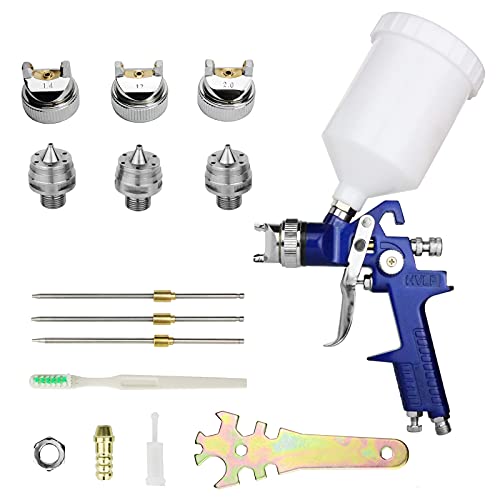
This kit pairs a 600 cc cup with three replaceable nozzle and needle sizes, and its applications extend from car primer and base coats to furniture, walls and crafts. That range makes it relevant for a buyer handling varied surfaces rather than only automotive refinishing. The maker advises testing and adjusting with water before use, and says the pigment needs dilution according to its manufacturer’s requirements.
Bottom line: Pick it for mixed surface projects if the included nozzle sizes match your coating.
How to choose an HVLP spray gun
Choose by coating viscosity, nozzle size and compressor capacity, not by nozzle count alone. Automotive base coats and clear coats commonly use nozzles around 1.2–1.4 mm, while primers often call for roughly 1.7–2.0 mm; the coating maker’s recommended tip size takes priority. A thicker coating generally needs a larger fluid passage, but thinning is only appropriate when the coating manufacturer permits it. Compare the gun’s air consumption in cubic feet per minute (cfm) with the compressor’s delivered cfm at the same pressure; tank volume alone does not tell you whether the compressor can keep up. With less than 4 cfm available at the required pressure, a gun needing 3.9 cfm leaves little reserve for continuous spraying.
This table links common needs to a selection check.
| Need | Selection check |
|---|---|
| Automotive top coat | Start near 1.2–1.4 mm, then follow coating guidance |
| Primer | Check whether about 1.7–2.0 mm is recommended |
| Small compressor | Match delivered cfm at operating pressure |
Nozzle sizes and coating fit
Nozzle diameter changes how readily material flows, but a larger tip is not automatically better. A 1.3 or 1.4 mm tip may suit thinner automotive finishes; thicker primers often use larger tips around 1.7–2.0 mm. These are typical ranges, not universal settings: coating chemistry, viscosity, gun design and the finish target all affect the correct setup. A 2.5 mm tip can accommodate materials that need a larger passage, but it won’t compensate for a coating that is too thick or a mismatched air supply. Use the coating maker’s specified tip range and reduction ratio, and test a small spray pattern on scrap before coating the finished surface.
Changing tips also means changing the matching needle and air cap when the gun design calls for a matched set. Keep components clean and avoid forcing a needle into the seat, which can damage sealing surfaces and affect fluid control.
Compressor and air supply requirements
Compressor compatibility depends on delivered airflow at the gun’s working pressure, not just the tank’s gallon capacity. Air tools can use more air than a small compressor supplies continuously, causing pressure to sag during a pass and changing atomization. One included gun gives a 3.0–3.9 cfm range at 2.0–3.5 bar; those figures offer a concrete comparison point, but other guns require their own air-demand figures. Confirm the compressor’s delivered cfm at the needed pressure before buying if uninterrupted spraying matters.
Use a regulator and a moisture-control setup appropriate to the compressor line; water or oil contamination can spoil a finish. Place a water separator where it can drain and maintain it, and use clean, correctly sized hose and fittings so restrictions do not starve the gun.
Safe spraying and cleanup
Spray coatings in a suitable spray area with effective ventilation, and keep flames, sparks, pilot lights and other ignition sources away from flammable vapors. Wear eye protection, gloves and respiratory protection selected for the coating’s safety data sheet; a dust mask is not a substitute for a respirator specified for solvent vapor. HVLP means high-volume, low-pressure atomization, not harmless overspray: atomized coating can still be inhaled or settle on nearby surfaces.
Clean the fluid path promptly using the coating maker’s compatible cleaning solvent or method. Do not soak seals or the gun body in an aggressive solvent unless the gun maker allows it, and never use a wire or drill bit that can enlarge a nozzle. Disconnect air before disassembly, and dispose of coating residue and cleaning solvent according to local rules.
Frequently Asked Questions
What does HVLP mean on a spray gun?
HVLP means high-volume, low-pressure: the gun uses a larger air volume at lower pressure at the air cap than conventional high-pressure spraying. The term does not tell you the compressor’s required cfm, so check the gun’s air-demand figure at operating pressure.
What nozzle size works for automotive paint?
Many automotive base coats and clear coats use roughly 1.2–1.4 mm tips, while primers commonly need about 1.7–2.0 mm. Use the coating maker’s specified tip size because product viscosity and gun design can shift the suitable range.
Can a small compressor run an HVLP gun?
A small compressor can run a gun only if it supplies the required cfm continuously at the gun’s operating pressure. For example, a requirement near 3.9 cfm leaves little reserve if the compressor delivers only 4 cfm at that pressure.
Should paint be thinned before spraying?
Thin paint only when its manufacturer allows it and gives a compatible reducer or dilution ratio. Test viscosity and spray pattern on scrap first; thinning too much can reduce coverage and change the finish.
What safety gear is needed for spray painting?
Use ventilation, eye protection, gloves and respiratory protection selected from the coating safety data sheet. Keep ignition sources away from flammable spray vapors, and do not assume an ordinary dust mask protects against solvent vapor.