
NEU Master Paint Sprayers Compared by Setup and Features

NEU Master 600W Stationary Sprayer is the NEU Master paint sprayer to consider first if you want a stationary setup with a 6-foot air hose; NEU Master 500W 1,200 mL Sprayer offers a 1,200 mL container and multiple spray options instead. Choose a different model if its feed style or nozzle setup better suits the surface and paint you plan to use.
We earn a commission if you buy through links on this page. As an Amazon Associate I earn from qualifying purchases. Products are compared on manufacturer specifications, not hands-on testing.
- Best overall: NEU Master 600W Stationary Sprayer – Its stationary design and 6-foot air hose distinguish it from the container-fed option.
- Best for nozzle choice: NEU Master 500W 1,200 mL Sprayer – It includes four nozzle sizes and three spray patterns, plus a 1,200 mL container.
| Product | Best for | Power | Paint feed | Spray options | Shop |
|---|---|---|---|---|---|
| NEU Master 600W Stationary Sprayer | Hose-fed setup | 600 W | 6-foot air hose | — | Check Price on Amazon |
| NEU Master 500W 1,200 mL Sprayer | Nozzle flexibility | 500 W | 1,200 mL container | 4 nozzles; 3 patterns | Check Price on Amazon |
| Paint Grids 1000W HVLP Sprayer | Copper nozzles | 1,000 W | — | 4 nozzles; 3 patterns | Check Price on Amazon |
NEU Master Paint Sprayers
Compare the two NEU Master models by paint feed and included spray adjustments before choosing one for your project.
NEU Master 600W Stationary Sprayer
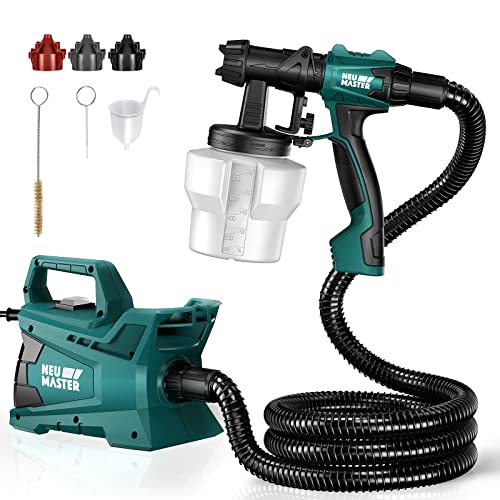
The stationary design and 6-foot air hose set this NEU Master model apart from the container-fed sprayer. It is a fit to consider when you prefer a separate sprayer unit rather than carrying paint in a gun-mounted cup. Its dimensions are 11 by 10 by 9 inches, and it weighs 6.8 pounds. The maker does not give nozzle sizes or spray patterns, so this option is less straightforward to compare if those adjustments determine your finish. Match the paint and surface to the sprayer’s supported setup before starting.
Bottom line: Choose this if a stationary unit with a 6-foot hose is your preferred setup.
NEU Master 500W 1,200 mL Sprayer

The 1,200 mL container and four nozzle sizes make this the more adjustable NEU Master option for projects where the spray setup matters. The included nozzle sizes are 1.5, 2.0, 2.5 and 3.0 mm, and the sprayer provides three patterns. The manufacturer says it supports materials up to 100 DIN-s viscosity and mentions thinned latex, chalk paint, stain, sealer and varnish. That broad stated compatibility does not mean every coating can be sprayed as-is: confirm the coating’s thinning and application requirements. At 3 pounds, this model weighs less than the stationary unit.
Bottom line: Choose this if you want a container-fed sprayer with several nozzle and pattern options.
Paint Grids 1000W HVLP Sprayer

This Paint Grids sprayer is a different brand, but its four copper nozzles and three spray patterns make it a related option for buyers comparing HVLP tools. Its 1,000 W motor and adjustable flow control are specified for projects including furniture, cabinets, fences, doors and walls. The pattern choices are vertical, horizontal and circular. Unlike the NEU Master options, the maker does not establish a container capacity or hose-fed setup, so buyers who need either feature should verify the exact configuration before choosing. The size is 7 by 7 by 6 inches.
Bottom line: Consider this if copper nozzles and adjustable flow are more important than the NEU Master brand.
How to Choose a NEU Master Paint Sprayer
Start with the paint feed and adjustment options, not wattage alone. A cup-fed sprayer keeps the paint at the gun, while a hose-fed stationary design separates the unit from the paint applicator; the latter can keep the gun from carrying a full container. For broad coverage, a larger nozzle generally passes thicker material more readily, while smaller openings suit thinner coatings and finer work. Always check the coating maker’s viscosity and thinning directions, because thinning too much can reduce coverage and change the finish. Choose a model with several nozzle sizes when you expect to switch among coatings or surfaces; fewer known adjustments may be sufficient for a single compatible product.
Matching Spray Patterns to Surfaces
Use a vertical or horizontal fan for long, flat surfaces, and a circular pattern for smaller or irregular areas when the sprayer offers those options. Keep the gun moving parallel to the work and overlap each pass by roughly half the fan width to reduce stripes and uneven coverage. Test the pattern on scrap material before spraying the finished surface; adjust distance and flow until the fan looks even. Edges, corners and narrow trim need lighter passes than open panels because paint can build up where spray overlaps. Mask nearby surfaces and work in a ventilated area, since overspray can travel beyond the target.
HVLP Paint Sprayer Setup and Safety
HVLP means high volume, low pressure: the tool moves a relatively large volume of air at lower pressure than conventional spray systems, helping control overspray when correctly adjusted. That does not remove airborne paint or solvent hazards. Spray only with suitable ventilation, keep ignition sources away from flammable coatings, and use respiratory and eye protection appropriate to the coating’s safety data sheet. Strain paint before filling a cup to catch dried bits that can clog a nozzle. Clean the nozzle, paint path and container promptly after each session using the cleaner recommended for that coating; dried paint is harder to remove and can disrupt later spray patterns.
Common Paint Sprayer Selection Mistakes
Choosing by motor wattage alone is a common mistake: nozzle size, coating viscosity, flow adjustment and feed style also affect whether a sprayer fits the job. A fine nozzle can struggle with thicker paint, while too much flow on a small object can create runs. Confirm that the sprayer supports the coating and follow the coating maker’s directions for thinning; the viscosity figure supplied for one model is not a universal target for every paint. For furniture or trim, practice on scrap and use light, overlapping coats rather than trying to cover in one heavy pass. For larger areas, consider how often you will need to refill a container or reposition a hose-fed unit.
Frequently Asked Questions
Can an HVLP sprayer apply latex paint?
Some HVLP sprayers can apply latex paint when the coating is thinned as directed and the nozzle can handle its viscosity. The NEU Master 500W model’s manufacturer gives a maximum of 100 DIN-s and mentions thinned latex; use the paint maker’s guidance for the specific product.
How far should I hold a paint sprayer from a surface?
A common starting distance for handheld paint sprayers is about 6 to 12 inches, but the correct gap depends on the spray pattern, coating and tool. Test on scrap and adjust until the coat looks even without dry overspray or runs.
How much should spray passes overlap?
Overlap adjacent passes by about 50 percent of the fan width to limit gaps and striping. Keep the gun moving at a steady speed, since pausing near an edge can deposit too much paint.
What protection is needed when spray painting indoors?
Use ventilation and respiratory and eye protection appropriate to the coating’s safety data sheet; a household dust mask may not protect against paint vapors. Keep people, pets and ignition sources away from the spray area, especially when using solvent-based or flammable coatings.
How soon should I clean an HVLP paint sprayer?
Clean the paint path and nozzle as soon as you finish spraying, before residue dries. Use the cleaner recommended for the coating and clear the small nozzle openings carefully to avoid damage or clogs.